
Day Porter Service | Miami-Dade, Broward & Palm Beach Counties
Clear Response Standards for Every Resident Request
By Ryan Jurney · Published November 8, 2026
A resident calls about a wet lobby floor. Another asks why the restroom ran out of paper. How fast should your day porter respond to each one?
There is no single day porter response time for every resident request. Sort each request by urgency, write the response windows into the scope, and log the timing so you can check the work.
Why There Is No Single Response Time for Every Request
One fixed response time does not fit every request in a high-rise. A spill in the lobby, a missing restroom supply, and a broken door lock each need different handling.
The useful question is not “how fast should we respond?” It is “what response do we expect for each type of request, and is that written down?” Many disputes start because the answer lives only in someone’s memory.
Timing also changes with the hour. A request at 7 a.m. in a busy lobby is not the same as one at midnight in a quiet garage. Clear categories help the crew too, because staff know which calls come first. For the full picture of daily upkeep, see the day porter service overview.
Not sure what your next step is?
Talk it through with our team — the first consultation is free, confidential, and carries no obligation.

Sorting Resident Requests by Urgency
Sort every resident request into one of three groups: routine, time-sensitive, or building safety.
Routine requests include lobby tidiness, restroom supplies, trash area upkeep, and general floor condition. These fit into the porter’s regular rounds.
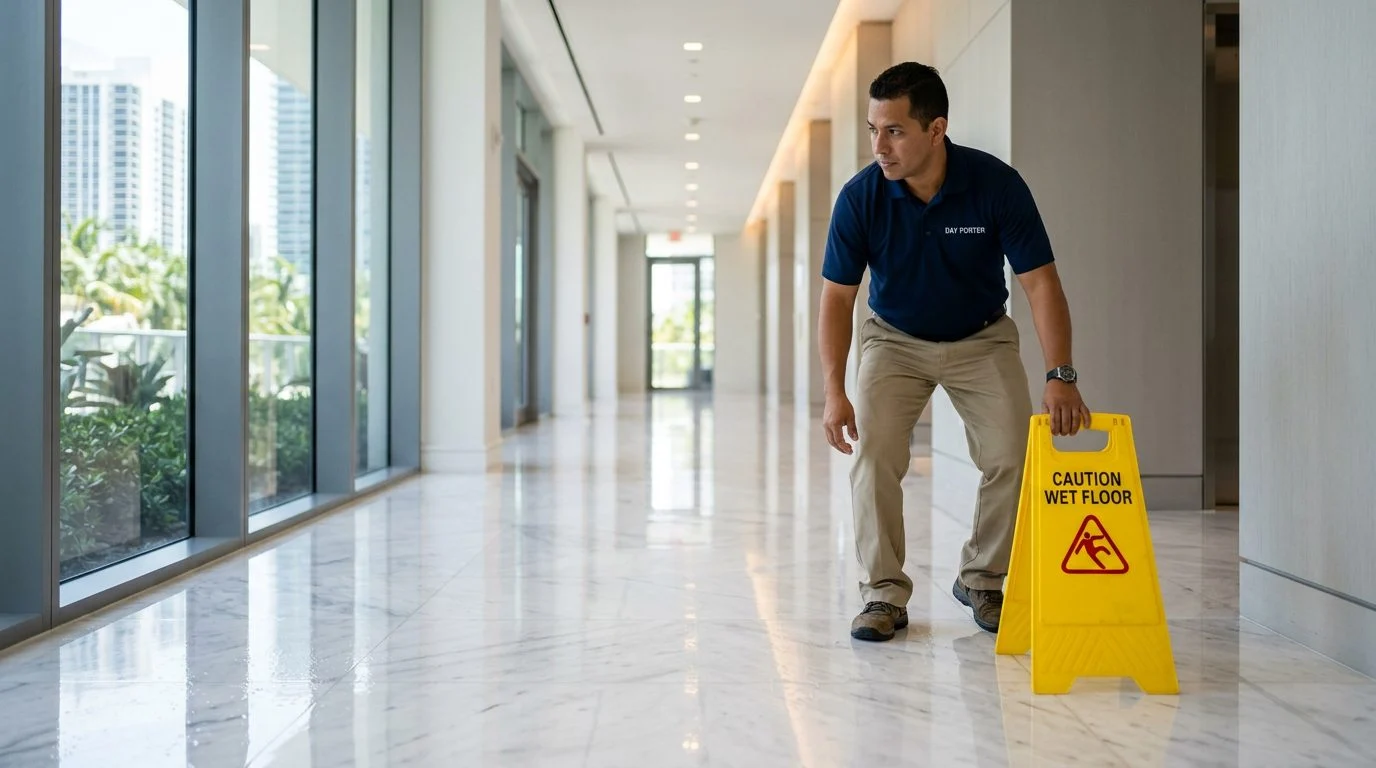
Time-sensitive requests involve wet or slippery floors in lobbies, elevator landings, and entry vestibules. A walking hazard should be handled before the next person crosses it, as the walking-working surface rules require. Well-maintained floors are a practical priority in busy commercial spaces.
Building-safety items go to management right away. Examples include a broken door lock, exposed wiring, or a loose handrail. These are not ordinary porter tasks, so route them to management under the building’s own procedure.
Chemical spills need care too.
Scheduled work is different. Floor care and pressure washing are planned jobs, not same-day porter calls. Scheduled floor work is covered on the floor care maintenance page.
Putting Response Windows in the Written Scope
Response windows belong in the written day porter scope, not in verbal understandings. A verbal promise is hard to check. A written scope gives the board, the manager, and the crew the same standard.
Define two separate steps. Acknowledging a request means someone received it and told the resident it is in progress. Completing it means the work is finished. Each step needs its own time limit.
Your written scope should also name:
- Who may submit a request, such as a resident, an owner, or a manager.
- The channel for requests, such as a front desk log, a text line, or a work order form.
- What counts as after-hours, and who covers it.
Needs vary by county and neighborhood. For county-level context, see the Miami-Dade day porter service page. Keep the scope short enough that someone can read it in one sitting, and review it when traffic changes.
Logging Requests So Response Times Can Be Reviewed
A simple request log lets you measure response time against the written scope.
Record five fields for each request: date, time received, request type, time of response, and time of completion. These fields turn a complaint into a fact. A spill logged in the afternoon and acknowledged hours later shows the gap clearly.
With a log, a building manager can raise issues with specifics. A board can ask what happened on a given day, instead of debating who remembers what.
If your building is a condominium, Florida law already sets record rules for the association. Bids for work must be kept for at least 1 year after receipt. Association records must be available to a unit owner within 45 miles of the condominium property or within the county where the property is located within 10 working days after receipt of a written request by the board or its designee, but this distance requirement does not apply to an association governing a timeshare condominium. The Florida condominium association statute covers those duties. Keep the log organized so it can be reviewed in the same way.
Review the log on a regular schedule. Adjust the windows when traffic or amenities change.
Planning Coverage When the Porter Is Busy or Off Shift
Set a priority order now, so the porter knows what comes first when two requests arrive at once.
A porter can be in the middle of a scheduled task when a spill happens in the lobby. The scope should say which task stops. A walking hazard usually comes before a restroom restock.
Shift handoffs need the same care. Open requests should pass to the next person on duty, with the time received and current status noted. Open items should not get lost between shifts. Name an after-hours contact in the scope, and make sure that person knows the process.
Coverage needs differ by building. A Brickell tower, a South Beach property, and a Coral Gables building each have their own traffic and amenities. For the regional view, see the South Florida day porter service page.

Talk Through Your Building’s Request Process
A written response standard gives your building one clear answer to resident complaints. Picture a board member who keeps hearing that a lobby spill sat too long, and no one can say what was promised. That is the moment to write the standard down.
Your first consultation is free, confidential, and comes with no obligation to continue.
Can a day porter response time be written into the contract?
Yes. Put response windows in the written scope so both sides work from the same standard.
What is the difference between acknowledging and completing a request?
Acknowledging means the request was received and is in progress. Completing means the work is finished.
Who should residents contact after hours?
Name the after-hours contact in the written scope, so residents know who to reach.
Does a day porter need chemical training?
Staff who work with cleaning chemicals should understand the products they use, as the Hazard Communication Standard requires for labeling, safety data sheets, and training.
If residents are asking why a request took too long, now is the time to set a clear day porter response time. Reach out through the contact form or call our office, and our team will talk through your building’s requests with you.
What Building Managers Can Expect From Our Day Porter Team
Response Windows in Writing
We help you define how quickly requests should be acknowledged and completed, and record those expectations in the service scope so both sides work from the same standard.
Clear Acknowledgment
Residents hear back when their request is received, so they know it is in progress rather than wondering whether anyone saw it.
Tracked to Completion
Our team tracks each request from intake to finished work, so open items do not fall through the cracks.
Support Staff You Can Reach
Our assistants and office staff coordinate with your property contacts to keep requests moving during the day.
Don't Rely on Verbal Promises
A quick verbal assurance is easy to forget. Ask for response expectations to be written into your service agreement so everyone can refer back to them.
How a Resident Request Moves Through Our Process
1. Request Received
The resident reports a need, such as a spill, restroom supply issue, or common-area cleanup, through the channel your property has set up.
2. Acknowledged
Our team confirms the request is in progress so the resident knows it has been logged and assigned.
3. Work Completed
The day porter completes the task and notes it, separating finished work from requests still underway.
4. Follow-Up
We check back with the property contact when needed and adjust staffing or schedules if patterns repeat.
Start With a Free First Consultation. It's Confidential and Carries No Obligation to Continue.
More of our services
- Day Porter Service in Miami-Dade
- Day Porter Service in South Florida
- Day Porter Service in Miami-Dade County
- Day Porter Service in Broward County