
Floor Care Maintenance | South Florida
Know What Protection Your Floor Care Contractor Should Provide
A clear checklist for reviewing insurance before a commercial floor care contract begins.
By Ryan Jurney · Published November 25, 2026
Floor Care Vendor COI: What Florida Stores Should Require?
Your store is about to bring in a floor care vendor, and its paperwork includes a certificate of insurance. The short answer: require a current certificate that shows general liability and workers’ compensation, with policy dates that cover your full contract. Also ask for the endorsements that name your store. The sections below explain each item and what to ask for in Florida.
What a Certificate of Insurance Proves, and What It Does Not
A certificate of insurance shows which policies a vendor holds. It does not extend coverage by itself. An insurance agent or broker issues it to list each policy, its coverage types, its limits, and its policy dates.
Think of the certificate as a snapshot. The real promise sits in the policy and its endorsements. Endorsements are attached changes that add or modify coverage. Ask for copies of those endorsements, not just the certificate.
Check the named insured first. This is the business the policy covers. It should match the legal name on your contract and invoices. If the names differ, ask why before you sign. A mismatch can leave open questions about who is covered for the work.
For background on the work itself, see floor care maintenance in Miami-Dade County. This guide is general information, not legal advice.
General Liability Coverage to Request
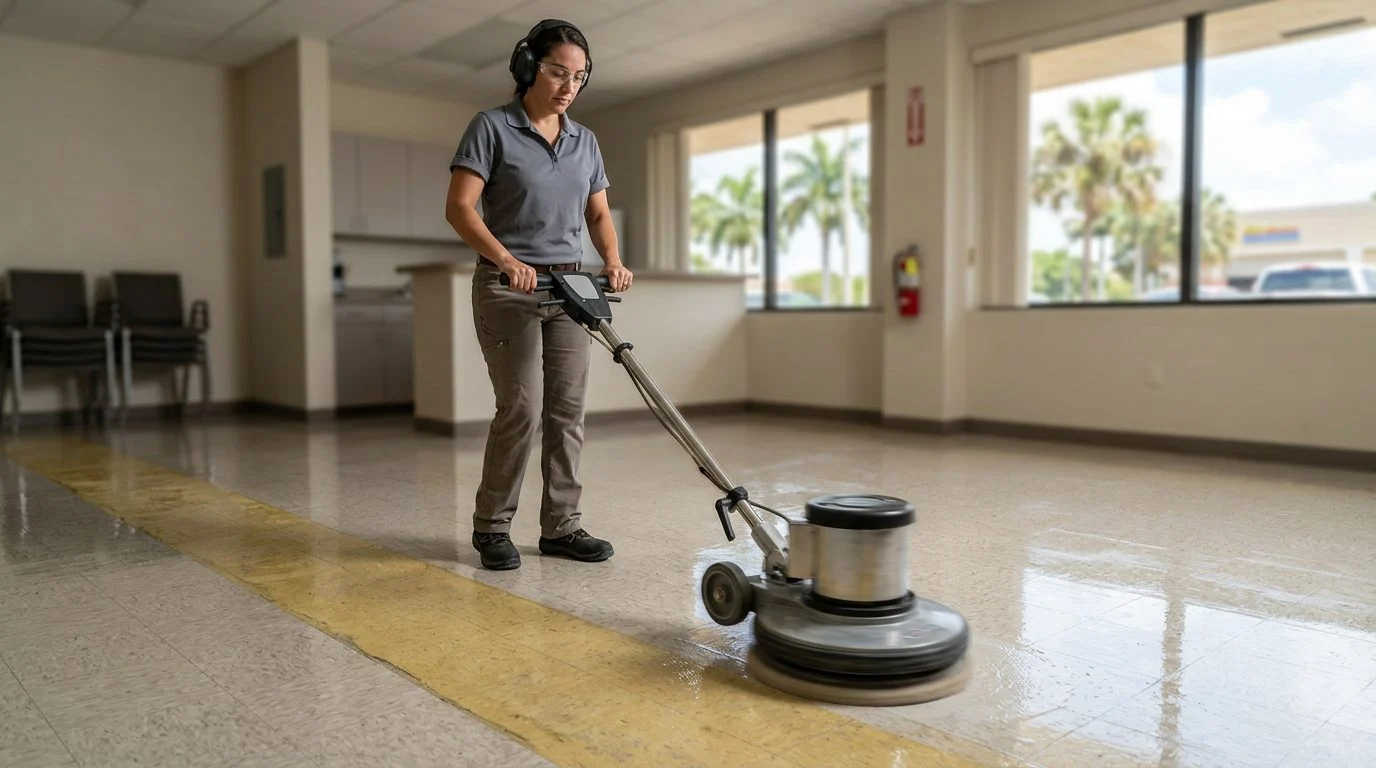
General liability coverage protects against injury and property damage that the vendor’s work may cause to others. A common example is a customer who slips on a freshly buffed or sealed floor in a store.
Two limits matter most. The per-occurrence limit is the most the policy pays for one claim. The aggregate limit is the most it pays for all claims in the policy period. Set the minimum limits in your contract. Don’t accept whatever amount appears on the certificate by default.
Call our office to learn more about our floor care maintenance services.
Slip risk rises after stripping, sealing, or polishing, when floors are wet or newly coated. Ask the vendor how it marks wet areas and reopens traffic lanes.
Workers’ Compensation and Employee Coverage
Workers’ compensation covers the vendor’s own workers who get hurt on the job. Florida law sets workers’ compensation coverage requirements that apply to many employers.
Florida law places this duty on employers. Under Fla. Stat. § 440.10, every covered employer must secure compensation for its employees. The same section says a contractor must require a subcontractor to provide evidence of workers’ compensation insurance. A subcontractor that is a corporation and has an officer who elects to be exempt must also provide a copy of that officer’s certificate of exemption to the contractor. Ask your vendor to show the same proof for any subcontracted crew.
Whether a given vendor must carry coverage turns on whether it is an employer coming within the provisions of this chapter, and a contractor or subcontractor engaged in construction must secure and maintain compensation for its employees.
Missing coverage carries real risk. Under Fla. Stat. § 440.11, an injured worker may sue for damages when an employer fails to secure compensation. Confirm that the certificate’s coverage period covers every scheduled visit.
Additional Insured and Certificate Holder Wording
A certificate holder is the party that receives the certificate. Being listed as the holder does not, by itself, give your store coverage under the vendor’s policy.
Additional insured status works differently. It typically extends the vendor’s policy to your store for claims tied to the vendor’s work. This is usually confirmed by a separate endorsement, so request that endorsement along with the certificate.
Make the certificate match your agreement. Your store’s legal name and location address should appear exactly as the contract states them. A mismatch makes it harder to tie the document to your building.
Ask whether the contract calls for a waiver of subrogation. This term means the vendor’s insurer gives up its right to recover payments from your store. If the contract requires it, confirm the policy includes it in writing.
Policy Dates, Cancellation Notice, and Renewals
The certificate should show policy dates that cover the full contract term. Don’t stop at the start date. Check the end date against your calendar, too.
Floor care work often runs for months. Stripping, sealing, and burnishing may fall on different dates. A policy that expires during a planned burnishing cycle leaves that visit uncovered.
Ask how the vendor will notify you if a policy is cancelled, not renewed, or materially changed. Write the notice terms into the contract.
Set a reminder to request an updated certificate before each policy expires. Request one again before any new crew joins the job.
Scope can change, too. If the work grows to include pressure washing of exterior walkways, the certificate should reflect that work. Ask for an updated certificate whenever the scope changes.
Not sure what your next step is?
Talk it through with our team — the first consultation is free, confidential, and carries no obligation.

Next Step: Review Your Floor Care Coverage With Our Team
Before you approve a floor care contract, confirm the liability limits, workers’ compensation, additional insured endorsement, and policy dates on the certificate. These four items show whether the paperwork matches the work.
Common Questions
Does a certificate of insurance give coverage by itself?
No. It summarizes policies, while the policy and its endorsements set what is covered.
Do floor care vendors in Florida need workers’ compensation?
Florida generally requires employers to carry it. Ask the vendor for proof before work begins.
What is the difference between a certificate holder and an additional insured?
A certificate holder receives the document. An additional insured is added to the policy through an endorsement.
If a floor care proposal for a store in Brickell, Coral Gables, South Beach, or elsewhere in Miami-Dade, Broward, or Palm Beach County is in front of you now, contact us. We’ll review your service needs with you. La consulta inicial es gratuita, confidencial y sin compromiso de continuar. You can fill out our contact form, call our office, or request a quote.
What to Confirm Before Work Begins
Written Proof of Coverage
Ask for current certificates of insurance and review the policy endorsements that govern the work.
Matching Coverage Limits
Confirm that liability limits fit the size, traffic, and risk of your facility.
Coverage for Crew Members
Verify who is covered on the job, including employees, subcontractors, and temporary workers.
Coverage in Place Before Start
Make sure insurance is active on the first day of service, not added later.
A Certificate Is a Summary, Not the Policy
A certificate of insurance summarizes coverage but does not create it.
Who Is Insured?
Ask whether the policy covers your contractor's own staff and any subcontracted labor.
What Is Excluded?
Ask which exclusions apply to slip hazards, equipment damage, and chemical use on your floors.
How Do Changes Get Documented?
Ask how updated certificates are provided when policies renew or change.
Who Do I Contact?
Confirm a named point of contact for claims, documentation, and questions during the contract.
Have Questions About Your Coverage?
The First Consultation Is Free, Confidential, and Carries No Obligation to Continue.