
Floor Care Maintenance | South Florida
Compare Floor Bids: Different Finishes, Passes, Frequencies
By Ryan Jurney · Published November 25, 2026
Floor care pricing depends on the scope of the work, so our team can review your floors and explain what is included. One prices each visit, one charges a monthly fee, and one lists a yearly figure. That makes it hard to compare floor care bids that use different finishes, passes and frequencies.
The short answer: contact our team with your floor areas, finish needs, and service schedule so we can prepare a proposal for your facility. Then the totals mean the same thing. This page walks through that process step by step.
Why Two Floor Care Bids Rarely Line Up
Two floor care bids rarely line up because each bidder prices the same floors in a different unit. One bid quotes a price per visit. Another quotes a monthly figure. A third quotes an annual total or a price per square foot per year.
A lower total can hide less work. A bid may include fewer finish coats, fewer passes or a longer gap between services. The bottom number looks smaller, but the floor gets less care.
Floor condition also matters for safety. Regular inspection and maintenance help keep walking surfaces clean and sanitary. Routine floor care maintenance keeps commercial floors in good condition for the people who use them.
Your goal is simple. Convert every bid to the same scope, the same frequency and the same time period. Only then does the price tell you something useful.
If your floor care quotes use different finishes, passes and frequencies, we can help you line them up on one scope before you decide. Talk it through with our team — the first consultation is free, confidential, and carries no obligation.

Start With One Shared Scope of Work
Start by contacting our team and describing the work your property needs. A scope of work lists the floors, areas and conditions the service covers.
Record the facts each bid must start from:
- Floor type: VCT (vinyl composition tile), LVT (luxury vinyl tile), sealed concrete or terrazzo.
- Square footage for each area.
- Traffic level, such as a busy lobby compared with a back office.
List every area in scope, such as lobbies, corridors, restrooms, kitchens and entrances. Then confirm that each bid covers the same areas.
If one bid shows a different square footage total, the comparison is already off. If anything in our figures needs clarification, contact our office before you go further.
Decode Finishes: Coats, Build-Up and Maintenance Coats
A finish count tells you how much protective coating each bid puts on the floor. Count it before you compare anything else.
A floor finish is a protective coating applied to a hard floor, usually in several thin coats. Bids often mix two kinds of coats. Build-up coats go on during the first application. Maintenance coats are thinner layers added between cleanings to keep the finish in good shape.
One bid may show four build-up coats and monthly maintenance coats. Another may show only maintenance coats. Those are not the same service.
Ask our team about the number of coats, the product category, and whether the finish is included in the quoted price or billed separately.
Finish choice also affects safety. Research on floor finishes reports that finish texture and roughness affect slip resistance under wet, soapy and oily conditions. Terrazzo needs its own care. The National Terrazzo & Mosaic Association guide covers neutral-pH cleaning, sealing and stripping old sealer when needed.
Read Passes Correctly: Scrub, Strip, Rinse and Burnish
A pass is one complete run of a process across the floor. Bids count passes differently, so you need the names and counts before you compare.
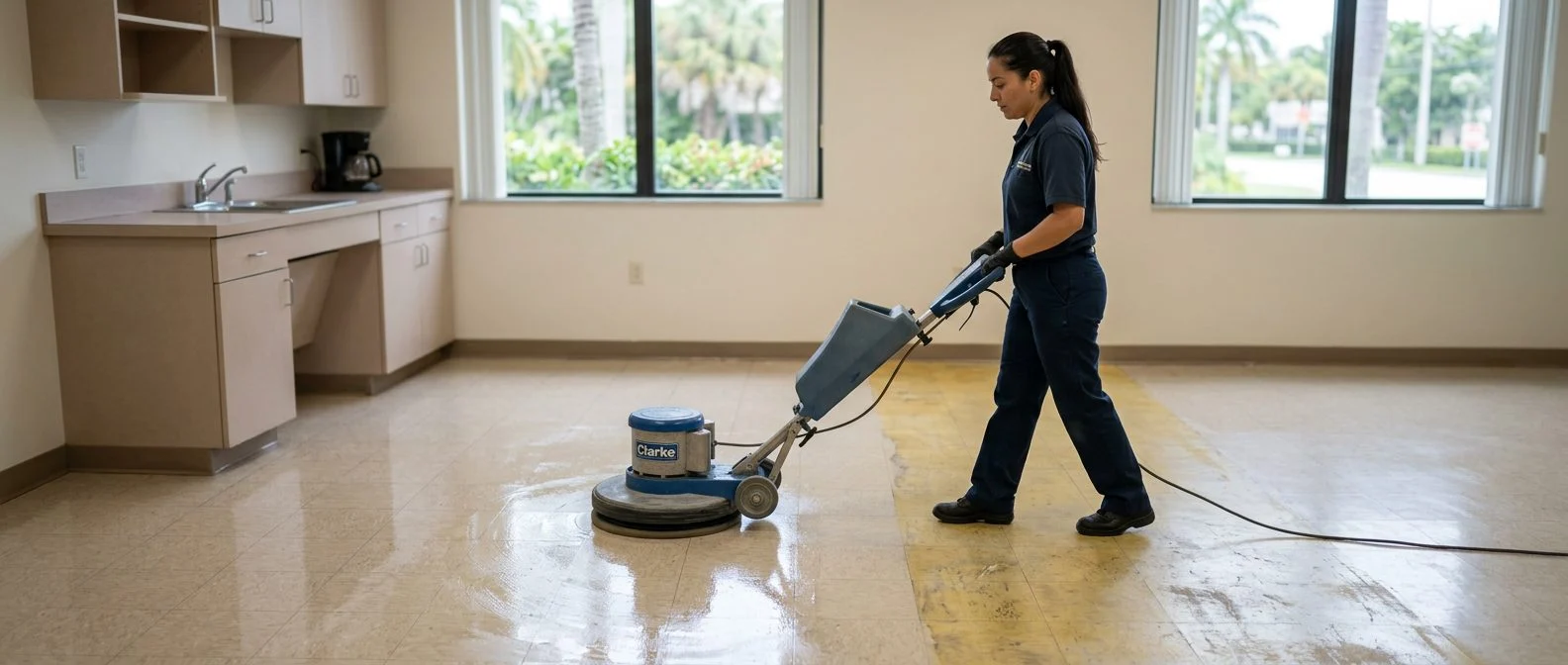
A scrub pass lifts soil from the surface. A rinse pass removes cleaner residue. A stripping pass removes old finish, and it is a different service from routine maintenance scrubbing. Stripping takes more time and more product.
Burnishing is a buffing process on a finish that restores sheen. Some bids list burnishing as its own line item. Others fold it into a maintenance visit.
Don’t accept “full service” as a description. Ask our team to list the passes by name and count. A bid with four named passes and a bid that says “full service” may cover different work.
Frequency: How Often Changes the Number
Frequency often changes the total more than the per-visit price does. Convert every bid to the same time period before you compare them.
Bids express frequency in different ways: per week, per month, per quarter or per year. Use one formula for all of them. Multiply the price per visit by the visits per year, then divide by 12 for a monthly figure.
These are example figures, not quotes. A bid of $250 per visit, once a week, comes to $13,000 a year. A bid of $900 per visit, once a quarter, comes to $3,600 a year.
The lower per-visit price can total far more over a year if it is scheduled more often. Also check whether a monthly strip-and-refinish sits in the same bid as weekly maintenance. Those are different schedules. Compare them only after you put both on the same annual basis.
Build a Side-by-Side Comparison Table
A side-by-side table exposes differences that a bottom-line total hides. Keep your floor areas, finish coats, and pass list in one place so you can share them with our team.
| Item | Bid A | Bid B | Bid C |
|---|---|---|---|
| Areas covered | |||
| Floor types | |||
| Finish coats | |||
| Stripping passes | |||
| Burnishing | |||
| Frequency (per year) | |||
| Equipment included | |||
| Labor hours | |||
| Exclusions | |||
| Monthly total | |||
| Annual total |
Enter every figure in the same unit. If a bid leaves a row blank, write “not stated” rather than assuming it’s included.
Then total each bid on a monthly and an annual basis. Review the rows that differ most before you read the bottom line.
Not sure what your next step is?
Talk it through with our team — the first consultation is free, confidential, and carries no obligation.
Check Exclusions, Equipment and Access
Exclusions are the first place a low bid can hide cost. Read them before you accept any total.
Look for work that appears in one bid but not another. Common examples include stripping, carpet, grout, high-speed burnishing and weekend access. Ask whether equipment, chemicals and labor are included. Ask whether work outside business hours changes the price.
Chemicals need paperwork too. Cleaning products work best when they are stored and used according to the directions on their labels. Ask our team for the Safety Data Sheets for the products included in your service plan.
Then confirm two more items. First, the start-up or first-service terms, since a first application often differs from recurring maintenance. Second, how each bid handles floor protection and damage responsibility during service. A new vendor’s damage terms belong in the comparison.
Questions to Ask Our Team
Ask our team any questions about the work, and we will put the answers in writing. Written scope is easier to check than a verbal promise.
Ask each bidder to:
- Share your floor areas, the number of finish coats, the named passes, and the frequency with our team.
- State in writing what the price covers and what would be billed as an extra service.
- Explain how changes in traffic, floor condition or schedule would be priced.
Should a bid list burnishing as a separate line?
Ask the bidder to say so in writing. A separate line shows you the cost, so you can decide whether you need it.
Can two bids with different scopes be compared?
Only after both are rewritten to the same areas, finish count, passes and frequency. Until then, the totals describe different work.
Talk Through Your Bids With Gator Protection
If you hold two or three floor care quotes for a South Florida facility, and their finish counts, pass lists and frequencies don’t match, a second review helps. Gator Protection, Inc. provides floor care maintenance, day porter service, landscape services and pressure washing across South Florida, including Miami-Dade, Broward and Palm Beach counties.
Our team can review your floor types, areas and current quotes with you and show where they differ. The initial consultation is free, confidential, and carries no obligation to continue.
To get started, contact Gator Protection with your floor areas and current quotes, or request a free quote through the same page.
What to confirm on every floor bid
Finish and protection
Ask whether the bid lists the finish type, coats and any stripping, sealing or burnishing as separate line items.
Passes and frequency
Look for how many passes each step requires and how often the work is repeated over a month or a year.
Don't compare totals yet
Totals describe different work when scopes differ.
Common finishes, passes and frequencies
Strip and wax
A full removal of old finish followed by new coats. Often priced as a periodic project rather than routine upkeep.
Burnishing
A buffing step that restores shine between coats. Ask whether it is included or billed separately.
Scheduled maintenance
Regular cleaning and spot care that keeps the finish in good shape.
Spot restoration
Targeted repair in high-traffic or damaged areas. Check whether the bid limits this work or includes it.