
Buyer's Guide | South Florida Commercial Services
Know What to Look for Before You Hire a Cleaning or Landscape Vendor
A practical checklist for property managers and business owners in Miami-Dade, Broward, and Palm Beach counties. Start with a free first consultation: confidential, with no obligation to continue.
By Ryan Jurney · Published October 26, 2026
How to Vet a Commercial Cleaning Vendor in Miami-Dade
To vet a commercial cleaning vendor in Miami-Dade, check three things before you sign: its E-Verify use, its local business tax receipt, and a written scope of work. This guide explains each step for day porter, floor care, landscape, and pressure washing contracts across South Florida.

Not sure what your next step is?
Talk it through with our team — the first consultation is free, confidential, and carries no obligation.
Why Vendor Vetting Matters for Commercial Property Services in Miami-Dade
Vetting a vendor protects your property, your tenants, and your budget. A service contract is a business decision with legal and daily consequences.
Commercial property services put people on your site every day. Day porters clean lobbies and restrooms. Floor care crews work on hard surfaces. Landscape and pressure washing crews work at entrances, walkways, and parking areas.
The people doing this work are your vendor’s employees or subcontractors. Their paperwork can become your problem if something goes wrong.
Florida law sets duties for employers and, in some public contracts, for the businesses that sign them. Those rules are easier to check before a contract starts than after a problem appears. This page covers four service lines: day porter service, floor care maintenance, landscape services, and pressure washing services.
What Florida Statute 448.095 Requires of Employers
Employers enrolled in E-Verify use the system to check whether new employees can legally work.
Timing matters. If E-Verify is unavailable for 3 business days after a new employee starts working for pay, and the employer still cannot access it, the employer must use Form I-9 instead. The employer must also document the outage. It can keep a daily screenshot, a public notice that the system is down, or another recorded notice.
Form I-9 is a separate duty. Copying a worker’s identity documents is optional. Copying does not replace completing section 2 of the form.
Whether a particular company must use E-Verify depends on the facts. Contract type and workforce both matter.
Who Is Required to Use E-Verify in Florida
Under the statute, a public agency must require its contractors and subcontractors to use E-Verify. Neither side may sign a contract until each party registers with and uses the system.
The statute says the public agency must include this requirement in any contract. Each contractor and subcontractor must verify work authorization for all new employees. The Fla. Stat. § 448.095 text sets these terms.
An independent contractor, as defined in federal laws or regulations, hired for a specified portion of work is not an employee under that definition. So a vendor’s crew list matters. Ask which workers are employees and which are independent contractors.
Federal law adds another layer. Under 8 U.S.C. § 1324a, a party that uses a contract to obtain labor from an unauthorized alien, knowing the alien is unauthorized, is treated as having hired that alien. Florida also makes it unlawful to knowingly employ an unauthorized worker under Fla. Stat. § 448.09.
Contact Gator Protection to discuss your property’s needs and to book a free first consultation, which is confidential and carries no obligation to continue. Ask whether it uses E-Verify for its crews. A covered vendor should be able to state its E-Verify status for the workers assigned to your property.
Have questions about what happened?
Ask our team directly. The first conversation is free, confidential, and there is no obligation to continue.
Florida’s Employment Verification Rules and the 2024 Amendments
The text of § 448.095 in force now is the version amended in 2024 (ch. 2024-6). It reflects amendments made in 2024 by chapter 2024-6 of the Laws of Florida.
Older summaries may be out of date. Earlier versions of the statute said something else. Use the current text when you compare a vendor’s practices against the law.
The statute’s history note names ch. 2024-6 as the session law behind these amendments. Look at the Fla. Stat. § 448.095 text for the operative rules and dates.
When you talk with a vendor, ask how it has updated its hiring and verification steps. Ask for the date of each change. A clear answer shows the vendor tracks the rules it must follow.
Local Business Tax Receipts in Miami-Dade County
Whether a local business tax receipt (LBTR) is required depends on the city or county where a business operates. Ask every vendor for a current copy before you sign.
Check three details on the copy. First, the business name should match the name on the proposal and invoices. Second, the address should match the vendor’s stated business address. Third, the receipt should be current, not expired.
A mismatch is a reason to pause. If the names differ, ask why. A vendor that uses a trade name should explain the difference in writing. Don’t sign until the details line up.
Keep the copy in your contract file with the date you received it. If the vendor renews its receipt during the contract, ask for the new copy right away.
What a Vendor Can Confirm About Its Workers and Verification Records
A vendor can confirm its E-Verify participation, the crew it assigns to your site, and the steps it takes before hiring.
Ask for a written statement of the verification process. It should explain how the vendor completes Form I-9 for each new hire and when it uses E-Verify. A written statement is easier to file and compare than a verbal promise.
Background checks are part of hiring care. Under Fla. Stat. § 768.096, in a civil case for injury to a third person caused by an employee’s intentional tort, an employer is presumed not negligent in hiring if it conducted a background investigation that includes the required steps, such as a criminal background check, and that revealed nothing reasonably demonstrating the worker’s unsuitability for the particular work or for the employment in general.
The investigation steps listed in that statute include a criminal background check. The check must come from the Florida Department of Law Enforcement, using the Florida Crime Information Center system. Other steps include contacting references, asking about convictions on the application, and interviewing the applicant.
Skipping the investigation does not, by itself, create a presumption that the employer was careless.
Copying practices matter too. Under 8 C.F.R. § 274a.2, copies or electronic images of a worker’s documents used to verify identity or employment eligibility may be used only for enforcement of the Act and sections 1001, 1028, 1546, or 1621 of title 18, United States Code. An employer should not copy or electronically image only the documents of workers of certain national origins or citizenship statuses, since doing so may violate section 274B of the Act.
Keep your own file. Include the LBTR copy, the E-Verify confirmation, the written verification statement, and a dated crew list.
Want to know where you stand?
Tell us what happened and our team will walk you through the options available to you, at no cost.
A Vetting Checklist for Day Porter, Floor Care, Landscape, and Pressure Washing Contracts
Before you sign, confirm a written scope for each service line. Also confirm the vendor’s LBTR, its E-Verify status, and a named site contact.
- Day porter service: Ask how chemicals are labeled, stored, and used. Check the disinfectants against the EPA’s disinfectant list.
- Floor care maintenance: Ask what slip-control steps the crew uses and how it marks wet floors.
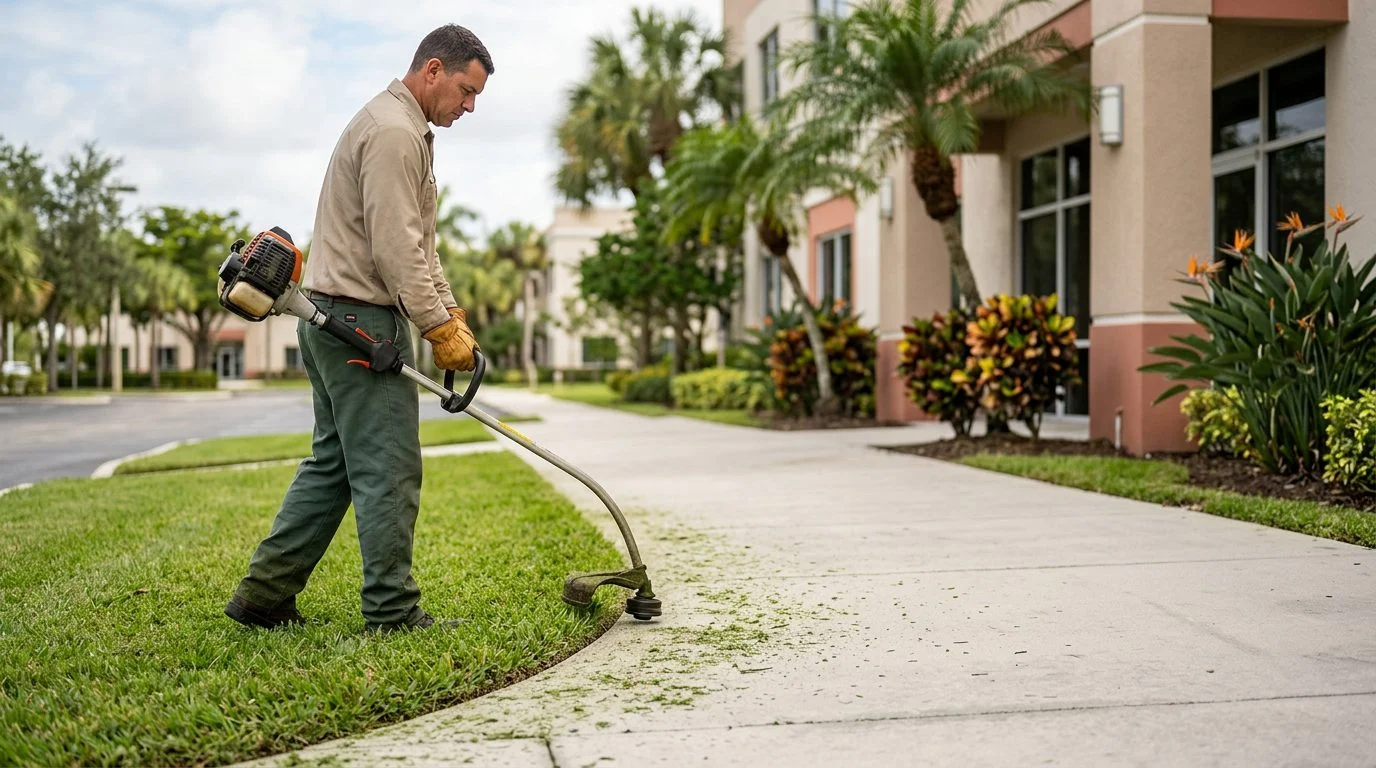
- Landscape services: Ask the crew to follow the South Florida Water Management District’s irrigation rules. Ask whether applicators hold state licenses through the Florida Department of Agriculture and Consumer Services.
- Pressure washing services: Ask which surfaces are in scope. Ask what the crew avoids and how it protects nearby plants and walkways.
Contact Gator Protection to discuss the scope and schedule your property needs.
Watch for these warning signs: no written scope, no LBTR, a business name that doesn’t match, or no stated verification process.

Next Step: Talk With Gator Protection About Your Property
If you’re weighing a vendor for day porter, floor care, landscape, or pressure washing work, Gator Protection can walk you through our services before you sign. Gator Protection, Inc. provides commercial janitorial and commercial landscape maintenance services throughout South Florida and parts of Atlanta, Georgia.
Who must use E-Verify in Florida?
Under § 448.095, public agencies must require their contractors and subcontractors to use E-Verify. Fla. Stat. § 448.095 reads: “A public agency or a contractor or subcontractor thereof may not enter into a contract unless each party to the contract registers with and uses the E-Verify system.” The rule applies through the contract.
What is a local business tax receipt?
Ask any vendor for its current copy before you sign.
Can a background check matter in a lawsuit?
Under § 768.096, in certain civil cases involving an employee’s intentional tort, an employer is presumed not to have been negligent in hiring if it conducted a background investigation that must include the statute’s listed steps (a criminal background check, reasonable efforts to contact references and former employers, a job application asking about criminal convictions and civil intentional-tort suits, a driver license check where relevant, or an interview) and that did not reveal any information that reasonably demonstrated the unsuitability of the prospective employee for the particular work or for the employment in general.
If you’re planning service for a building, campus, or community property and want these questions answered first, reach out through our contact form, call us, or request a free quote for your property’s service needs. Our first consultation is free, confidential, and comes with no obligation to continue (Spanish: consulta inicial gratuita, confidencial y sin compromiso).
What a Reliable Commercial Vendor Should Show You
A Written Scope of Service
Look for a clear description of tasks, frequencies, and areas covered, whether that is day porter rounds, floor care, grounds upkeep, or pressure washing.
A Defined Service Schedule
Your vendor should state when each task happens, how often it repeats, and how after-hours or emergency requests are handled.
Clear Communication
A dependable partner answers questions directly, explains the reasons behind its recommendations, and keeps you informed when conditions change.
Familiarity With Your Area
South Florida properties face heavy rain, humidity, salt air, and seasonal growth. Ask how the vendor plans for these conditions at your location.
Trained, Supervised Staff
Ask who will be on site, how they are trained, and who to contact when a question or concern comes up.
Watch for Vague Pricing
A very low price with no written scope often means important tasks will be missed or billed later. Make sure every quote lists what is included and what is not.
Questions to Ask Before You Sign
What exactly is included?
Ask for a task list that covers each area of your property, along with how often each task is performed.
How do you handle problems?
Find out how issues are reported, how quickly your vendor responds, and how corrections are made.
Who is on my property?
Confirm who will be assigned to your site and how they are supervised during regular service.
How is the work documented?
Request a simple reporting process, such as visit logs or walkthroughs, so you can confirm service is being delivered as agreed.