
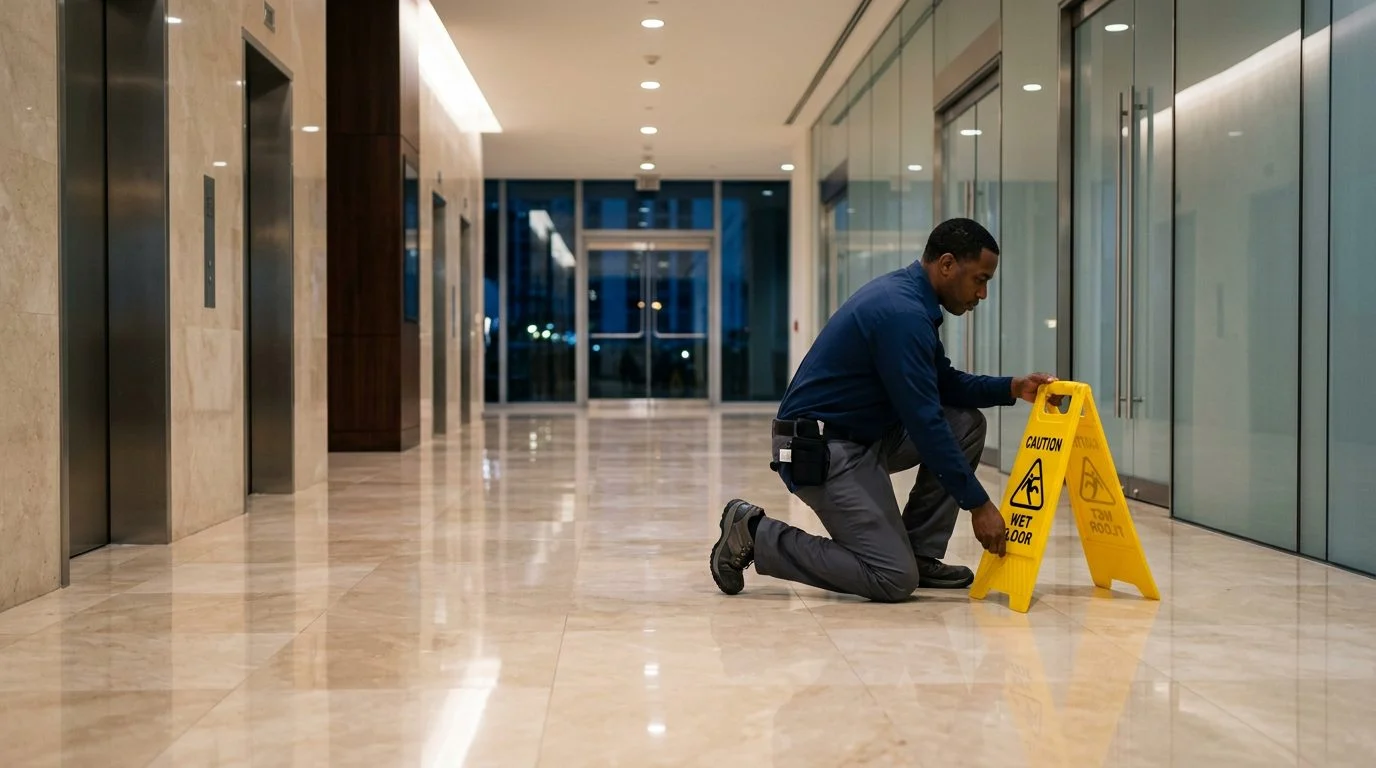
Resident Requests Don't Stop When the Day Shift Ends
Gator Protection, Inc. helps Miami-Dade, Broward, and Palm Beach properties set up a clear after-hours route for resident requests, so issues are handled instead of waiting until the next shift.
By Ryan Jurney · Published November 4, 2026
Day porter after hours resident requests Miami buildings receive are easy to lose. A spill in the lobby at night or a full recycling bin by the pool can sit until morning, or get buried in a text thread. A written plan fixes that. This guide shows Miami-Dade, Broward, and Palm Beach building managers and board members how to set one up, step by step.
What a Day Porter Shift Covers and Where After-Hours Requests Fit
A day porter shift covers daytime cleanliness and upkeep of shared spaces, so after-hours requests need a route of their own. The porter usually works on lobbies, restrooms, entries, walkways, elevator areas, and trash and recycling spaces. Residents often notice problems in the evening or overnight. By then, the porter has gone home.
Without a defined route, those problems wait for the next shift or never reach anyone. Sort the issues by urgency. A dusty handrail or a small pile of leaves can wait for morning. A wet floor at a main entrance needs attention right away. Decide ahead of time which problems fall in each group, so nobody has to guess at 9 p.m.
Write that decision down. A short list of what waits and what doesn’t gives residents clear expectations. It also gives the staff member on call a clear answer when a message arrives late.

If your building takes after-hours requests and has no written route for them, our team can help you set one up. Talk it through with our team — the first consultation is free, confidential, and carries no obligation.
Sort Resident Requests by Category Before You Assign Them
Sort each request into a category first, then send it down one of three routes. Categories are simple to write down and easy for residents to understand. Sorting first keeps a complaint about a full trash can from landing on the same list as a spill at the front door.
Common categories include:
- Spills and slip hazards
- Trash or recycling overflow
- Restroom supply gaps
- Lobby and elevator cleanliness
- Exterior debris
- Walkway and entry conditions
Each category goes to one of three routes: the next day porter shift, a same-day daytime task, or immediate escalation to the on-call contact. Spills and slip hazards almost always belong in immediate escalation. Exterior debris usually fits the next shift. Restroom supply gaps often fit a same-day task, because a supply run can be done in the daytime.
Put the category list into the building’s written request policy. Residents, staff, and the porter then apply the same rule to the same problem. That consistency matters more than any single decision made on a busy night.
Set Shift Hours and Coverage Windows
Set shift hours around the times residents most often notice conditions, and name a contact for the hours outside them. Map the porter’s start and end times against when people use the lobby, elevators, and common areas. A shift that ends in the early afternoon may miss the evening rush of deliveries and trash drop-off.
Plan a short handoff window. During it, the outgoing porter, the incoming porter, or the building manager reviews open requests. Nothing falls through the gap between shifts when someone checks the list out loud. The handoff also gives the incoming person a clear starting point.
Decide which hours fall outside the shift. Then assign a named contact for those hours and write the name and number into the policy. A name in writing works better than “call the office” when nobody is in the office at night.
Build an Intake Process That Captures Every Request
Every day porter after hours resident requests Miami building managers handle needs the same intake steps. Give residents one written route that works at night and captures the same details each time. Pick channels that someone actually monitors. Options include a written form, a dedicated phone line, or a message log at the front desk.
Require each request to include the location, the time it was observed, a short description, and whether the resident sees a safety concern. Those four details let the porter or the on-call contact act without a follow-up call. A vague message like “the lobby is gross” wastes a night and delays the fix.
Send an acknowledgment after each request. The message should confirm the request was received and state which route it will follow. Residents stop resubmitting the same problem once they know it’s logged. The acknowledgment also builds trust that the building takes requests seriously.
Not sure what your next step is?
Talk it through with our team — the first consultation is free, confidential, and carries no obligation.
Write Response Standards and Escalation Rules
Write separate response expectations for routine items and for hazards, and name who is contacted at each level. Routine items, like a full trash can, follow the next-shift route. Hazards follow faster escalation, and the policy should say so in plain words. Building managers should also keep in mind landlord maintenance duties when deciding how quickly a hazard must be addressed.
Walking surfaces need extra care. A wet floor at night is a hazard, so it should never wait for the morning route.
Cleaning chemicals bring their own rules. Your escalation list should note where those Hazard Communication Standard safety data sheets are kept, so anyone on shift can find them.
Review the rules with everyone who works the shift. Each porter should apply the same thresholds. Otherwise the policy exists only on paper, and residents get different answers depending on who picks up the message.
Log, Document, and Close the Loop
A request log that records time, category, route, and completion shows whether each request got handled. Keep a running log with the date, the time received, the category, the route taken, the time completed, and the name of the person who finished the work. Simple columns in a shared sheet are enough for most buildings.
Where your building’s policy calls for it, photograph the condition before and after the work. Store the photos with the matching log entry. This gives the manager proof of the work done. It also gives a record to check if the same problem keeps coming back.
Send a daily summary to the building manager. List open items, completed items, and anything that needs a decision. The summary turns a pile of messages into a short list someone can act on. A regular summary also shows which categories come up most, which helps you adjust the shift over time.
Coordinate the Day Porter Shift With Floor Care, Landscape, and Pressure Washing Schedules
Schedule floor care, pressure washing, and landscape work outside the porter’s busiest route so they don’t block residents. A pressure washing job in a walkway or a freshly mopped lobby floor creates the same slip risk as a spill. Plan those tasks in quieter hours and mark the work zone clearly with signs and cones.
Landscape and irrigation work also follow local rules. Check the current landscape irrigation rules before you set a watering schedule on the same calendar as the porter’s route.
Pool deck and outdoor sanitation tasks deserve their own calendar line. That keeps them from crowding the porter’s daily route. Review the combined schedule every month. Foot traffic and rainy-season weather change what needs attention and when, so the calendar should change with them.

Talk Through Your Building’s Setup With Our Team
If your building takes after-hours requests and has no written route for them, our team can help you set one up. Start by listing your request categories, your shift hours, and your after-hours contact. From there, the intake, escalation, and logging steps can be built around how your building actually runs.
Common Questions
What does a day porter do?
A day porter keeps shared spaces like lobbies, restrooms, entries, and walkways clean and in good order during the day.
Who handles resident requests after the shift ends?
A named after-hours contact should handle them under a written route. Without one, requests can wait until the next shift.
Does every request need immediate escalation?
No. Hazards and access problems need immediate escalation, and routine items can wait for the next shift.
If lobby spills and trash complaints reach your building at night and no one is set up to answer them, that’s the gap this plan closes. Our first consultation is free, confidential, and carries no obligation to continue. Reach out through the contact form, call the office, or request a quote, and tell us how resident requests reach your building after hours.
Have questions about what happened?
Ask our team directly. The first conversation is free, confidential, and there is no obligation to continue.
How a Clear After-Hours Route Helps Your Property
Defined Handoff
A written route shows who picks up a resident request once the day porter's shift ends.
A Named Contact
Residents know exactly who to reach, so questions do not sit unanswered overnight.
Written Procedures
Clear steps for logging, routing, and following up on requests keep the process consistent from one shift to the next.
Shared Spaces Protected
Lobbies, entries, restrooms, and walkways stay in good order when issues are reported and addressed promptly.
Tip: Don't Leave the Handoff to Chance
If your property has no named after-hours contact, requests can wait until the next shift. Put the route in writing before the next shift begins.
Building Your After-Hours Request Process
1. Identify the Contact
Choose a named person or role responsible for resident requests outside day porter hours.
2. Document the Route
Write down how requests are received, who is notified, and what the response steps are.
3. Share It with Residents
Make sure residents and staff know the contact method and the hours it covers.
4. Review Regularly
Check the route with your day porter team and adjust it as building needs change.
Talk With Our Team About Day Porter Service in Miami
Related practice areas
- Day Porter Service in Miami-Dade: What It Covers and How to Switch Vendors
- Day Porter Service in South Florida
- Day Porter Service in Miami-Dade County
- Day Porter Hialeah Apartments: Scope and How It Works