
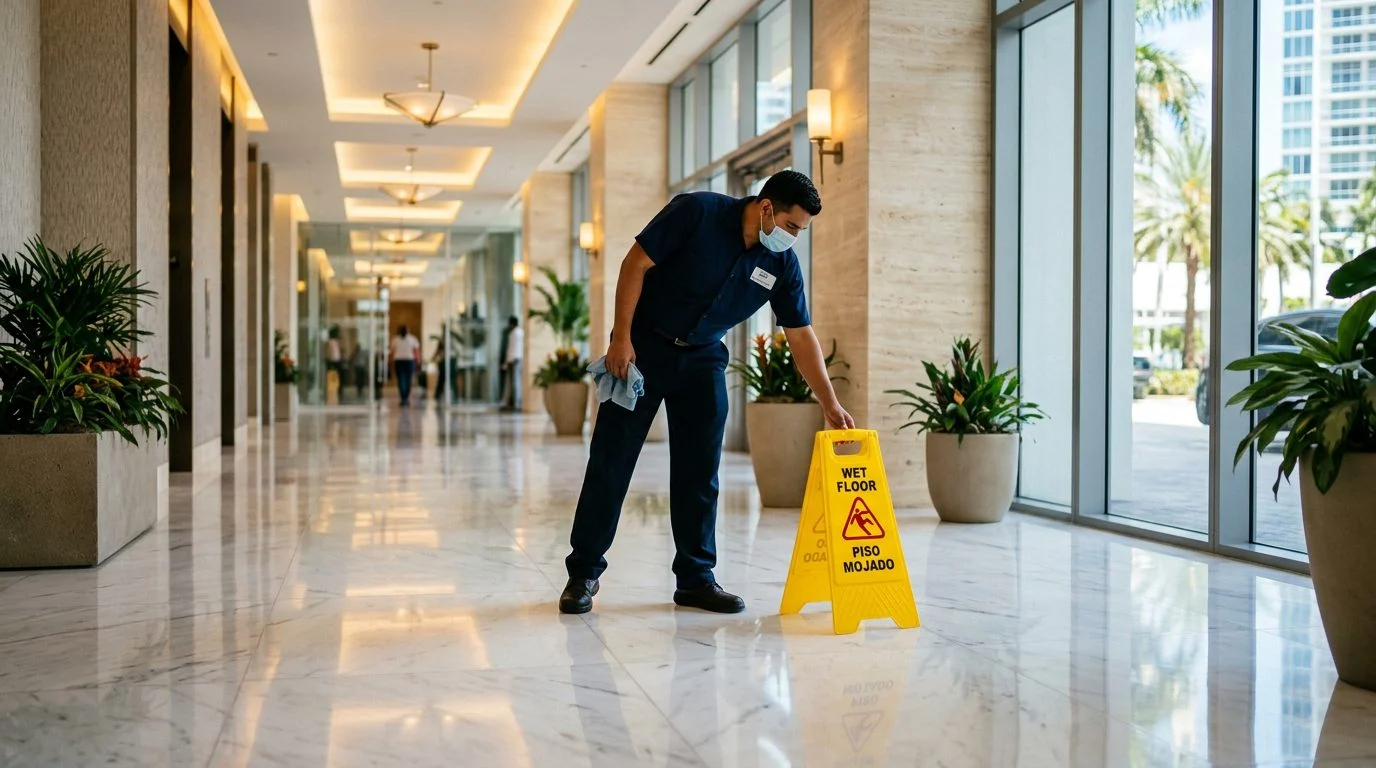
Miami Condo Day Porter Service
Is Your Condo's Day Porter Running on Empty?
Missed rounds, slipping floors and a lobby that never quite looks finished can all point to a workload that has outgrown the schedule.
By Ryan Jurney · Published November 18, 2026
Your building’s lobby looks rushed, trash sits out late, and residents keep raising the same complaints. That’s often the first sign a day porter is stretched too thin. A day porter is overloaded when the daily route can’t be finished within the shift. Look for work that is regularly skipped, outside tasks that keep getting pushed back, and staff who run past their scheduled hours. Here is how to spot each sign and what a different route can look like.
What Does a Day Porter Cover in a Miami Condo?
A day porter handles a building’s daytime upkeep, mostly in lobbies, elevators, entries, and shared spaces. The core duties usually include lobby and common-area cleaning, elevator and entry upkeep, moving trash and recycling to pickup points, checking restrooms, and answering residents’ day-to-day requests.
A route only makes sense against a defined scope. A porter covering a small building with one lobby carries a very different load than one covering a tower with a pool deck, two garages, and busy amenity rooms. Overload is measured against the written route, not against how tired the porter looks.
Our day porter service covers this daily route. Floor care maintenance, pressure washing services, and landscape services are separate work. They usually run on their own cycles, and they’re easier to manage when they don’t compete with the porter’s shift.
If your building's porter route is slipping, you don't have to work out the schedule alone, so talk with our team about what a revised route could look like. Talk it through with our team — the first consultation is free, confidential, and carries no obligation.
Which Signs Inside the Building Point to Overload?
The clearest sign is common-area work that is regularly skipped or finished late. Lobby glass, elevator interiors, mailroom counters, and amenity rooms often slip first because they are visible but not urgent. When they are always the last item on the list, the route has more work than time.
Watch the trash and recycling areas too. If they fall behind on the same days each week, the problem is built into the schedule, not one bad morning. Residents often notice a pattern before management does, so repeated complaints about the same space matter.
A simple test is a two-week log. Note the day, the time each area was done, and anything left undone at the end of the shift. A pattern usually shows up quickly. The common mistake is judging the route by one busy day. One heavy day rarely proves the route is wrong. Repeated gaps at the same time and place usually do.
Is Outside Work Pushing the Porter Off Schedule?
Outside work is pushing the porter when floor care or pressure washing lands in the day shift and never gets finished on time. Floor stripping, buffing, and spot treatment are the usual examples. They take real time, and they get moved again and again when lobby duties come first.
Pressure washing shows the same problem. Entries, walkways, garages, and pool decks get postponed week after week. Grounds debris builds up between visits, especially after storms or heavy rain. Once debris covers walkways and entries, the porter spends time clearing it instead of working the planned route.
Floor work also involves safety and chemical handling considerations. If the porter also mixes and uses those products, the route needs time for that too.
What Staff Signs Show the Route Is Too Long?
A route is too long when the porter regularly works past the scheduled end time. Overtime, early starts, and late finishes are the first staff-side signs. They are easy to miss, because the work still gets done, just a little later each week.
Florida law gives a reference point for the working day. Under Fla. Stat. § 448.01, ten hours of labor counts as a legal day’s work for manual labor employed by the day, week, month or year, unless the employee and employer have signed a written contract requiring a less or greater number of hours daily. Without such a contract, the person employed is entitled to extra pay for all work performed by the requirement of his or her employer in excess of 10 hours’ labor daily.
Breaks matter too. Under rest period rules, short rest periods of about 5 to 20 minutes must be counted as hours worked. Under meal period rules, a meal period is ordinarily 30 minutes or more, and the employee must be completely relieved from duty. A porter who eats at a desk while covering the lobby is still working.
Watch for fatigue, frequent call-outs, and turnover in the porter role. Also watch for tasks handed off informally to other staff. Those handoffs can leave coverage gaps that nobody has written down.
How Does South Florida Weather Change the Load?
South Florida’s heat, humidity, salt air, and heavy seasonal rain add work to grounds and exterior surfaces. That extra load often shows up as debris, mildew on outside surfaces, and more frequent pressure washing. A route built for mild conditions may not hold up once these demands arrive.
Peak periods add another layer. Move-in and move-out days bring elevator bookings, deliveries, and heavy trash. Storm cleanup can leave debris across lobbies and entries. Seasonal visitor traffic can keep common areas busy for days at a time. When these periods run longer than the normal route allows, the porter falls behind.
Irrigation is another factor. Watering days should be planned with the grounds crew so landscape work and lobby work don’t collide.
What Are the Options for a Different Route?
Most overloaded routes get fixed by moving outside work to fixed cycles, not by simply adding hours. The porter keeps the daily core, and scheduled crews handle the heavier jobs.
A split route usually looks like this. The porter keeps lobby, elevator, trash, and restroom work. Floor care and pressure washing run on fixed cycles agreed with the board. Landscape services follow a set grounds schedule, so debris doesn’t pile onto porter time.
Peak periods can get their own coverage. Extra or second-shift coverage during move-in, move-out, and storm recovery keeps the regular route intact. Plan that coverage before the busy days arrive, not after the complaints start.
Finally, put the revised route in writing. List each task with its frequency, such as daily, weekly, or per cycle, so the board can check coverage against the agreed scope. Under Fla. Stat. § 718.111, bids for work must be kept for at least one year after receipt, and the association’s official records must be kept in an organized way that lets a unit owner inspect them. Keep the revised schedule and the bids together in that file.
Not sure what your next step is?
Talk it through with our team — the first consultation is free, confidential, and carries no obligation.
Talking Through Your Building’s Route With Our Team
If these signs keep showing up, a conversation about the route is a sensible next step. Resident complaints or a visible change in the building can be a reasonable reason to start this review before deciding anything. That is a fair place to begin.
Our team can review the signs you’ve noticed, which duties fit the current route, and which might move to a fixed cycle. We can also look at where extra coverage would help during peak weeks.
Frequently asked questions
How many hours is a legal workday for a porter in Florida?
Ten hours is a legal day’s work for manual labor performed by the day, week, month or year, unless a written contract signed by the employee and employer requires a different number of hours. When no such written contract exists, an employee is entitled to extra pay for work performed by the requirement of his or her employer in excess of 10 hours’ labor daily (Fla. Stat. § 448.01).
Should a condo porter handle floor stripping and pressure washing?
Those jobs fit a porter’s day only when the route has room for them. Many routes run more smoothly when floor care and pressure washing follow fixed cycles.
Does a day porter need extra coverage during move-in and move-out?
Peak days often need coverage beyond the normal route. Plan that extra coverage in writing before the busy days arrive.
La consulta inicial es gratuita, confidencial y sin compromiso de continuar.
If your building’s porter route has started to slip, reach out through our contact page and we’ll walk through the current route with you.
Common Signs of an Overloaded Porter
Routine tasks slide
Trash rooms, elevators and common areas get cleaned late or skipped, and the building's daily standard starts to slip.
Floors show the strain
Scuffs, dull patches and tracked-in grime build up between passes because there is no time left for proper floor care.
Outdoor areas fall behind
Entryways, walkways and landscaped spaces look neglected, and pressure-washed surfaces go too long without attention.
Residents start complaining
Repeated comments about cleanliness, missed requests or a lobby that looks unattended are often the first visible signal.
What Balanced Day Porter Coverage Looks Like
Scheduled, consistent rounds
Daytime visits planned around the building's traffic so common areas stay presentable throughout the day.
Floor care maintenance
Regular cleaning and upkeep that protects finishes and keeps high-traffic floors looking their best.
Landscape and pressure washing
Exterior service that keeps entrances, walkways and surfaces in step with the interior work.
Clear communication
Our team works with building managers to review what is being covered and where the gaps are.
Don't Wait for a Complaint
When the same areas keep needing attention, the problem is usually the workload, not the people doing the work. Addressing it early keeps small issues from becoming costly ones.
Ready to Take the Pressure Off Your Building?
The First Consultation Is Free, Confidential and Carries No Obligation to Continue.