
Landscape Services | South Florida
Build a Landscape Scope of Work Your Commercial Bid Can Stand On
Start with clear boundaries, defined tasks, and a plan for changes, so every party reads the same bid the same way.
By Ryan Jurney · Published November 23, 2026
You’re reviewing commercial landscape bids for a property you didn’t choose to manage, and someone else set the deadline. A bid only means something when every bidder priced the same work, and the scope of work defines that work.
What Is a Landscape Maintenance Scope of Work?
A landscape maintenance scope of work is the document that states which tasks get done, where, how often, and to what standard. Two bids can only be compared if they describe the same areas, tasks, and frequencies.
Without that common basis, one bid may cover mowing twice a week while the other covers it once. Both prices can look reasonable, but they buy different service.
A complete scope usually includes:
- Property boundaries and a site map
- Named maintained areas, with measurements
- A task list for each area
- A service schedule by task and season
- Known site conditions
- Access rules
- Exclusions
A clear scope also protects both sides. The owner knows what to expect, and the contractor knows what is base service and what is extra.
If you inherited a grounds contract and must review bids before the board meets, we can help you put the scope in writing so every bid is measured the same way. Talk it through with our team — the first consultation is free, confidential, and carries no obligation.

What Commercial Landscape Maintenance Includes
Commercial landscape maintenance is recurring, scheduled care of grounds at commercial properties, condos, and associations. It isn’t a one-time cleanup.
Each task should be spelled out in the scope:
- Mowing: turf height, mowing pattern, and what happens to the clippings.
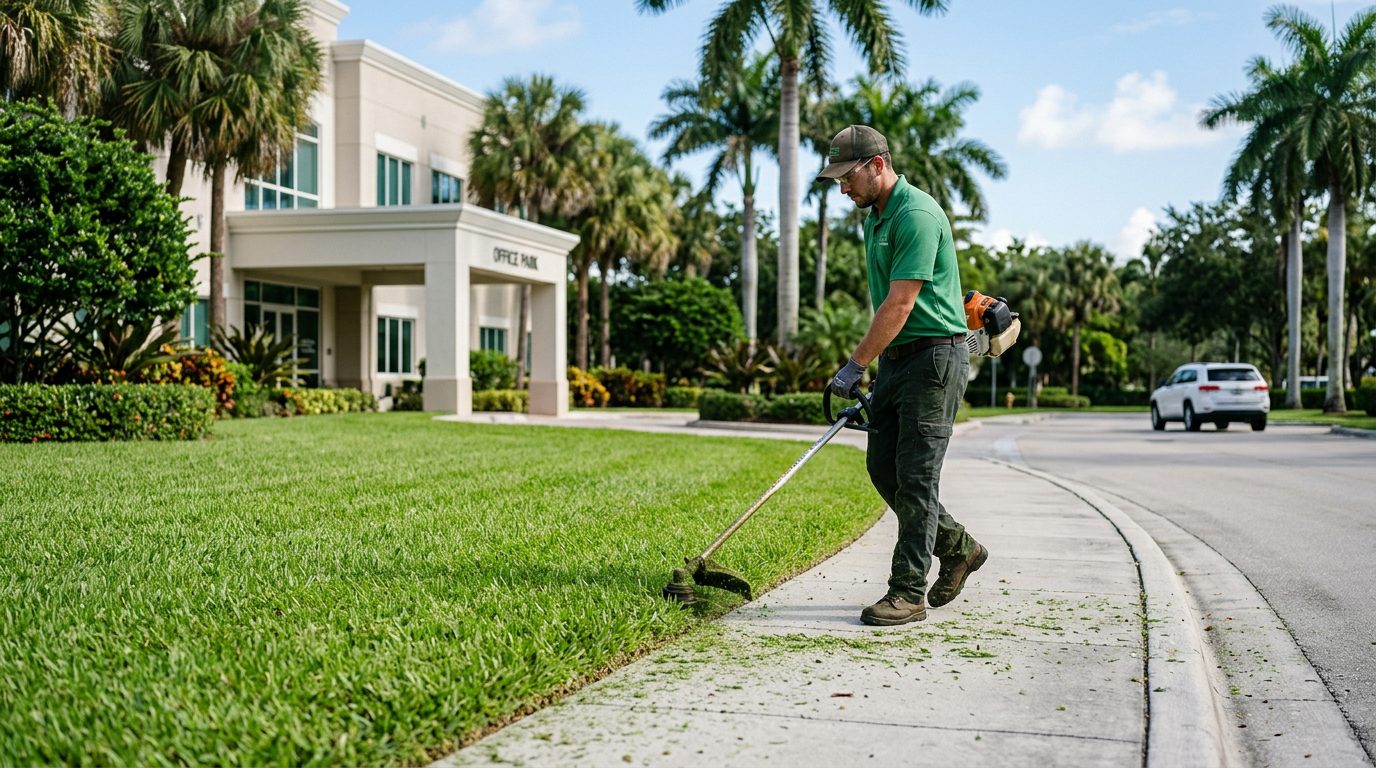
- Edging: along walks, curbs, and beds, followed by blowing debris off hardscape on the same visit.
- Pruning: shrubs and hedges, with what gets trimmed every visit and what gets trimmed seasonally.
- Weed control: in beds, along hardscape edges, and in turf.
- Bed maintenance and debris removal: cleanup tied to each visit, not left for later.
Our team can talk through the fertilizer and pesticide questions that come up on your grounds.
Map the Property and the Maintained Areas
Each maintained area should have a name, a measurement, and its own line in the scope. Vague labels like “grounds” hide what is actually being priced.
Name each zone, such as the front entrance, parking islands, common areas, and the rear lawn. Attach a site map so every reader sees the same boundaries.
Separate turf, planting beds, tree areas, and hardscape. Price and schedule each one on its own line. A lump sum for the whole property makes it hard to see what changes when one area is added or removed.
Mark exclusions clearly. Common exclusions include private unit patios, construction zones, and areas another party maintains. Measure square footage or linear footage per zone, because a bid is only as fair as its measurements.
Coastal properties need extra care. Read that guidance before trimming or removing anything near the dune.
Set Task-Specific Service Schedules
Each task needs its own frequency, and the schedule should show what is due on every visit. A single flat frequency rarely fits the whole year.
Growth shifts with rain, heat, and irrigation. Mowing may run weekly in the growing season and less often in cooler months. Edging and blowing ride along on the same visit.
Build the schedule as a grid. List tasks down the side, visit days across the top, and season in the header. The crew can then see exactly what is due on each visit.
Pruning and weed control need their own lines. State the frequency and the method. Also name the trigger for extra visits, such as storm cleanup or a written request from management.
Our team builds schedules around the property’s traffic, its use patterns, and South Florida growing conditions. A parking lot busy all day needs different edging than a quiet association courtyard.
Record Existing Conditions and Access Rules
A dated baseline of existing conditions, backed by photos, shows what the crew found on arrival. Take it before service begins.
Photograph beds, turf, trees, irrigation heads, and any existing damage. Date every photo and keep copies with the scope. When a dispute comes up, both sides can check the same record.
Access rules belong in the scope too. List gate codes or key control, allowed service hours, parking for equipment, and noise limits. Note who reports damage to irrigation, lighting, or hardscape found during service, and how fast.
Walking surfaces need attention. The 29 CFR Part 1910 Subpart D text is the official source.
The baseline helps both sides agree on what was there at the start and what changed during the contract.
Comparing Bids: Why an Hourly Rate Does Not Settle the Question
An hourly rate says little until you know the scope, crew size, visit count, and equipment behind it. A figure that looks high for one small job can be fair for a larger one.
Then compare line items before totals.
- What is included in the monthly price?
- What is billed as an extra?
- How are added visits priced?
- How is damage handled?
A lower total can mean a thinner scope. A bid that leaves out edging or pruning will look cheaper, even though it isn’t cheaper to get the whole job done.
Keep the paperwork. For condo associations, Fla. Stat. § 718.111 says bids for work, materials, equipment, or services must be maintained for at least 1 year after receipt of the bid. For homeowners’ associations, Fla. Stat. § 720.303 treats bids received for work as official records that must be kept for 1 year.
Not sure what your next step is?
Talk it through with our team — the first consultation is free, confidential, and carries no obligation.
How We Write and Deliver a Commercial Scope
Our team starts by walking the property, measuring each zone, and drafting the scope with the client before any price is set. Pricing comes after the scope, not before.
Walk the grounds with the board or property manager. Measure zones, record conditions, and photograph the baseline. Then draft the task list and schedule, and review them together.
We offer landscape services, pressure washing services, floor care maintenance, and day porter service. When one property uses more than one of these, a single coordinated scope keeps zones, visits, and responsibilities from overlapping.
We serve Miami-Dade County, Broward County, and Palm Beach County, including Coral Gables, Brickell, and South Beach. Local conditions shape each schedule, from seasonal growth to beach-adjacent rules.
Scope changes should be written, not handled by phone. When needs change, update the scope with the new area, task, or frequency, and have both sides review the revised version.

Frequently Asked Questions and Next Step
What is the difference between a scope of work and a service agreement?
The scope lists the tasks, areas, and frequencies. The service agreement holds the contract terms and refers back to the scope.
Can a scope change during the contract?
Yes, when the change is written into the scope with the new area, task, or frequency. Verbal changes are hard to check later.
Who should review the scope before bidding?
The property manager or board should review it, along with the people who inspect the grounds each week.
What does a first conversation involve?
La consulta inicial es gratuita, confidencial y sin compromiso de continuar. We’ll walk through your zones, tasks, and schedule together.
Many readers reach this topic while comparing bids for a property they inherited, under a board deadline they didn’t set. If that’s your situation, fill out our contact form, call the office, or request a free quote, and we’ll help you put the scope in writing.
What Our Team Looks for in a Landscape Scope
Defined property boundaries
Each site, zone, and planting bed is identified so the bid covers exactly the grounds that need service.
Clear visit frequencies
Mowing, edging, pruning, and cleanup cycles are written out so the schedule is easy to follow and price.
Specific tasks
Each maintenance task is described in plain terms, leaving less room for misunderstanding between the property and the contractor.
Written change control
Additions, removals, and seasonal adjustments are recorded in the scope itself, not left to verbal agreement.
Core Sections of a Commercial Landscape Scope
Scope and site map
Describe the property, include a map or plan, and mark any areas excluded from service.
Task list and standards
Break down mowing, trimming, irrigation checks, mulching, and debris removal with the expected condition after each task.
Schedule and frequency
Set weekly, biweekly, monthly, and seasonal intervals so the bid can be compared line by line.
Pricing and change terms
Connect each task to its price and state how new work or changes will be added and approved in writing.
Put Every Change in Writing
Verbal changes to a landscape scope are hard to verify later. Record any new area, task, or frequency in the written scope before work begins.