
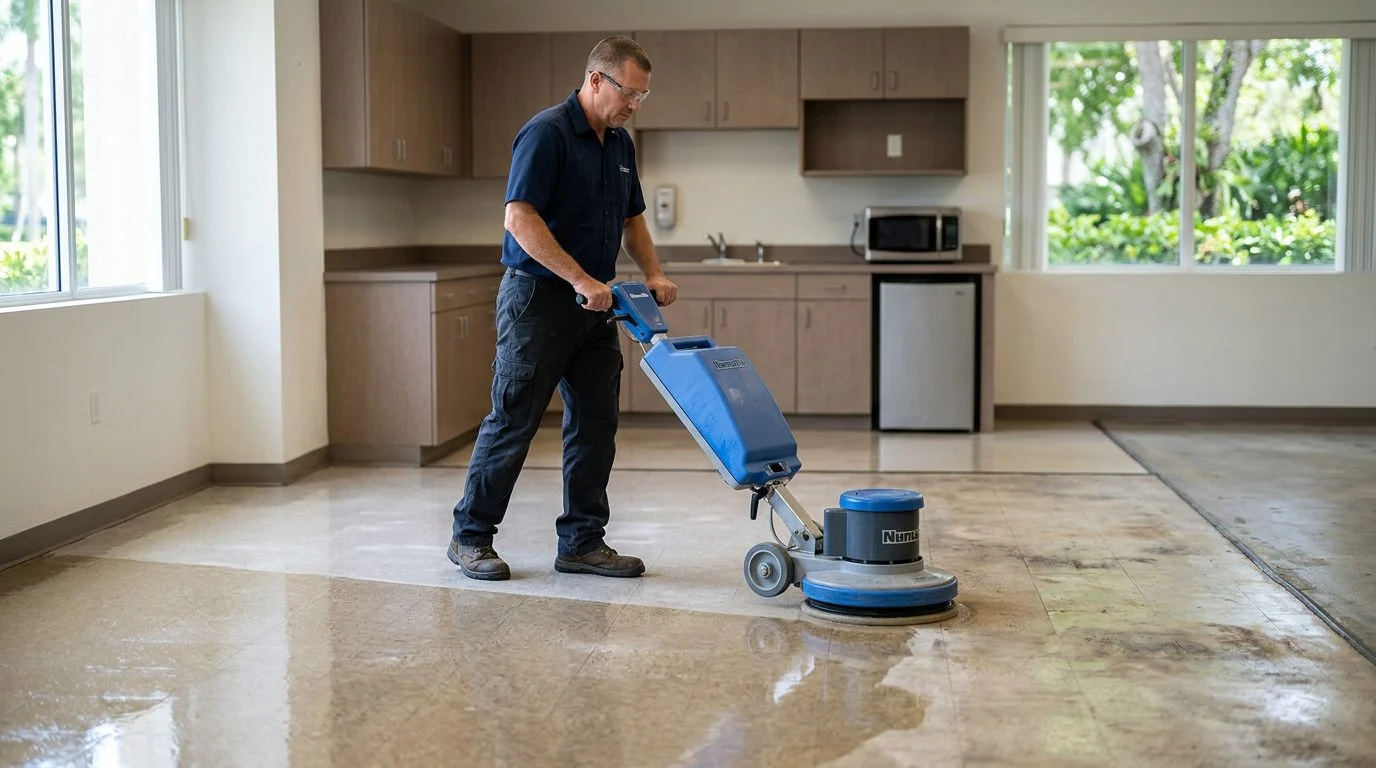
Floor Care Maintenance | South Florida
How Often Commercial Floors Need Stripping and Waxing in South Florida
The right schedule depends on your floor, your foot traffic, and the local climate. Here is how to tell when it is time.
What Shapes Your Floor Care Schedule
Foot traffic
Lobbies, entrances, and hallways wear finish faster than offices or back rooms.
Floor type and existing finish
Tile, vinyl, terrazzo, and other surfaces each respond differently to stripping and waxing.
Heat, humidity, and sun
South Florida's climate and sun exposure can speed up yellowing and wear, especially near glass doors.
Hours of operation
Buildings that run around the clock need services planned around occupied areas.
By Ryan Jurney · Published November 7, 2026
There is no single schedule for stripping and waxing a commercial floor. The right timing depends on how much traffic the floor carries, what finish is on it now, and what the floor is made of.
This guide is for facility managers, building managers, and board members in Miami-Dade, Broward, and Palm Beach counties. It explains how the timing gets set and what to watch for. For ongoing care between major jobs, see our day porter service in Miami-Dade page.
How often do you strip and wax floors? The short answer
Stripping and waxing are separate jobs, so each one follows its own timing. Stripping removes old finish and buildup. Waxing, or adding a new finish coat, protects the floor after that.
Because every floor is different, the schedule comes from the facts of that floor, not from a fixed calendar. Many shorter pages give one number for every floor. That number can be wrong for a busy lobby and for a private office that sees very little traffic.
Three things matter most. The first is foot traffic. The second is the floor material. The third is the condition of the finish already down. Routine cleaning between major jobs also shapes how fast buildup returns.
The sections below cover those factors, the warning signs, the process, and the mistakes that shorten a floor’s life.
If a floor in your building looks dull and you're not sure when it's due, our team can talk it through with you. Talk it through with our team — the first consultation is free, confidential, and carries no obligation.

What stripping and waxing actually do
Stripping removes the built-up finish, dirt, and residue that regular cleaning leaves behind. Waxing lays down a new protective layer and gives the floor an even sheen.
Buildup does not spread evenly. It collects in traffic lanes, at doorways, and along walls and corners where mops and floor machines reach less. Over time the old finish turns dull and uneven, and dirt gets trapped under the surface.
That is why a floor often needs stripping before it needs another coat. Adding wax over a dirty floor seals the dirt in. Stripping first clears the surface so the new coat can bond evenly.
Think of painting a wall. You scrape off peeling paint before you add new paint, or the new layer peels too. Routine cleaning keeps the finish in better shape, but it does not remove what has already built up. That is the job stripping does.
Factors that set the schedule for stripping and waxing
Four main factors set the timing. They are foot traffic, floor material, the condition of the current finish, and how well routine care is kept up.
Foot traffic comes first. Lobbies, main corridors, and entrances take the most wear. Private offices and rooms with little use wear more slowly. A busy floor needs attention sooner than a quiet one, even inside the same building.
The floor material matters next. Commercial hard floors are not all finished the same way. Vinyl composition tile (VCT) is a common commercial floor that is handled differently from other hard surfaces. The material shapes the stripping and finish approach, so one schedule does not fit every floor.
Then comes the current finish: its thickness, its age, and how well it has held up. A finish with good coverage can go longer. One that has thinned in busy areas needs attention sooner.
South Florida conditions add to the picture. Humidity and sand or grit tracked in from outside can speed up soil at entrances. Floors near doors often build up faster than the rest of the space.
Routine cleaning is the last factor. Good daily care slows buildup and stretches the time between stripping cycles. Weak daily care does the opposite.
Signs a commercial floor is due for stripping or waxing
A floor is usually due when routine cleaning no longer brings back its shine. Look for these signs on the floors in your building.
A dull or hazy look that does not improve with regular buffing is the first clue. The floor may look cloudy even after it has been mopped.
Visible buildup along walls, in corners, and in traffic paths is another sign. These areas often show a dark line or film where the mop does not reach well.
Scuffs and marks that stay after regular cleaning point to finish that has worn thin. Marks that return soon after cleaning suggest the finish is no longer doing its job.
Finally, look at the floor as a whole. Patchy shine, uneven color, or finish worn through in heavy-use areas means the floor needs a planned job, not just spot work. Compare the busiest areas with the quiet rooms. The gap between the two shows how much traffic is wearing the floor.
How the strip and wax process runs
The job runs in clear steps: clear the room, protect the edges, strip, rinse, dry, then apply thin coats. Each step affects the final result.
First, remove floor mats, furniture, and loose objects from the area. Anything left behind can block the stripping solution and leave uneven marks when the job dries.
Second, protect the adjoining areas. Walls, baseboards, and nearby surfaces can be damaged by stripping solution, so they need covering before work starts.
Third, strip the old finish. Floor stripping products are chemical products, so they call for careful handling. Rinse well afterward so no residue stays on the floor.
Fourth, let the floor dry fully. A new coat over a damp floor will not bond well.
Fifth, apply finish in thin, even layers. Let each layer dry before the next. Thick coats look heavy, dry unevenly, and can trap dirt.
Last, buff the floor and keep foot traffic off the area until the finish has cured. Cure time varies by product and conditions, so the schedule is set for each floor.
Safety matters at every step. Mark a freshly worked floor until it is safe to walk on.
Wood floors and occupied spaces: common questions
Wood floors follow a different path than commercial hard floors. Most commercial jobs also get planned around the people who use the space. The finish already on the wood decides the method and timing.
How often should wood floors be waxed?
The schedule depends on the finish already on the wood. Each floor is set on its own facts.
Can people stay in the building during stripping and waxing?
Many commercial jobs are planned after hours or in sections, so other areas can stay open. Tell staff and tenants which areas are off limits while the finish dries.
Is stripping more often always better?
No. Stripping more often than a floor needs adds work and removes finish that is still doing its job. Routine care is the right tool when it is enough to hold the finish.
Not sure what your next step is?
Talk it through with our team — the first consultation is free, confidential, and carries no obligation.
Common mistakes that shorten floor life
The most common mistakes are stripping too often, waxing over dirty buildup, and skipping the setup steps. Each one can wear a floor faster or leave it looking poor.
Stripping too often is the first. When routine maintenance would hold the finish, extra stripping adds cost and strips away good coverage.
Waxing over dirty or uneven buildup is the second. The new coat traps soil under the surface, so the floor looks dull sooner.
Skipping protection of adjoining areas is the third. Stripping solution can damage walls and baseboards, and a quick cleanup later does not always undo it.
Waxing without clearing mats and objects comes next. Items left in place cause uneven coverage and marks.
Letting the schedule slide is the last mistake. A floor left until it is badly worn takes more work to bring back. A planned cycle is easier on the floor and on the budget.
Talk through your floors with our team
If you’re reading this for a building you manage or a board you serve, you may not know yet whether a floor is due. That is a normal place to start. You may be weighing the look of a lobby against the cost of a job, and you want clear facts before you decide.
Our team can talk through your floor type, the traffic it carries, and its current condition. Then we can help you think about a schedule that fits your building. Our first consultation is free, confidential, and carries no obligation to continue.
To start, use the contact form, call the office, or request a quote.
Do Not Strip on a Calendar Alone
Stripping removes the protective finish along with the dirt. Doing it more often than a floor needs can shorten its life. Check the floor's condition before each service.
Signs Your Floor Is Ready for Service
Dull or uneven shine
When the surface looks flat across high-traffic lanes while other areas still reflect light, the finish may be wearing thin.
Visible scuffs and traffic lines
Dark paths from doors to desks or counters often show where the finish has worn through.
Haze or wax build-up
A cloudy film or buildup that resists regular cleaning can mean the old layers need to be removed.
Discoloration near entrances
Yellowing or staining by doors and windows may point to a finish that has aged faster than the rest of the floor.