
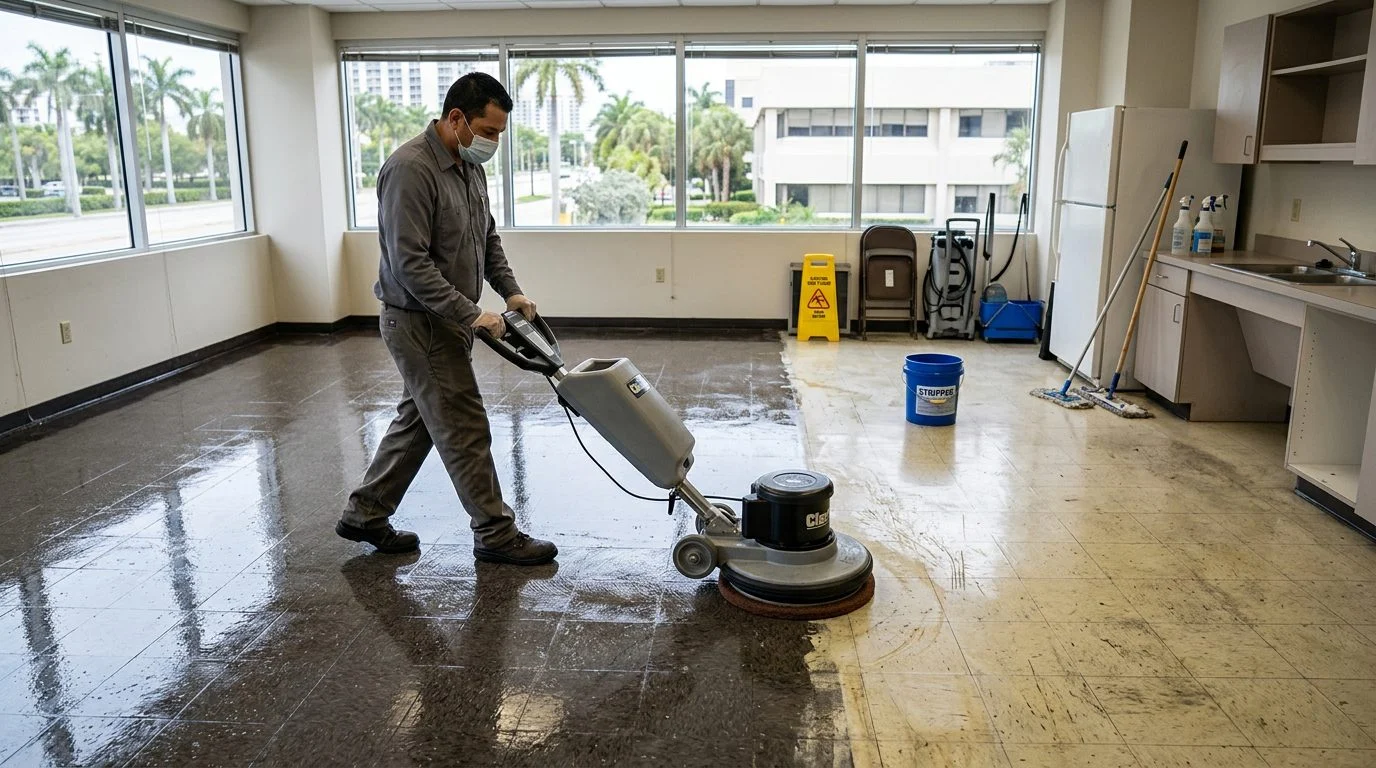
Planning a Strip and Wax for Your Office? Start With the Schedule.
Floor work goes smoothly when the timing fits how your staff, visitors, and building access actually work. Here is how that plan comes together.
By Ryan Jurney · Published November 26, 2026
If your office floor needs stripping and waxing, you want to know how much of your workday it will take. The answer is a site-specific estimate. Crew size, shift length, furniture, finish buildup, and access hours set the schedule for a 10,000-square-foot office.
How Long a Strip and Wax Takes on 10,000 Square Feet
The time is a planning estimate, and the walk-through is where the schedule gets set. A square footage number alone can’t tell you how many nights the work will take.
A strip and wax removes old finish, rebuilds the floor with fresh wax coats, and needs drying time between steps. On a floor this size, those steps can fill one shift or several. Four factors move the schedule most: crew size, furniture and occupancy, finish layers, and after-hours access. Each is covered below.
For the full scope of this work, see our floor care maintenance overview.
If your office floor needs stripping and waxing around desks and a short after-hours window, we can walk the space with you and map out a realistic schedule. Talk it through with our team — the first consultation is free, confidential, and carries no obligation.
How Crew Size and Square Footage Set the Schedule
Adding crews shortens the calendar, but it doesn’t shorten the work on each square foot. Start with simple arithmetic. Divide the total square footage by how much floor one crew can strip and wax in one shift. That gives you the number of shifts.
A single crew on one shift spends part of its time on setup. Crews need staging space, equipment set up, and a defined work zone before the first stripping pass. Several crews on one floor need zones that don’t overlap, so they spend more time coordinating.
Setup is easy to overlook. It takes a real share of the shift before any old finish comes off the floor. A good plan counts it in advance.
For how much floor one crew can cover, see square footage per crew shift.
How Furniture and Occupied Areas Add Time
Furniture and occupied space add time before, during, and after the work. Desks, chairs, cabinets, and equipment must come off the floor before stripping starts. That clearing is a separate task, and it counts toward the total.
Once the floor dries, everything goes back. Moving furniture out and back takes crew hours at both ends of the job.
Occupied floors take longer. Work moves in sections. The crew strips one zone, lets it dry, waxes it, and then moves on. Each section adds transitions that an empty floor doesn’t need.
Edges, corners, and areas under fixed fixtures take hand work. Machines can’t reach baseboards and tight spots, so crews finish those by hand. That work is slower than open floor, so it should be counted in the plan.
How Finish Layers and Drying Time Affect the Job
Wax buildup sets how long stripping takes. Stripping removes old finish and built-up wax. A floor with heavy buildup needs more passes and more residue removal than one with a thin layer.
The sequence runs in order. The crew strips, rinses and removes residue, lets the floor dry, and then applies wax coats with drying time between each one. Each added coat adds application and drying time. The number of coats is decided for each floor before the job is scheduled.
Drying depends on humidity, airflow, and ventilation. South Florida’s humidity can slow drying, so crews plan for it. Ventilation matters for safety too. OSHA’s chemical hazards guidance states that ventilation, chemical mixing, sprays, and mechanized equipment affect exposure risks. Air movement belongs in the plan for any occupied office.
How After-Hours Access Changes the Shift
A short after-hours window means more crews, a longer calendar, or both. Many offices schedule strip and wax work after business hours or on weekends. The crew then works inside a limited window, and access rules decide how much of that window is usable.
Building access can add time before the first pass. Elevator and loading dock limits, alarm codes, key handoffs, and security check-in each take minutes. A crew that waits at a dock gets less floor done in the same shift.
Cleaning products also call for careful attention to safety.
To see how labor, materials, and setup show up on a bill, read floor care invoice line items.
What Happens After the Floor Is Stripped and Waxed
Foot traffic and furniture should wait until the finish has set. Once the wax is on, the floor needs time to dry fully. Traffic waits until that happens, and heavy furniture moves back last.
Wax buildup changes how a floor looks and wears over time. Scuffs and dull spots build up in high-traffic lanes. That’s why a maintenance schedule matters after the first strip. Day porter service can handle spills and daily upkeep between cycles.
Slip resistance is part of the plan. Keeping walking surfaces clean and dry helps reduce slip hazards. For testing before the rainy season, see testing floor slip resistance.
Frequently Asked Questions
How long does a strip and wax take for a 10,000 square foot office?
It’s a site-specific estimate set by crew size, shift length, furniture, and access hours. The walk-through is where that schedule gets set.
Can floor stripping be done after business hours?
Many offices schedule it after hours or on weekends, within the access the building allows.
Can people walk on a floor right after it is waxed?
Traffic should wait until the finish has dried fully. The crew sets that timing for your floor.
Not sure what your next step is?
Talk it through with our team — the first consultation is free, confidential, and carries no obligation.

Get a Walk-Through Estimate for Your Office Floor
A walk-through is how a realistic schedule for your floor gets set. Our team measures the floor, counts the furniture to move, checks access rules, and sets the crew size and shift plan. Share the building’s access details and the finish you use, if you know it.
The first consultation is free, confidential, and carries no obligation to continue.
If your office is planning a strip and wax and you’re weighing how many nights it will take, contact Gator Protection, Inc. through the form, by phone, or with a quote request.
What We Review Before Setting Your Schedule
Crew Size
The number of technicians on site affects how quickly the floor can be stripped, finished, and cleared for use.
Shift Length
We match the work window to your business hours, cleaning windows, and any after-hours access your building allows.
Furniture and Layout
Moving, covering, and returning furniture is planned into the schedule so nothing is left to chance on work day.
Access and Building Rules
Elevator, loading dock, and security requirements are confirmed in advance so the crew can arrive and work without delay.
Tip: Share Your Access Details Early
Send us your office hours, building access limits, and any furniture that must stay in place. The earlier we have these details, the more accurate your schedule will be.
How Your Strip and Wax Is Planned
1. Walk-Through
We visit the office to measure the floor, note its condition, and review traffic patterns and areas that need extra attention.
2. Access Window
We agree on the days and hours the crew can work, including any after-hours or weekend options your building permits.
3. Crew and Preparation
We confirm the crew, equipment, and room-by-room preparation so the work moves in an organized sequence.
4. Reopening the Space
We plan how and when the floor is cleared for foot traffic and furniture, so your team can return with minimal disruption.