
Floor Care Maintenance | South Florida
Know What Your VCT Floor Needs Before You Commit
Here is how commercial VCT floor stripping and waxing is priced, and what shapes the final number for your space.
By Ryan Jurney · Published November 18, 2026
If you’ve just been put in charge of a commercial floor, you probably want a realistic number and a clear reason behind it. The cost of stripping and waxing a VCT floor mainly turns on square footage, how much old finish has built up, how many coats it needs, and when the work can happen.
If your South Florida office, school, clinic, or retail space has traffic and cleaning schedules that vary a lot, you are not alone.
What VCT Flooring Is and Why It Gets Stripped and Waxed
Vinyl composition tile (VCT) is a resilient floor tile found in many commercial buildings, including offices, schools, clinics, and retail spaces. A wax-based floor finish protects its surface, and that finish is what gets stripped and renewed.
Wax doesn’t last forever. Foot traffic wears it down, especially in entryways, hallways, and the paths to break rooms. Dirt mixes into the finish, and polish builds up in layers. Over time the floor looks dull, hazy, or yellowed, even when it’s mopped regularly.
Routine care and a full strip-and-wax cycle are different jobs. Routine care keeps the existing finish clean and bright. A full cycle removes the old finish and residue down to the tile, then rebuilds the protective coats. If you’re weighing a full cycle, you’re really looking at your floor care maintenance plan as a whole.
If a worn VCT floor landed on your desk, you don't have to work out the scope alone; our team can talk through your floor with you. Talk it through with our team — the first consultation is free, confidential, and carries no obligation.
How the Strip-and-Wax Process Works, Step by Step
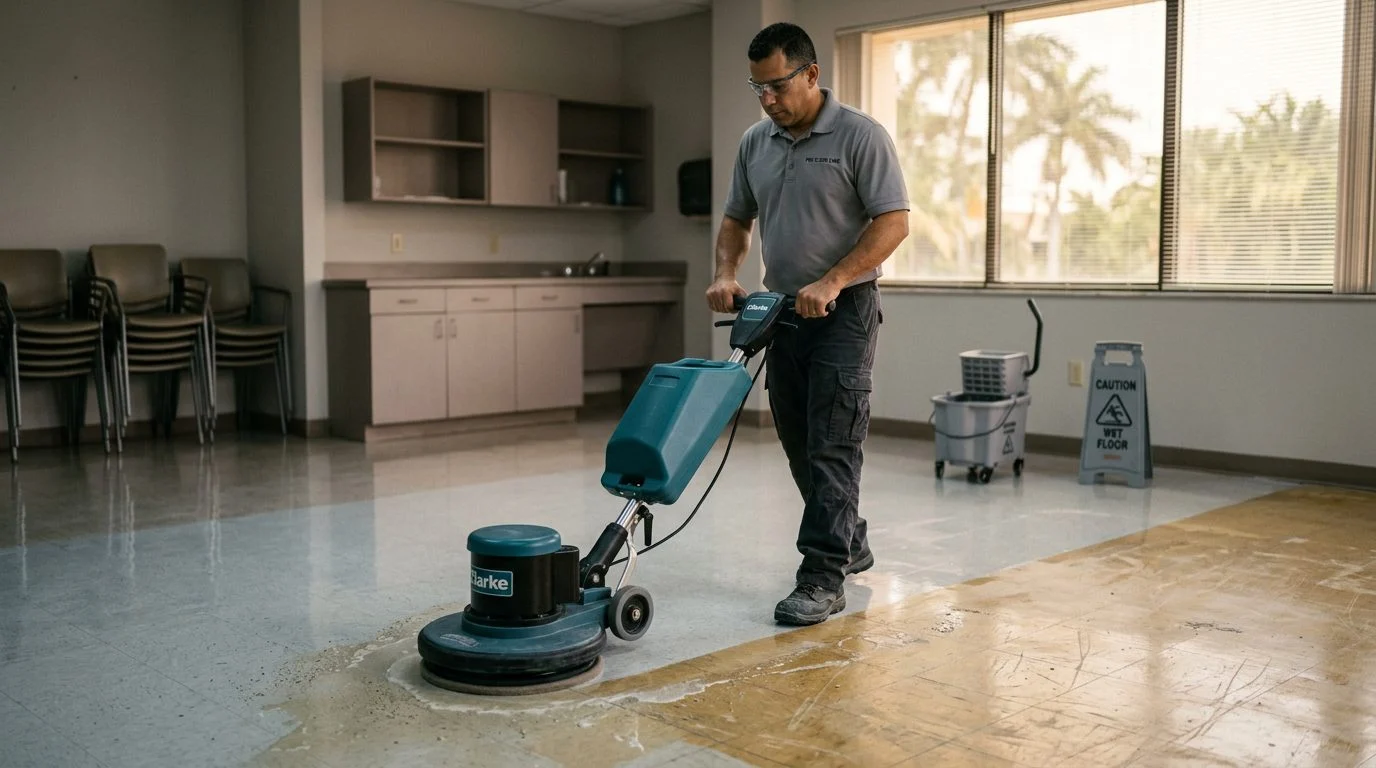
Stripping removes the old finish, and waxing lays down new coats. Each step prepares the next one. Skipping a step often shows up later as streaks, residue, or uneven shine.
First, the area is prepared. Rooms are cleared where possible, fixtures and equipment are moved or protected, and the floor is swept or dust mopped so grit doesn’t scratch the surface during scrubbing.
Next, a floor stripper is applied and left to work on the old finish. The crew then scrubs and removes the loosened finish and residue.
Rinsing comes next. Leftover stripper or residue can keep new finish from bonding evenly, so the floor is rinsed and allowed to dry. Wet floors are a slip risk. Regular floor care can support safer surfaces in busy commercial spaces, and our team plans that work around your daily operations.
Then the new finish goes down in several thin coats, with time for each to dry before the next. Thin coats are the usual approach because they dry more evenly. Finally, the finish must cure before foot traffic returns to full use.
What Affects the Cost of Stripping and Waxing VCT Floors
Five factors shape the cost most: square footage, buildup, coat count, access, and scheduling. Each one changes how much labor and product the job takes.
Square footage sets the base. A large open floor costs more to strip than a small room. A space split into many separate rooms adds setup and movement between them.
Buildup changes the work. Heavy, layered finish takes more stripper, more scrubbing, and more rinsing than a floor with light wear. A floor that has never been fully stripped often shows more buildup than owners expect.
Coat count matters too. Restoring an even, glossy look may take several coats, and each coat adds product and drying time.
Access and layout affect labor. Furniture, equipment, and fixtures that must be moved or worked around add time to the job.
Scheduling is the last factor. After-hours or weekend work lets the floor dry and cure without disrupting people in the building, and that timing changes the plan.
Because these factors combine, an accurate figure comes from walking the actual floor. A general per-square-foot rate can’t account for your building’s buildup, layout, or hours.
How Often VCT Floors Should Be Stripped and Waxed
Most VCT floors need a full strip and wax when the finish wears out, not on a fixed calendar. Traffic level, the type of use, and the cleaning routine decide how fast that happens.
Look for a few practical signs. Dull or hazy patches are one. Scuffs that won’t buff out are another. Wear paths along main routes, such as the lobby to the elevator, are a third. When these show up across the floor, a full cycle is usually due.
Routine buffing and spot care can stretch the time between cycles. Spot care lifts small wear before it spreads, and periodic buffing restores shine between full jobs.
Floors don’t wear evenly. A high-traffic corridor may need attention on a different schedule than a private office in the same building. Plan by zone, not by one date for the whole space.

How Long Stripping and Waxing Takes and How Long the Finish Lasts
A job takes as long as the square footage, buildup, coat count, and drying time allow. No single duration fits every floor, so the schedule should come from a walkthrough.
Large open floors are often planned across more than one work window. Splitting the job lets each section dry and cure before the next one starts, which keeps the rest of the building working.
The life of the finish hinges on foot traffic, the cleaning routine, and how much wear it takes. Regular cleaning with the right products helps the finish last longer between cycles. The wrong cleaner can dull or break down the finish early.
Keeping VCT Floors Looking Good Between Full Strip-and-Wax Cycles
Dust mopping, damp mopping with a neutral cleaner, and periodic buffing keep a VCT floor looking good between full cycles. These habits protect the finish that’s already there.
Daily dust mopping removes grit that scratches the surface. Damp mopping with a neutral cleaner lifts soil without wearing down the finish. Use only the cleaner the finish is meant for, because the wrong product can dull it.
Periodic buffing restores shine and softens light scuffs. It often bridges the gap between full cycles.
Spot care matters most in entryways and corridors, where wear concentrates. Quick attention to spills and scuffs keeps damage from spreading across the floor. A day porter can handle this kind of daily spot care, and floor care work can be scheduled around the building’s hours and usage.
Not sure what your next step is?
Talk it through with our team — the first consultation is free, confidential, and carries no obligation.
Talking Through Your VCT Floor With Our Team
A real number starts with a conversation about your specific floor. Many people reading this have inherited a floor, been asked to look into it, or need a plan on a short deadline.
Have these details ready: approximate square footage, current condition, traffic level, whether the space is one area or several rooms, and the days and hours that suit the building. Photos of the worst areas help too.
La consulta inicial es gratuita, confidencial y sin compromiso de continuar.
How much does it cost to strip and wax a VCT floor?
The cost hinges on square footage, buildup, coat count, access, and scheduling. A walkthrough of the floor gives the most accurate figure.
How often should a VCT floor be stripped and waxed?
Most floors need a full cycle when wear shows, such as dull patches or scuffs that won’t buff out. Routine buffing and spot care can extend the time between cycles.
How long before people can walk on the floor?
Foot traffic returns once the new finish has cured. The crew confirms that timing for your floor before the work starts.
If a worn VCT floor has landed on your desk, you don’t have to work out the scope alone; our team can talk through your floor with you.
What Shapes the Price
Square footage
The total area of your VCT floor is the starting point for any estimate, along with how the space is laid out.
Buildup and wear
Years of finish layers and traffic wear affect how much preparation the floor needs before new wax goes down.
Coats and finish
The number of wax coats and the type of finish you want change the labor and materials involved.
Access and scheduling
Furniture moves, occupied hours, and how easily crews can reach the floor all influence the timing and cost.
How We Approach Your Floors
In-person walkthrough
We look at your floor directly so the estimate reflects its actual condition, not a guess.
Scheduling around your business
We plan strip and wax work around your operating hours to keep disruption low.
Floor care focus
Our team focuses on commercial floor care maintenance, including stripping, waxing, and routine buffing.
Clear, written quotes
You receive a written quote that spells out the scope of work before any job begins.
Don't Let Scuffs Set In
Dull patches and scuffs that will not buff out are often a sign the floor is due for a full strip and wax. Waiting too long can make the job larger and more costly.