
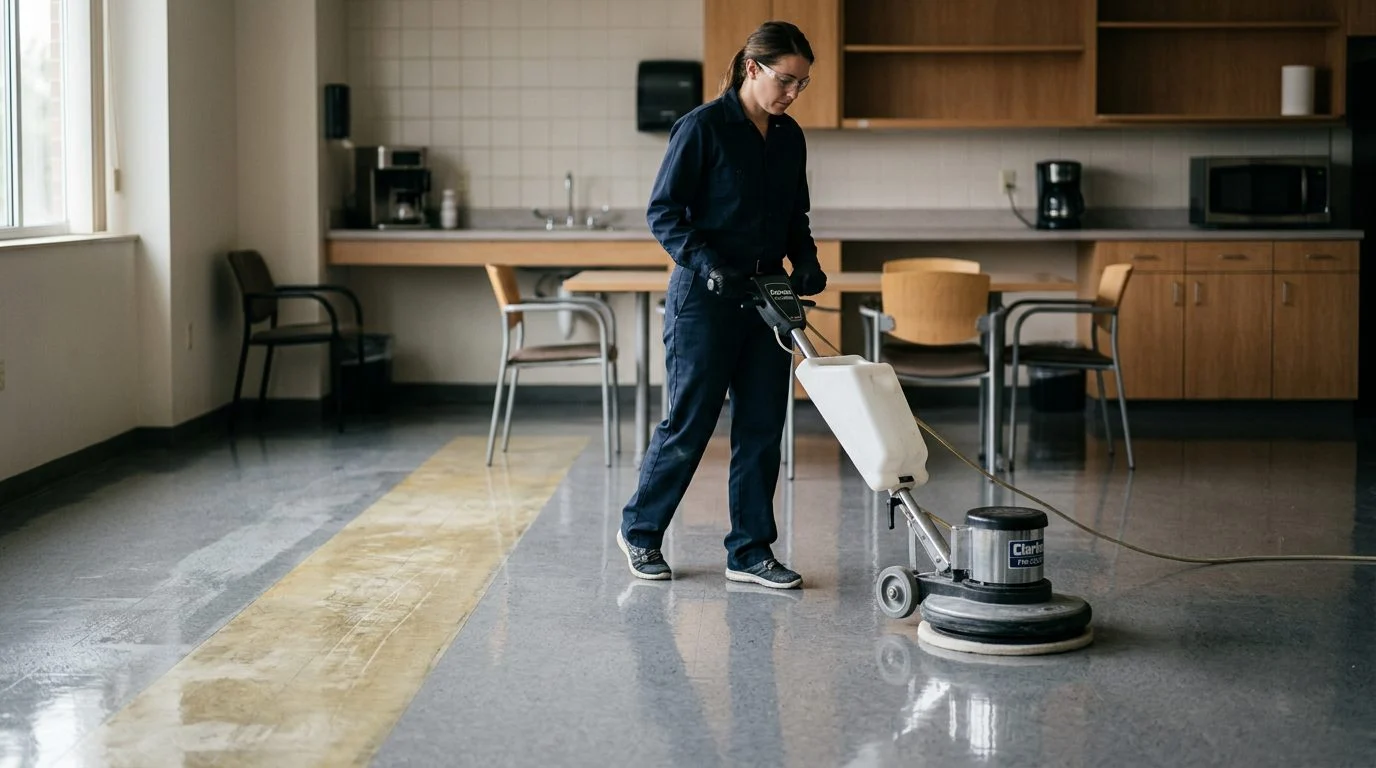
Floor Care Maintenance | South Florida Condos & Commercial Lobbies
Why Are Your Vinyl Lobby Floors Turning Yellow?
Yellowing vinyl is often a sign of sunlight, cleaning products, or buildup in the finish. Learn the common causes and how our team can help protect your floors.
By Ryan Jurney · Published November 4, 2026
Many managers ask, why are vinyl floors yellowing in a condo lobby? Usually the floor material, its finish, or something sitting on it has changed. Age, sunlight through glass, harsh cleaners, rubber mats, and buildup can each play a part. Often two or three of these act at once, so the first step is reading the pattern.
Why Lobby Vinyl Floors Yellow: The Main Causes
Lobby vinyl usually yellows because the material, its finish, or what sits on top of it has changed. It is rarely one single defect. A lobby gets heavy foot traffic, daylight, daily cleaning, and entry mats. Each can leave a mark over time.
Sheet vinyl and luxury vinyl plank (LVT) can both yellow. The pattern often differs, though. Sheet vinyl is one continuous piece, so discoloration tends to follow room shape, traffic lanes, or the glass. LVT is made of planks or tiles, so marks may follow a single plank, a seam, or the edge of a mat.
That is why you should look at the whole lobby before blaming one thing. A harsh cleaner may cause one problem while sun and mats cause another. Both can happen on the same floor.

Not sure what your next step is?
Talk it through with our team — the first consultation is free, confidential, and carries no obligation.
Age, Plasticizer Changes, and Sunlight Through Lobby Glass
Age and sunlight are two of the slowest causes of yellowing. Vinyl contains plasticizers and stabilizers, which are additives that keep it flexible and stable. Over years of use, these additives can change, and the surface can shift in color.
Sunlight is the more visible cause. Ultraviolet (UV) light from the sun can change the color of vinyl over time. Lobby windows, glass entry doors, and skylights let that light in. The yellow usually shows most on the part of the floor closest to the glass.
A simple check helps. If the yellow sits in a band near the windows while the back corners look normal, light is a likely factor. If the discoloration spreads evenly across the traffic path, look at buildup and cleaning first.
Harsh Cleaners and Chemical Reactions
Some cleaners can react with vinyl or its finish over time. Strong alkaline products, ammonia-based cleaners, and bleach-heavy solutions are the usual concerns. Using them often, or at full strength, raises the risk.
Residue is another problem. Stripping products that are not fully rinsed or neutralized can leave a film behind. That film can darken and turn yellow as it dries and builds up.
In busy buildings, several cleaning routines often overlap. One crew may use one product on Monday and another on Thursday. When products don’t match the floor’s finish, the reaction can build quietly.
Ask for each product’s label and data sheet so you know what is on the floor.
Rubber Mats, Rubber Feet, and Contact Staining
Rubber-backed entry mats can leave yellow or brown marks on vinyl. Rubber furniture feet and rubber casters can do the same. Where they touch the surface, the rubber can react with the vinyl and leave a tinted spot.
These marks have a clear shape. They look like the outline of a mat, the foot of a chair, or the path of a cart wheel. The floor around them may look normal. That shape is one of the most useful clues in diagnosis.
Contact staining also responds to change. Move the mat, bench, or cart, and the mark often stops growing. Some marks lighten once the object is moved and the area is cleaned. Deeper marks may need more work.
Have questions about what happened?
Ask our team directly. The first conversation is free, confidential, and there is no obligation to continue.
Yellow Buildup in the Finish and Embedded Soil
Floor finishes and sealers protect vinyl, but they can yellow with age. This is most common when many coats have gone on without stripping. Old finish can also trap dirt, so the whole floor can look dull and yellowed.
Embedded soil is a separate problem. Oils from shoes and hands, grime, and dust can work into the surface or sit under layers of buildup. From a distance, that soil looks like yellowing. It also dulls the sheen, so the floor looks tired even where the vinyl is fine.
A thorough deep clean helps sort this out. Once the soil and old finish come off, the true color of the vinyl is easier to see. If yellow remains, the cause is more likely in the vinyl itself or in a residue that needs a different product.
How to Tell Which Cause You Are Dealing With
Start with location and shape. Uniform dulling across traffic lanes usually points to finish buildup, soil, or general wear. Yellowing near windows or doors suggests light exposure. Clean outlines of mats, furniture, or casters suggest contact staining.
Texture gives another clue. Sticky, tacky, or sheen-changed patches may point to a product reaction or residue. These areas usually need a different approach than standard cleaning.
Jot down a few answers before you call anyone:
- Where is the yellow: traffic lanes, the glass side, or under mats?
- What shape does it take: broad, banded, or outlined?
- Does it feel sticky, or does the sheen look different?
- Did a cleaning or stripping routine change recently?
These answers narrow the field. A professional floor assessment confirms which combination of causes applies to a specific lobby. Our team can look at the floor in person and check the finish.
Can Yellowed Vinyl Be Brought Back?
Often, cleaning helps. Cleaning and stripping can lift yellow buildup and soil, and that can change the floor’s look a lot. A dull or yellow finish may look cleaner once old layers are removed and fresh coats are applied.
Discoloration inside the vinyl is harder. Light exposure and chemical reactions can change the surface itself. Whether a given discoloration lifts fully depends on the facts: the cause, how long it has been there, and the floor type.
Common options include deep cleaning, stripping and recoating, and, in some cases, replacing damaged sections. The right choice follows from the assessment. An assessment can point to the likely layer and cause. It cannot promise that every mark will lift, because some discoloration sits in the vinyl itself.
Preventing Yellowing in a Condo Lobby
Prevention comes down to four habits. Match entry matting to the floor. Choose cleaning products that suit the floor type. Limit direct sun where possible. Keep a steady floor care schedule.
Matting matters most. Use entry mats that are appropriate for vinyl, and check them often for backing residue. Move mats now and then so the same spot does not sit under the same weight for months.
Sun is the next factor. Reducing direct sun exposure on the floor can lower how much UV it receives. Ask which lobby windows get the most direct sun, and plan treatment around those areas.
Daily care counts too. Quick spill response also keeps residue from sitting on the surface.
Standards help with routines. The ISSA cleaning management standard addresses management principles for cleaning operations, such as quality systems, service delivery, human resources, and health and safety. When you check a disinfectant, look at its label claims. EPA’s list of selected disinfectants organizes registered disinfectants by pathogen or use, such as List N and List K.
Want to know where you stand?
Tell us what happened and our team will walk you through the options available to you, at no cost.
Contact Us About Lobby Floor Care
If your lobby floor has turned yellow or patchy, a floor assessment is the practical next step.
Common Questions
Why are vinyl floors yellowing in a condo lobby?
Usually because of age, sunlight through glass, harsh cleaners, rubber mats, or buildup in the finish. Two or more causes often act together.
Can sunlight yellow vinyl floors?
Yes. UV light through windows and doors can change vinyl’s color over time, most near the glass.
Can yellowed vinyl be cleaned?
Often, at least in part. Stripping can lift buildup and soil, but discoloration inside the vinyl may remain.
If your board is asking what caused the yellowing and what to do next, contact Gator Protection, Inc. through our contact form, by calling our office, or by requesting a quote. We can set up a floor assessment of the lobby. The first consultation is a free initial consultation that is confidential and comes with no obligation to continue (consulta inicial gratuita, confidencial y sin compromiso).
Common Causes of Yellowing Vinyl
Sunlight Through Glass
UV light entering through windows and doors can change vinyl's color over time, especially in spots closest to the glass.
Harsh or Incorrect Cleaners
Some strong cleaning products can react with vinyl and leave a yellowed or dull look that is hard to reverse with routine mopping.
Rubber Mats and Backings
Rubber-backed mats and some floor protectors can transfer color to vinyl when they sit in one place for long periods.
Buildup in the Finish
Layers of old wax, grime, and residue can trap dirt and cause a yellow, cloudy appearance across high-traffic areas.
A Quick Tip for Building Managers
Yellowing often has more than one cause. Avoid switching to strong household cleaners on vinyl floors, and have a maintenance plan that matches the floor type and the lobby's traffic and sun exposure.
Why Property Managers Work With Gator Protection
Floor Care Maintenance
Routine cleaning and finish care planned around the traffic and sun exposure of your lobby and common areas.
Scheduled Service
Regular visits that fit your building's hours so floors stay consistent without disrupting residents or tenants.
Dedicated Support Staff
Our team coordinates scheduling, service details, and follow-up so your property stays on track.
Serving South Florida
Condos and commercial properties across Miami-Dade, Broward, and Palm Beach counties, including South Beach, Coral Gables, and Brickell.
Not Sure What's Causing the Yellowing?
Start With a Free First Consultation. It's Confidential and There's No Obligation to Continue.