
Floor Care Maintenance in Miami
Schedule Floor Stripping in Your Miami Apartment Building with a Clear Plan
Tell us about your floors, your building, and your access needs, and we will help you map out a schedule that works for property managers and residents alike.
Why Plan Floor Stripping with Gator Protection
Zone-Based Planning
Work is organized into zones so the rest of the building stays accessible while one area is being serviced.
Scheduling Around Your Building
We coordinate timing with property management and the daily routines of residents.
Coordinated Team
Our team keeps communication open with building staff from scheduling through completion.
Free First Consultation
The initial consultation is free, confidential, and carries no obligation to continue.
By Ryan Jurney · Published November 18, 2026
If you manage an occupied apartment building in Miami, the main worry is simple. Residents still need to reach their doors, the stairwell, and the exit while the hallway is being stripped.
The short answer: split the corridor into work zones, strip in low-traffic hours, build in drying time for each zone, and tell residents before the work starts. A clear floor stripping schedule for an apartment corridor in Miami keeps at least one open route to every unit.
Why Floor Stripping Can Block an Occupied Corridor
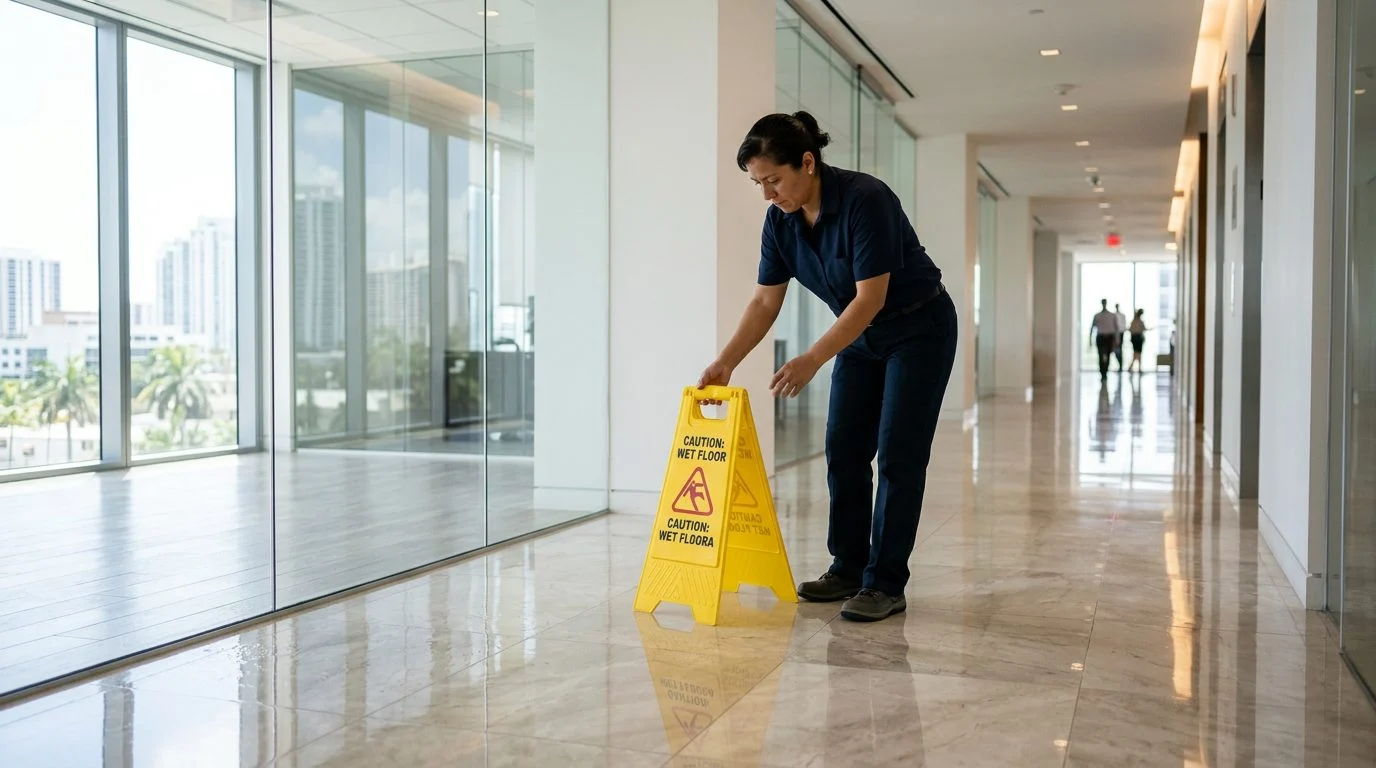
Floor stripping blocks a corridor because the new finish has to dry before people can safely walk on it.
Stripping removes old wax and finish from the floor. The crew then rinses the surface and lets it dry. New finish goes on in coats, and each coat needs time before the next one. A wet surface is a slip hazard.
Keeping floors clean and dry is a practical way to help reduce slipping risks in busy commercial spaces. Florida law also sets a landlord duty. Under Fla. Stat. § 83.51, a landlord of an apartment building other than a single-family home or duplex must make reasonable provisions for clean and safe common areas, unless the parties agree otherwise in writing.
The real scheduling problem is access. A corridor can be clean and dry and still trap a resident if the path to their door is closed. For the full scope of this work, see floor care maintenance in Miami-Dade.
If you manage an occupied Miami building and worry that stripping will trap residents behind wet floors, our team can talk through your corridor with you. Talk it through with our team — the first consultation is free, confidential, and carries no obligation.
Divide the Corridor into Work Zones
Split the hallway into short sections, and close only the section being worked.
Each zone should have a clear path to the unit doors on both sides and to the stairwell or elevator. Walk the corridor before work starts. Mark where each zone begins and ends with tape or cones, so the boundary is visible at a glance.
Keep at least one open route to every unit at all times. A zone’s wet finish should never sit between a resident and the stairwell. Plan the order of zones so the path out always runs through a dry, open section.
A common mistake is closing the whole hall for one day to save crew time. That shuts every door at once and turns a manageable job into a complaint. Short zones take more setup, but they keep the building in use.
Write the zone map down and share it with the building manager. A simple floor plan with numbered zones works well.
Choose a Low-Traffic Work Window
Schedule stripping in the hours when the fewest residents use the corridor, and confirm that window with building management in advance.
Look at when people leave for work, when deliveries arrive, and when move-ins or move-outs happen. Those events change the traffic pattern. A quiet weekday morning may not be quiet on a moving day.
Check building rules before you book. Confirm access agreements, elevator reservations, and any loading-dock times that apply to your Miami-Dade property. Find out who controls the stairwell door keys so the crew can reach each zone.
Build drying time into the window. A zone that reopens early can scuff, and a scuffed finish can mean another pass. Leave a buffer so a slow zone does not push work into the next day’s traffic. Plan the window around the zone that needs the most time, not the shortest one.
Sequence Stripping, Rinsing, Drying, and Finish Coats
The usual order is strip, rinse, dry, then apply finish coats, letting each coat dry before the next.
Stripping lifts the old finish. Rinsing removes the stripper and any residue. Skipping this step leaves residue that can cause an uneven finish or a slippery spot.
Cleaning chemicals need care. The EPA Safer Choice program lists floor-stripper and floor-finish products that have earned its certification.
Floor finish that looks dull or yellow after cleaning often has buildup under it. The guide on why VCT floors look dull explains the cause.
Entrances need planning too. Pressure washing or landscape work near doors puts wet surfaces and foot traffic where the corridor crew needs to work. Schedule exterior work on a different day or hour.
Notify Residents and Keep Access Clear
Give residents written notice with the dates, the zone, the hours, and one contact person, several days before work starts.
A notice that says only “floor work this week” leaves residents guessing. Name the hallway section, the start and end times, and the expected reopening time. Post it at the stairwell landing and at each unit door in the affected zone.
Put wet-floor warnings at each zone boundary and at the stairwell landing. Keep fire exit and stairwell routes free of equipment, buckets, and drying material at all times.
Name one contact person for questions during the work. That gives residents one place to ask. If residents read Spanish, post the notice in Spanish too.
Signs a Schedule Needs Review Mid-Project
Review the schedule as soon as residents cannot reach their doors or a zone dries more slowly than planned.
Other warning signs matter too. Residue, a slip risk, or an uneven finish in a section already worked means that section needs attention before the next zone starts.
Humidity and weather can slow drying. When a zone is still tacky at its planned reopening time, move the later zones to a different day rather than rushing the crew.
Building events change the traffic pattern. Deliveries, move-ins, move-outs, and maintenance visits can put people in the hall at the hour you planned to close a zone.
A mid-project change is ordinary planning, and it protects residents’ access. Write down what changed and the new dates. Then send the updated notice before the next zone starts.
Not sure what your next step is?
Talk it through with our team — the first consultation is free, confidential, and carries no obligation.
Questions to Settle Before the Work Starts
Settle the access rules, the approver, the drying plan, and the floor type before the crew arrives.
- Which corridor sections, stairwells, and elevators must stay open, and during which hours?
- Who approves the schedule, and who answers resident questions during the work?
- How much drying time does each zone get, and what happens if a zone runs behind?
- Is the floor VCT (vinyl composition tile) or another surface? The floor type changes how the stripping and finish steps are sequenced.
Get written answers to these questions before the crew starts. Written answers leave less room for confusion later.
Frequently Asked Questions
Can residents still reach their units during floor stripping?
A zone-based plan is built to keep a clear route to every unit, the stairwell, and any required exit. Only the active zone is closed at a time.
Why does VCT look dull after cleaning?
Buildup can cause a dull or yellow look. The dull VCT floor guide explains how.
Talk Through Your Corridor’s Schedule with Our Team
If you are planning floor stripping for an occupied Miami building, our team can help you map the zones, hours, and drying time.
Gator Protection, Inc. provides commercial janitorial and commercial landscape maintenance across South Florida and parts of Atlanta, Georgia. Our services include floor care maintenance, pressure washing, day porter service, and landscape services. We serve Miami-Dade County, Broward County, and Palm Beach County, as part of our work across South Florida.
La consulta inicial es gratuita, confidencial y sin compromiso de continuar.
If stripping is on your calendar and you’re worried residents will be cut off from their doors, describe your corridor layout, traffic hours, and floor type to us through our contact form.
Share Access Details Early
Before work begins, share your floor types, building layout, and access schedule with us. Clear information makes it easier to plan a route to every unit, the stairwell, and any required exit.
How to Schedule Floor Stripping
1. Contact Us
Reach out by form or phone to describe your building and the areas that need floor stripping.
2. Review the Floors
We look at the floor type and condition so the approach matches the surface.
3. Build a Zone Plan
The work is divided into zones, with clear routes kept open for residents and exits.
4. Confirm the Schedule
We agree on timing with property management and confirm the plan before work begins.