
Corporate Landscape Maintenance | South Florida
Write a Landscape RFP That Produces Bids You Can Compare
A clear scope, defined visit schedules, and a consistent pricing format let every bidder quote the same work.
By Ryan Jurney · Published November 23, 2026
If your corporate office is about to issue a landscape maintenance RFP, you need a written scope that every bidder prices the same way.
A strong RFP names the scope, visit frequency, storm response, pricing structure, insurance, and reporting in plain terms.
What a Corporate Landscape Maintenance RFP Covers and Who Writes It
A landscape maintenance RFP, or request for proposal, is the written document that sets the work a vendor must price and perform. Procurement teams, facilities managers, and office administrators usually write it for corporate sites in Miami-Dade, Broward, and Palm Beach counties. Many sites bundle more than one service into the same request. Common lines include landscape services, irrigation maintenance, pressure washing, and day porter service.
A vague RFP produces bids that can’t be compared. One vendor may skip irrigation. Another may leave out debris removal. The lowest total may simply hide the biggest gaps. The sections below list what to write in so the bids match.
If your corporate office is preparing a landscape maintenance RFP or renewing a contract, send us your site details and we'll review the scope with you. Talk it through with our team — the first consultation is free, confidential, and carries no obligation.
Scope Requirements: What the RFP Must Spell Out
The scope should name every zone on the property and the work the vendor does in each one. Include these details:
- Site map: each zone labeled, such as turf, planting beds, palms and trees, hardscape, parking edges, and entries.
- Mowing: cut height, mowing pattern, and how clippings are handled.
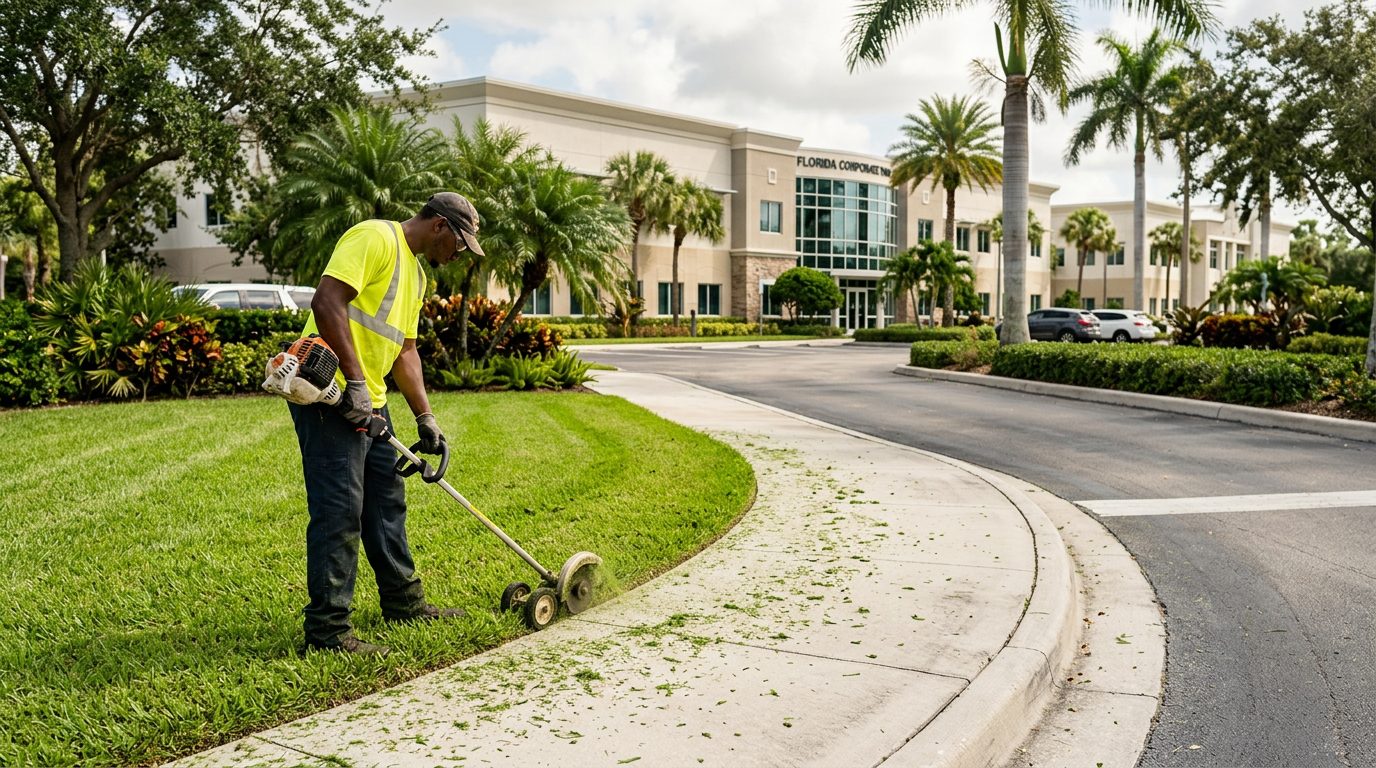
- Edging and beds: edge lines along walks, curbs, and beds, plus weeding and mulch touch-up.
- Irrigation: whether the vendor inspects zones and controllers, checks heads, reports leaks, and who pays for parts.
- Pressure washing: which surfaces are covered, how often, and whether it is priced on its own line.
- Exclusions: anything the vendor will not do, written out, so no bidder assumes extra work is included.
Watering schedules for landscaped areas can vary by property, so our team can discuss your site’s needs during a consultation. The FDEP water conservation pages cover landscape irrigation restrictions and reclaimed-water use.
Sites near the beach, including South Beach properties, need one more check. Dune areas and native plants call for careful planning, and our team can talk through your property’s specific conditions with you.
Schedule, Frequency, and Response Times to Require
Every service in the RFP should carry a fixed number of visits per month. Open-ended terms like “as needed” give the client no way to check performance. Ask for these terms:
- Visit counts: a monthly count for each service, such as more mowing visits in the peak growing season than edging visits.
- Seasonal change: how counts shift during South Florida’s wet season and drier months.
- Response time: a set number of business hours to answer a reported problem.
- Closures: how holiday and office-closure weeks are scheduled, and how make-up visits work.
- Written schedule: delivered before the contract starts and updated whenever the site changes.
Storm and Debris Response Requirements
Storm cleanup should be its own defined service, with a response window written into the RFP. Otherwise, the vendor decides what counts as storm work after the fact. Specify:
- Inspection: a post-storm walk of the property and debris clearing within the stated window.
- Debris scope: who clears fallen limbs, palm fronds, and storm debris from walks, lots, and entries, and whether that work sits inside the monthly price.
- Documentation: photos or a written log before and after each response.
Walkways and entries need clear, dry footing. Ask bidders how they will clear those surfaces first after a storm.
Pricing Structure and Lease Cost Allocation
The RFP should ask for a base monthly price for each service line, plus unit rates for extra work. Separate lines show exactly what each bidder includes. Require these details:
- Line items: landscape, irrigation, pressure washing, and debris removal each priced separately.
- Inclusions: whether labor, equipment, fuel, disposal, and materials are in each price.
- Add-ons: a unit-rate schedule for extra pressure washing or additional debris removal.
- Escalation: whether prices can change over a multi-year term, and how much notice is required.
Two more points matter. Edging frequency changes the monthly total, so state it. Also confirm in the RFP whether the tenant or the property owner pays for landscape work. The lease sets that, so check its terms before bids go out.
Insurance, Staffing, and Reporting: Evaluating the Responses
A complete bid includes a current certificate of insurance and a clear reporting plan. Score every bid on the same criteria: price, scope fit, response time, insurance, and reporting. Check these items:
- Insurance: a certificate naming your organization, with general liability and workers’ compensation limits stated in the RFP.
- Workers’ compensation: Florida law requires an employer with employees working in Florida to hold a Florida policy or endorsement, per Fla. Stat. § 440.10.
- Subcontractors: if the vendor sublets part of the work, the contractor is liable for the subcontractor’s employees on that work, unless the subcontractor has secured the coverage. Ask for proof for each subcontractor.
- E-Verify on public work: if a public agency issues the RFP, Fla. Stat. § 448.095 requires each contractor and subcontractor to register with and use E-Verify before a contract can be signed.
- Staffing: who supervises the crew on site, who the account contact is, and how crew changes are communicated.
- Reporting: visit logs, service records, and a monthly walk-through or summary the client can review.
Not sure what your next step is?
Talk it through with our team — the first consultation is free, confidential, and carries no obligation.
Why Work With Gator Protection, Inc.
Gator Protection, Inc. provides commercial landscape services, pressure washing, floor care maintenance, and day porter service throughout South Florida. If your site needs more than one of these, list each line in the RFP so every bidder prices it the same way.
Our team works from the scope your RFP sets. Our proposal follows that scope line by line, including the site map, visit counts, storm response, and pricing lines. Our team includes assistants and office staff, so your questions have a direct point of contact.
Frequently Asked Questions About Landscape Maintenance RFPs
Should the RFP include irrigation maintenance?
Yes. Name it in the scope or as a separately priced line, so every bidder prices the same work.
How specific does visit frequency need to be?
State visits per month for each service, plus how that count changes by season. Avoid open-ended terms like “as needed.”
Can pressure washing sit in the same contract?
Yes. Price it as its own line, and list the surfaces and the frequency.
What training do fertilizer applicators need in Florida?
Ask bidders to show proof of that training with the proposal.
What should a bidder submit with the proposal?
A certificate of insurance, a written schedule, a pricing breakdown, and the staffing and reporting approach.
What does the first step with Gator Protection involve?
The first step is a conversation about your site, your current scope, and what your RFP should require.

Next Step: Send Us Your Site Details
If your corporate office has an RFP to issue, or a landscape contract that needs a clearer scope before renewal, send us the site address, the current scope, and your RFP deadline. You can fill out the contact form or call our team.
La consulta inicial es gratuita, confidencial y sin compromiso de continuar. (The initial consultation is free, confidential, and carries no obligation to continue.)
What to Put in Your Landscape RFP
A Written Scope of Work
List every area, bed, and feature to be maintained so each bidder prices the same property.
Visit Frequency by Service
State the number of visits per month for each service and how that count changes across the year.
A Standard Pricing Format
Request line-item pricing so you can compare monthly costs and add-on services side by side.
Clear Service Standards
Describe the condition the property should be in after each visit, so quality can be checked consistently.
Avoid Open-Ended Terms
Phrases like "as needed" or "when required" leave visit counts and costs undefined. Replace them with specific frequencies, triggers, and approval steps.
Key Sections of a Commercial Landscape RFP
Scope and Included Services
Define mowing, edging, pruning, irrigation checks, and any seasonal work, and state whether each item is included or priced separately.
Seasonal Adjustments
Explain how service levels change during the rainy season and dry months so bidders account for those shifts.
Site Access and Conditions
Share site maps, access hours, and any restricted areas so every bid reflects the actual property.
Reporting and Communication
Specify how visits are logged, how issues are reported, and who receives updates on the property.