
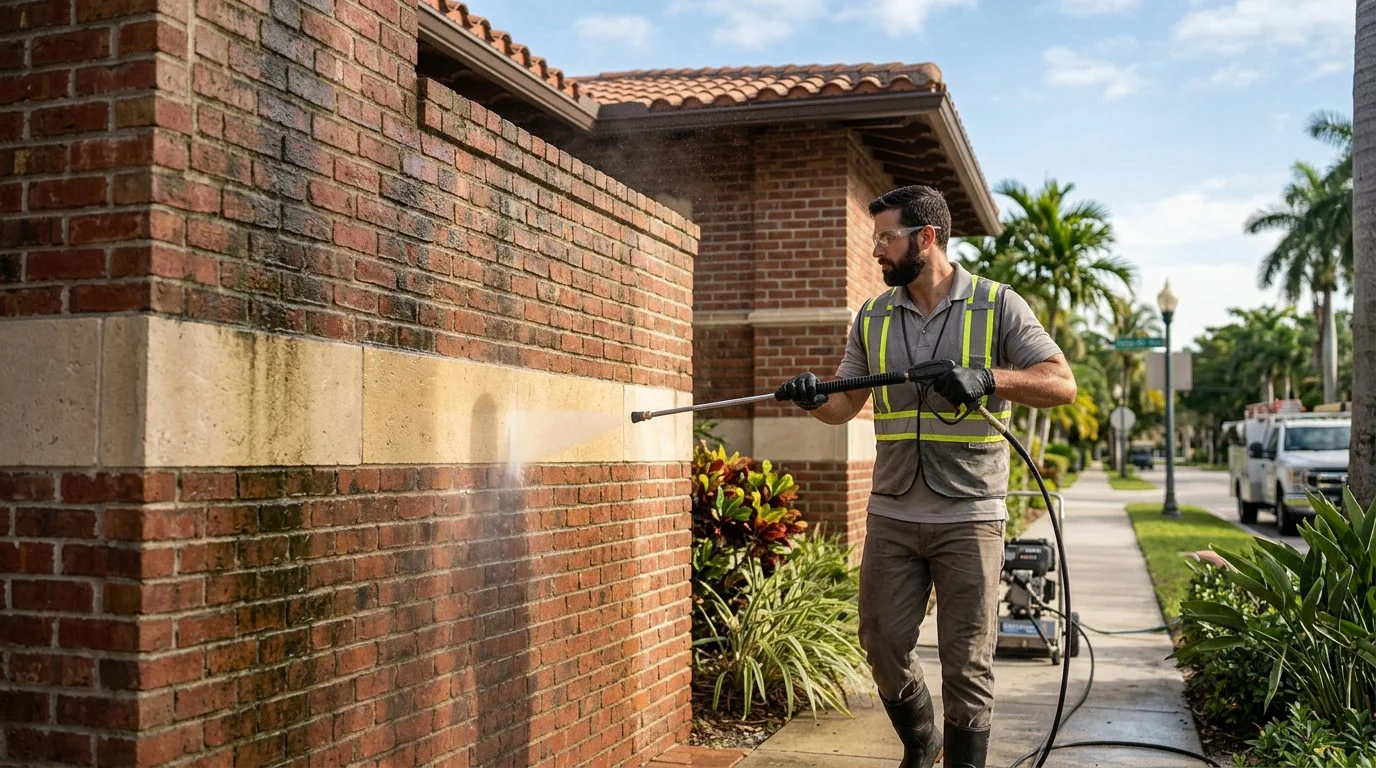
Pressure Washing · Commercial Offices · South Florida
Pressure Washing Contractor COI for a Corporate Office?
A few questions to ask before the crew arrives, and how we handle paperwork for commercial clients across Miami-Dade, Broward, and Palm Beach counties.
By Ryan Jurney · Published November 24, 2026
Your office has a pressure washing proposal in hand, and the vendor’s insurance paperwork is still missing. Before you approve anything, you need to know what that paperwork should show.
A corporate office should ask for a current certificate of insurance (COI) showing commercial general liability, workers’ compensation, and commercial auto coverage. The office should be listed as certificate holder, and as additional insured when your agreement requires it.
What Certificate of Insurance Should a Pressure Washing Contractor Show a Corporate Office?
A corporate office should expect a certificate that shows three core lines: commercial general liability, workers’ compensation, and commercial auto liability. Each line should list an insurer, a policy number, and policy dates that cover the work.
A certificate is a summary. It shows which policies exist and when they run. It doesn’t change the policies, so the policy terms still control what’s covered.
Your lease or service agreement sets the required limits and any special endorsements. Compare the certificate against those documents line by line. If they don’t match, ask the vendor to correct the certificate before work starts.
Ask for the certificate in writing before you sign. Check it at signing, again at each renewal, and whenever the scope of work changes.
This guide is for procurement and facilities teams approving a pressure washing vendor for exterior walkways, parking garages, entrances, and building surfaces.
Commercial General Liability: The Core Coverage for Pressure Washing Work
Commercial general liability (CGL) covers third-party bodily injury and property damage tied to the contractor’s work. For pressure washing, it’s the line that matters most.
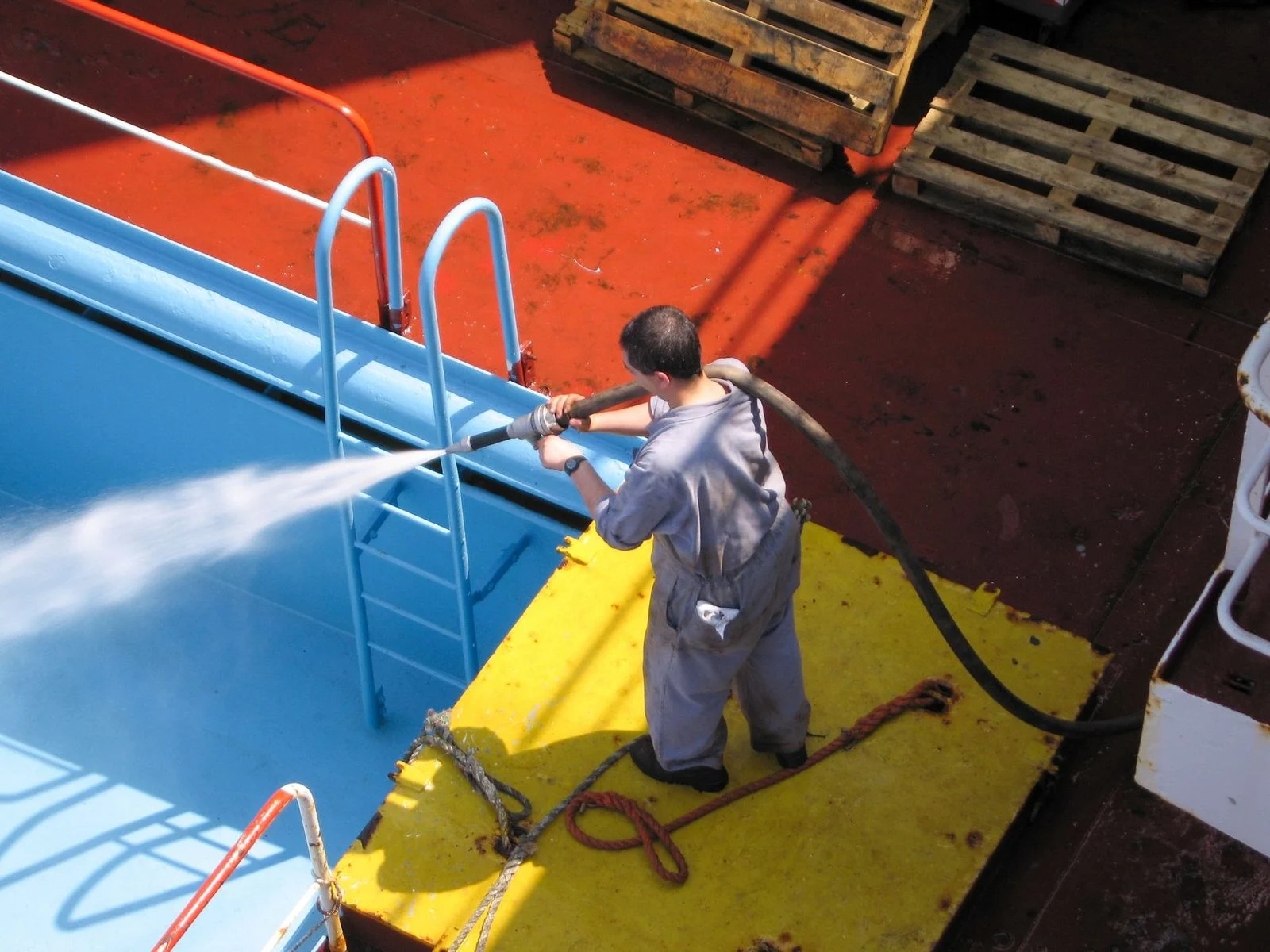
High-pressure water can break window seals, strip paint, and damage signs, vehicles, and landscaping near the work zone. Wet walkways and loading docks can also cause slips and falls.
Two details are easy to miss. First, completed operations coverage matters because damage sometimes shows up after the crew leaves. Confirm the certificate or policy lists it. If the certificate leaves any doubt, ask for the policy’s declarations page.
Second, cleaning agents and wash water need attention. The South Florida Water Management District states that polluted runoff entering South Florida storm drains is discharged untreated into connected water bodies. Ask how the vendor handles wash water and chemicals, and whether your agreement requires pollution coverage.
Ask how the crew manages wet surfaces during service hours.
Workers’ Compensation and Employer’s Liability
Workers’ compensation should appear on the certificate for every crew member who works on your property. The Florida Office of Insurance Regulation states that Florida employers, including applicable vendors or contractors, generally must carry workers’ compensation insurance.
The Florida Division of Workers’ Compensation says a contractor must require its subcontractors to provide evidence of workers’ compensation insurance.
If the vendor uses subcontractors, ask for proof for them too. Under Fla. Stat. § 440.10, a contractor shall require a subcontractor to provide evidence of workers’ compensation insurance.
Why does this matter? Under Fla. Stat. § 440.11, if an employer fails to secure payment of compensation, an injured employee may choose to claim compensation or to sue for damages.
Employer’s liability is a separate part of many workers’ compensation policies. It can respond to certain claims that the workers’ compensation part does not cover. Check that it appears on the certificate.
Finally, confirm the certificate shows the policy period. It should cover the full service term, not only the day the paperwork was signed.
Commercial Auto Liability for Service Vehicles and Equipment
Commercial auto liability should appear on the certificate whenever a vehicle is used for the work. That includes trucks that carry pressure washing units, water tanks, and hoses.
Vehicles often sit in loading zones, parking structures, and drive lanes during exterior cleaning. A truck that blocks a drive lane or backs into a parked car is a business vehicle issue.
Personal auto policies are usually written for personal use. They may not respond to a work vehicle, so the certificate should show a commercial auto line.
Ask two questions. Which vehicles does the commercial auto line cover? And are crew members hauling equipment in their own cars? If so, ask how that is insured.
Ask how trailers and equipment racks are secured and insured when they travel between sites.
Additional Insured, Certificate Holder, and Waiver of Subrogation Wording
The certificate holder is the party that receives the certificate. That’s usually the property owner, management company, or corporate tenant. Confirm the name matches the entity on your lease.
Additional insured status lets your office be covered under the contractor’s liability policy for claims arising from that contractor’s work. It applies only when the policy includes that endorsement.
A note on the certificate that says “additional insured” isn’t enough on its own. Ask for the endorsement itself.
Waiver of subrogation means the insurer agrees not to pursue the named party for losses it would otherwise recover from the contractor. Your agreement will say whether you need it.
A certificate doesn’t change the policy. The endorsements in the policy control what is covered, so ask that they be attached or referenced on the certificate. Ask the vendor to confirm these wordings in writing before the contract is signed.
Limits, Policy Periods, and What the Lease or Contract Requires
Required limits come from your lease, master service agreement, or purchase order. Compare the certificate’s limits against those figures before you approve the vendor.
Two limit types appear on most certificates. Per-occurrence limits cap payment for a single claim. Aggregate limits cap payment for all claims within a policy period.
Next, check dates. Every policy listed should have an effective date and an expiration date that cover your scheduled service dates.
Compare those dates against your calendar, not just the certificate’s issue date. A certificate issued last month can still show a policy that expires before your contract does.
If a policy expires mid-contract, note the renewal date. Request an updated certificate when it renews.
Keep a dated copy in your vendor file, with the date you received it. A dated file makes the next review faster for your team. If the limits fall short of your contract, don’t approve the vendor until a corrected certificate arrives.
Not sure what your next step is?
Talk it through with our team — the first consultation is free, confidential, and carries no obligation.
Gator Protection’s Services and Certificate Requests at Onboarding
Gator Protection offers commercial pressure washing in South Florida and parts of Atlanta, Georgia. Its other services are day porter service, floor care maintenance, and landscape services.
The business serves South Florida, including Miami-Dade, Broward, and Palm Beach counties.
Pressure washing covers the surfaces most corporate sites need cleaned, such as exterior walkways, entrances, garages, and building surfaces. Confirm which scopes your agreement includes so the insurance review matches the work.
Gator Protection’s pressure washing work is one of four offerings. If your building also needs floor care maintenance or landscape upkeep, ask the vendor to show which policies cover each scope.
At onboarding, raise your certificate holder name, additional insured wording, and any required endorsements. Raising them early gives your team time to review the paperwork before the first service date.

Request a Quote for Your Property
Your facilities or procurement team may be weighing a pressure washing proposal for a corporate building, lot, or walkway. Until the certificate, endorsements, and policy dates match your agreement, the vendor isn’t ready to start.
Gathering your lease, the agreement draft, and the site scope when you contact our team makes the review faster.
Does a pressure washing contractor need workers’ compensation in Florida?
Yes. Florida employers generally must carry workers’ compensation insurance, including applicable vendors or contractors.
What is additional insured status?
It lets your office be covered under the contractor’s liability policy for claims from that contractor’s work, when the policy includes the endorsement.
Does a certificate change the policy?
No. A certificate summarizes coverage, and the policy and its endorsements control what is covered.
La consulta inicial es gratuita, confidencial y sin compromiso de continuar. (The initial consultation is free, confidential, and carries no obligation to continue.)
If your office is still waiting on a vendor’s certificate, request a quote from Gator Protection and ask how the certificate will be handled at onboarding.
What to Check on a Contractor's Certificate
Named policy details
Confirm the insured name, policy number, and coverage types listed on the certificate match the company that will be on your property.
Coverage dates
Make sure the policy is active on the days the work is scheduled, not only on the date the certificate was issued.
Liability and workers' compensation
Review both lines of coverage so you know who is protected if equipment damages property or a worker is injured on site.
Additional insured wording
Ask whether your office is named as an additional insured and read the endorsement language, not just the summary box.
Don't Sign Off Before Reviewing the Paperwork
Request the certificate before work begins, and hold the schedule until you have read it. Certificates are summaries, so the policy endorsements and coverage limits are what count.
How We Support Commercial Clients
Pressure washing for corporate sites
Exterior walkways, entrances, parking structures, and building façades cleaned on a schedule that fits your office hours.
Documentation for your records
We help you organize the details your facilities or risk team typically asks for, so your file is complete before work starts.