
Day Porter Service | Miami-Dade & Broward
Day Porter Uniforms and ID Badges, Handled to Fit Your Condo's Rules
Gator Protection, Inc. helps condo associations and property managers in South Florida keep day porter staff in the right uniforms and ID badges, with clear access for every shift.
By Ryan Jurney · Published November 5, 2026
Day porters usually wear a uniform and carry some form of identification, but no single rule applies to every building. Whether they must is set by the condo’s own governing documents and the day porter service agreement. It separates three questions that often get mixed together: what staff wear, how they are identified, and who controls entry to the building.
Each question has its own paper trail. Check each one separately and write the answers down before work begins. Gator Protection, Inc. provides day porter service across South Florida. This page explains the checks a board, manager, or owner can make on their own.
Why this question comes up for condo boards and managers
Most questions about uniforms, badges, and access come up at one of three moments. A board is reviewing a new day porter contract. A manager is handling resident complaints about staff they do not recognize. Or an owner who lives elsewhere wants to know who controls the building.
Each reader needs a different answer. A board needs terms it can approve and enforce. A manager needs a clear rule to point to when a resident asks questions. An owner needs to know who holds access to shared areas. Many buildings have none of these answers written down.
Start with the question you face today. A board drafting terms needs the contract section. A manager with complaints needs the building’s rules. An owner needs the access policy. Expect a multi-part answer, because uniforms, badges, and access are related but separate. This page explains how each is usually decided and documented. It does not give one universal rule, since each building’s documents differ.
If you are reviewing a day porter arrangement for a building you manage or live in, our team can help you sort out the uniform, badge, and access questions. Talk it through with our team — the first consultation is free, confidential, and carries no obligation.

What uniforms and ID badges do for a residential building
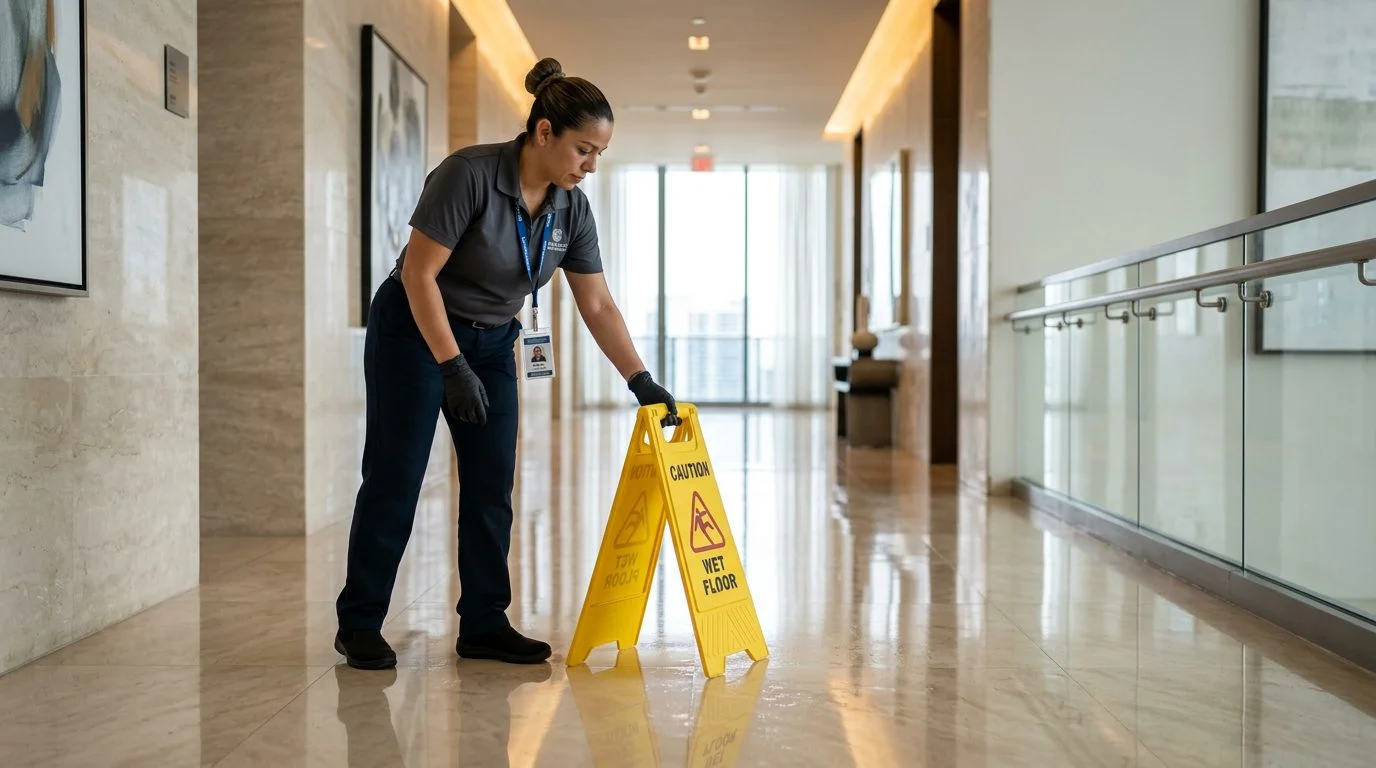
Uniforms and visible identification help residents and visitors tell day porters apart from unknown people in shared areas. That is the main practical value, and it is simple to state.
Badges also support a sign-in routine. When staff wear a visible badge with a name and employer, a resident who sees someone in the lobby at an odd hour has a quick way to check. Building staff can also confirm who is working in the building at a given time.
The value depends on consistent use. A badge left in a locker does nothing. A uniform rule that nobody enforces gives residents no clear signal. Common mistakes include writing a badge rule with no one responsible for checking it, and issuing badges with no record of who holds each one.
Keep the rule simple. Decide what is worn, where it is worn, and who checks it. A short written standard is more useful than a long policy nobody reads.
Where the rules actually come from
The rules usually live in three places: the condo’s governing documents, the association’s rules, and the day porter service agreement. Check them in that order, and note which document answers each question.
Florida law sets the basic framework. Under Fla. Stat. § 718.112, the operation of a condominium association is governed by its articles of incorporation, if it is incorporated, and by its bylaws. The bylaws are included as exhibits to the recorded declaration. Start there when you look for who has authority over building operations.
The association’s official records are another useful source.
The service agreement is the most direct document. Look for uniform terms, identification terms, conduct rules, who supplies items, and how replacements are handled. If the building uses a community association manager, that manager’s duties also matter. Under Fla. Stat. § 468.4334, a community association manager must discharge duties on the association’s behalf loyally, skillfully, and diligently, with care and full disclosure.
Separating entry authority from possession of a key
Entry authority is the permission to go somewhere. A key, fob, or entry code is only the tool that carries that permission. Decide the authority first, then issue the tool.
In a building, the question of who grants entry should be answered in writing.
A common mistake is giving a shared code to many people with no list of who has it. When someone leaves the job, the code stays active. A better practice ties access to a named role, a set schedule, and a written record of when each key, fob, or code was issued and returned.
Once the board or manager decides who may enter a space, the rest is simple. The authority sets the list. The key, fob, or code only follows the list.
Access routines that keep the building traceable
A sign-in and sign-out routine shows who entered the building, when, and for what purpose. That record helps with security questions, resident complaints, and proof of completed work.
Set the routine for three cases: after-hours entry, work in restricted areas, and visitors who are not staff. Keep the log in one place. A written daily work log can tie each entry to the tasks completed, so the building has a clear record of each day.
Plan for emergencies too. A power outage or water shutoff can change who needs to reach a room and how. The access routine should say who may enter during an emergency and how staff check in while they work.
Questions to settle in writing before work begins
Put each answer into the contract or the building’s written rules before the first shift starts. Florida’s Supreme Court holds that even an oral contract must meet the basic requirements of contract law. Those include offer, acceptance, consideration, and sufficient specification of essential terms. Vague talk about uniforms and keys is a weak foundation.
- Uniforms: What is worn? Who supplies it? How is it cleaned or replaced? Is it required in every common area?
- Badges: Who issues them? What do they show? How is a lost badge reported? When are badges returned at the end of an assignment?
- Access: Which doors, fobs, or codes are granted? How are codes changed? Who approves exceptions?
- Insurance and responsibility: What coverage does the contractor carry? How are incidents reported? Who pays for damage or lost access items?
Each answer should name a role, not a person’s private habit.
Common questions
Do day porters have to wear uniforms in a condo?
The building’s rules and the day porter agreement set this. Check both before the first shift.
Who decides which staff can enter common areas?
The governing documents and access policy usually answer this.
What happens if a badge is lost?
The service agreement should say how the loss is reported and how a replacement is issued.
Not sure what your next step is?
Talk it through with our team — the first consultation is free, confidential, and carries no obligation.

Bringing your building’s access questions to our team
If you are working through these questions for a building, our team can help you talk them through. You might be a board member drafting a day porter contract. You might be a manager who inherited an access policy nobody wrote down. You might be an owner who wants to know who holds keys to shared areas and to your unit.
Reach out through the contact form, by calling our office, or by requesting a free quote. Your first consultation is free, confidential, and comes with no obligation to continue.
What We Plan Around Before Day One
Review the Governing Documents
Building rules, the declaration, and the day porter agreement often set the uniform and badge requirements, so we start there.
Confirm Who Can Enter Common Areas
Access policies differ from building to building. We align our staff's entry permissions with what the property has approved.
Coordinate With Building Management
Clear communication with the property manager and residents helps badge and uniform standards stay consistent over time.
Keep Staff Ready for Each Shift
Our team keeps uniforms clean and presentable and makes sure each porter carries the correct ID badge.
Check Before the First Shift
Review the building's rules and your day porter agreement before the first shift. Badge and uniform requirements should be settled in writing, not left to memory.
Common Questions About Uniforms and Badges
Do day porters need to wear uniforms?
The building's rules and the day porter agreement set this. We confirm both with the property before work begins.
Who decides which staff can enter common areas?
The governing documents and the building's access policy usually answer this. We work from those documents and the property's instructions.
What if an ID badge is lost?
Report the loss right away so the property can follow its access procedures. Our team can help coordinate the replacement process.