
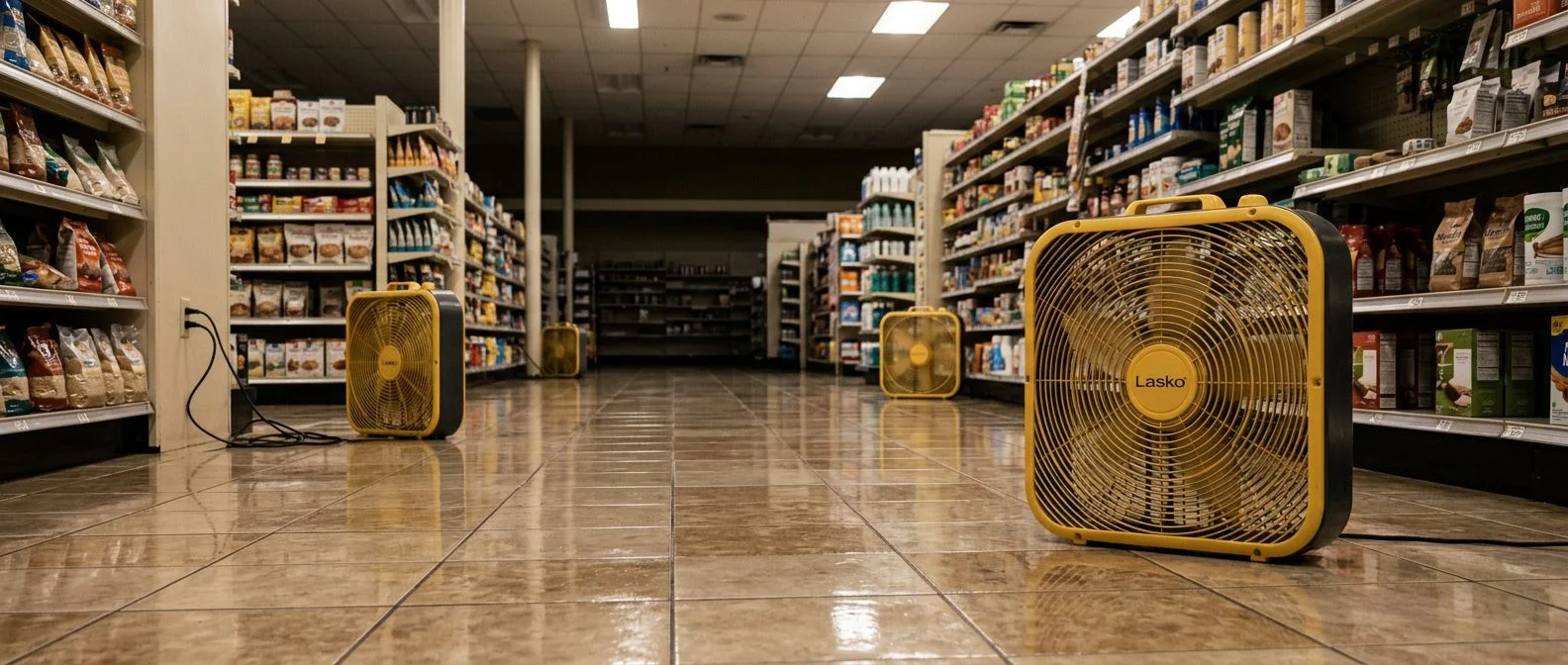
Floor Care Maintenance | South Florida
Choosing a Retail Floor Finish That Holds Up in South Florida Humidity
Here is how water-based and solvent-based finishes behave in damp air, and how to plan a floor project around the weather and your store hours.
By Ryan Jurney · Published November 25, 2026
Your store floor takes the carts, the door traffic, and the nightly mopping. The finish on top takes the same beating, and South Florida humidity makes its behavior harder to predict.
The short answer: water-based and solvent-based finishes both work on commercial floors. The better choice depends on your floor material, your traffic, and when you can close aisles for work.
Why Floor Finish Choice Matters in a South Florida Retail Store
A floor finish is the protective layer that takes the wear, so its type shapes how the floor looks and how often it needs attention.
Carts, shoes, grit, and daily cleaning all work on that layer. In a retail store, the damage usually shows first at the entry, along the main aisle, and at the checkout.
South Florida adds a second problem. Heat and humidity change how a finish dries and cures, so a coat that goes on smoothly in a dry month can behave differently on a muggy morning.
Moisture also reaches the floor beneath the finish. Grout is one place it shows up. Our article on grout darkening in South Florida humidity covers that side of the problem.
This page answers one question. Which finish type holds up better in humid retail conditions, and how do you decide for your own store?
Not sure what your next step is?
Talk it through with our team — the first consultation is free, confidential, and carries no obligation.
Water-Based vs Solvent-Based: The Core Difference
A water-based finish uses water as its carrier. A solvent-based finish uses organic solvents to carry the coating. That difference drives most of the practical gap between them.
The carrier changes how the work feels on site. Solvent-based products usually have a stronger smell, so they call for more ventilation while they are applied and while they cure. Water-based products are generally less strong-smelling, which can matter when staff and shoppers are nearby.
Application is also different. Each family has its own sequence of cleaning, coating, and recoating. The crew should follow the product maker’s instructions for the family they use.
Both families show up in commercial work. A Florida public-project floor finish specification lists solvent-based concrete sealer and water-based epoxy among the commercial floor-finish types it specifies. It also addresses multi-coat application and slip-resistance requirements.
So the question is not which family wins in general. The question is which one fits your floor, your traffic, and your schedule. Before you agree on a price, contact our team to talk through your property’s cleaning needs.
How Each Finish Responds to South Florida Humidity
High humidity can slow drying and curing. A finish may need more time before foot traffic returns to the floor.
Air moisture and floor moisture both matter. The day’s humidity and temperature change the timing. A finish that cures in a dry week may need longer on a muggy one. Plan for the weather you will actually get.
Water-based finishes rely on water leaving the film as it sets, so damp air and damp floors can stretch that stage. Solvent-based finishes release solvent into the air, so heat and airflow change how fast they set. Neither family is immune to Florida conditions.
Ask your provider how they check humidity, temperature, and floor moisture before they start. A crew that schedules around the forecast protects the finish and keeps your busiest days clear.
Scheduling is the practical lever. If rain is coming, a good plan moves the work instead of pushing the store into a rushed cure.
Traffic, Wear, and Recoating on Busy Retail Floors
Traffic level sets how fast a finish wears. Busy zones usually need recoating or spot repair sooner than quiet ones.
Retail wear follows a pattern. Entry mats and door zones take grit and standing water. Main aisles take cart wheels and scuffs. Checkout lanes take foot traffic that stands in one place, along with spills.
Plan each zone on its own. A single recoat schedule for the whole floor often leaves the entry worn while the back aisles still look fine. Check the entry first when you review the floor.
Between full recoats, routine care protects the finish. Use cleaners that suit your finish type, and follow the product guidance your provider gives you. The maintenance plan matters as much as the finish.
For the full scope of this work, see our floor care maintenance guide for Miami-Dade.
Planning Application Around Store Hours
Retail floor work often runs after closing, overnight, or in phases that keep part of the store open.
Phased work keeps the store running. Close one zone, let it cure, then move to the next. Clear signs tell shoppers and staff which path to use and when the zone reopens.
Ventilation is part of the plan. Ask your provider how they will manage air during application and curing. Ask whether the area must stay closed to foot traffic while it sets.
A day porter service fills the gap between floor care visits. A porter keeps grit, spills, and debris off the finish during business hours. A porter does not replace professional finish application, which stays with the floor care crew.
Staff handling matters too.
How to Choose the Right Finish for Your Store
Match the finish to your floor material, traffic, moisture exposure, sheen, application window, and maintenance routine.
- Floor material and its current condition
- Traffic volume in each zone
- Moisture at the entry and in the floor
- Sheen that suits your lighting and merchandise
- A closed-hours window long enough for the finish to cure
- A routine maintenance plan after the work is done
Ask our team to explain everything included in your proposal, beyond the headline price. Look at the finish type, the prep work, the application method, and the maintenance plan that follows. When you receive a proposal from Gator Protection, review exactly which services, areas, and schedules it covers before you decide.
Before work begins, ask for proof of insurance and for the Safety Data Sheets for every product the crew will use. Our certificate of insurance guide explains what to request. For how floor care is usually scoped and quoted by area, see our price per square foot guide.
Common Questions
Which finish holds up better in South Florida humidity?
Humidity affects drying and curing for both families. Timing and conditions matter most.
Can floor finish go down during business hours?
Often the work is phased or scheduled after closing, so one zone can cure while the rest stays open.
Can a day porter maintain a finished floor?
A day porter keeps the floor clean between visits. Finish application stays with the floor care crew.
Not sure what your next step is?
Talk it through with our team — the first consultation is free, confidential, and carries no obligation.
Talk Through Your Store’s Floors With Gator Protection
If your store floor is dulling, scuffing, or showing moisture wear, the next step is a conversation about that floor.
Gator Protection, Inc. provides floor care maintenance and day porter service, along with landscape services and pressure washing. We serve South Florida and parts of Atlanta, Georgia.
Contact Gator Protection, Inc. through the contact form, call the office, or request a free quote for your store.
La consulta inicial es gratuita, confidencial y sin compromiso de continuar.
Check conditions before you finish
Do not start a floor coating in a closed, unventilated space without first checking the humidity and the product's recommended application conditions. Starting in damp air can leave a finish that cures poorly or looks cloudy.
Key questions for retail floors in humid weather
Water-based finishes
Typically easier to clean up and lower in odor, but their drying and curing depend closely on air moisture and airflow.
Solvent-based finishes
Known for durable film build, but they need careful ventilation and timing so the coating cures evenly in humid conditions.
Timing and phasing
Work is often divided into zones or scheduled after closing, so one area can cure while the rest of the store stays open.
Day-to-day upkeep
A day porter can keep the finished floor clean and protected between maintenance cycles so the coating lasts longer.
How we plan floor care work
Scheduled around your hours
We plan floor work to fit your opening times, including phased or after-hours schedules where they suit your store.
Support from our team
Our team, including office and support staff, helps coordinate scheduling, preparation, and follow-up.
Focused on South Florida
We focus our floor care and maintenance services on Miami-Dade, Broward, and Palm Beach counties, along with Coral Gables, Brickell, and South Beach.
Start with a conversation
The first consultation is free, confidential, and carries no obligation to continue.