
Floor Care | South Florida Condominiums
Know who cares for your condo floors
Clear responsibilities keep corridors, lobbies, and common areas looking their best, and a dependable service partner makes that routine.
By Ryan Jurney · Published November 18, 2026
Who Is Responsible for Floor Care in a Florida Condominium?
The lobby tile has gone dull, and the corridor needs stripping.
Who is responsible for floor care in a Florida condominium? In most cases, the association handles the shared floors, like lobbies, hallways, and stairwells, and pays for that work. Individual owners usually handle the floors inside their own units. This is a general overview, and your building’s documents control the details.
If your board is looking at a dull lobby floor or can't tell whether stripping falls to the association or an owner, we can talk it through with you. Talk it through with our team — the first consultation is free, confidential, and carries no obligation.
The Short Answer: Common-Area Floors Generally Fall to the Association
For shared floors, the association is generally the party responsible for upkeep. Shared floors are common elements, such as lobbies, corridors, stairwells, and amenity rooms like a clubhouse gym. The association holds the budget and signs the vendor contract. The floor care vendor then works for the association under the scope the association approves.
Owners pay for these costs through their assessments. A unit owner is liable for all assessments that come due while he or she owns the unit (Fla. Stat. § 718.116). That makes shared floor care a building-wide cost, not one owner’s problem.
Your unit’s own floor covering, such as carpet or tile inside the unit, is usually the owner’s job. The declaration can change that split, so check it first.
Common Elements vs. Unit Floors: How to Tell Them Apart
The declaration of condominium is the document that draws the line between shared floors and private ones. Florida law requires the declaration to include a survey and graphic description that identifies the common elements and each unit, along with their relative locations (Fla. Stat. § 718.104). Use those plans to mark each floor area before the board assigns any work.
Some areas fall between the two. A terrace or balcony reserved for one unit is a limited common element. That means it is reserved for that unit to the exclusion of other units, as the declaration specifies (Fla. Stat. § 718.103). Ask the declaration who handles its upkeep.
Here is a simple split. Corridor tile is a common element. A bedroom floor inside a unit is usually the owner’s. A private terrace in a Brickell or South Beach tower may be a limited common element, depending on the declaration. The goal is to name each area, not to guess from how the building looks.
What the Statute and the Governing Documents Say
Chapter 718 of the Florida Statutes, the Condominium Act, sets the baseline for these buildings. It does not settle every floor question, though. The articles of incorporation and bylaws govern how the association runs. The bylaws are included as exhibits to the recorded declaration (Fla. Stat. § 718.112).
A clause in those documents can give the association a specific floor duty, or narrow it. So the answer can differ from one building to the next.
A board should not assume the statute alone decides the question. Review the declaration’s maintenance language, then the bylaws, then any rules the board has adopted. Write down what each says. If a clause is unclear, the board should settle it in writing before signing a floor care contract.

Which Budget Line Covers Common-Area Floor Care
Recurring floor care usually falls under the association’s operating budget. Florida defines common expenses as all expenses properly incurred by the association in the performance of its duties (Fla. Stat. § 718.103). Routine cleaning, scrubbing, and maintenance coating of shared floors fit that definition.
Larger restoration or replacement work is a different conversation. A board planning a full floor restoration should check the reserve account and the vote rules before it commits.
The board, not an individual owner, generally approves the budget line and the spending for common areas. Keep each vendor invoice tied to a budget line. That way the board can explain every charge to owners later.
Who Decides on the Vendor and the Scope of Work
The usual path runs in three steps. The board identifies a floor problem, gathers proposals, and approves one written agreement.
Florida requires that bids for work, materials, equipment, or services be maintained for at least 1 year after receipt (Fla. Stat. § 718.111). Keep every proposal on file.
Put these terms in the agreement before work starts:
- Which floor areas are covered, named by area and room
- The stripping, finish, and cleaning schedule, with frequency
- Traffic and equipment rules, including work hours
- Who supplies the chemicals
- Safety Data Sheets for every product used in the building
Safety Data Sheets matter. A vendor should hand the board those sheets before the first shift.
Not sure what your next step is?
Talk it through with our team — the first consultation is free, confidential, and carries no obligation.
Floor Types and How They Change the Maintenance Plan
Each floor type needs its own care, so the scope should name the floor. Vinyl composition tile (VCT), terrazzo, and sealed concrete respond to different cleaners and finishes. A scope that says only “clean the floors” leaves the board guessing about cost and results.
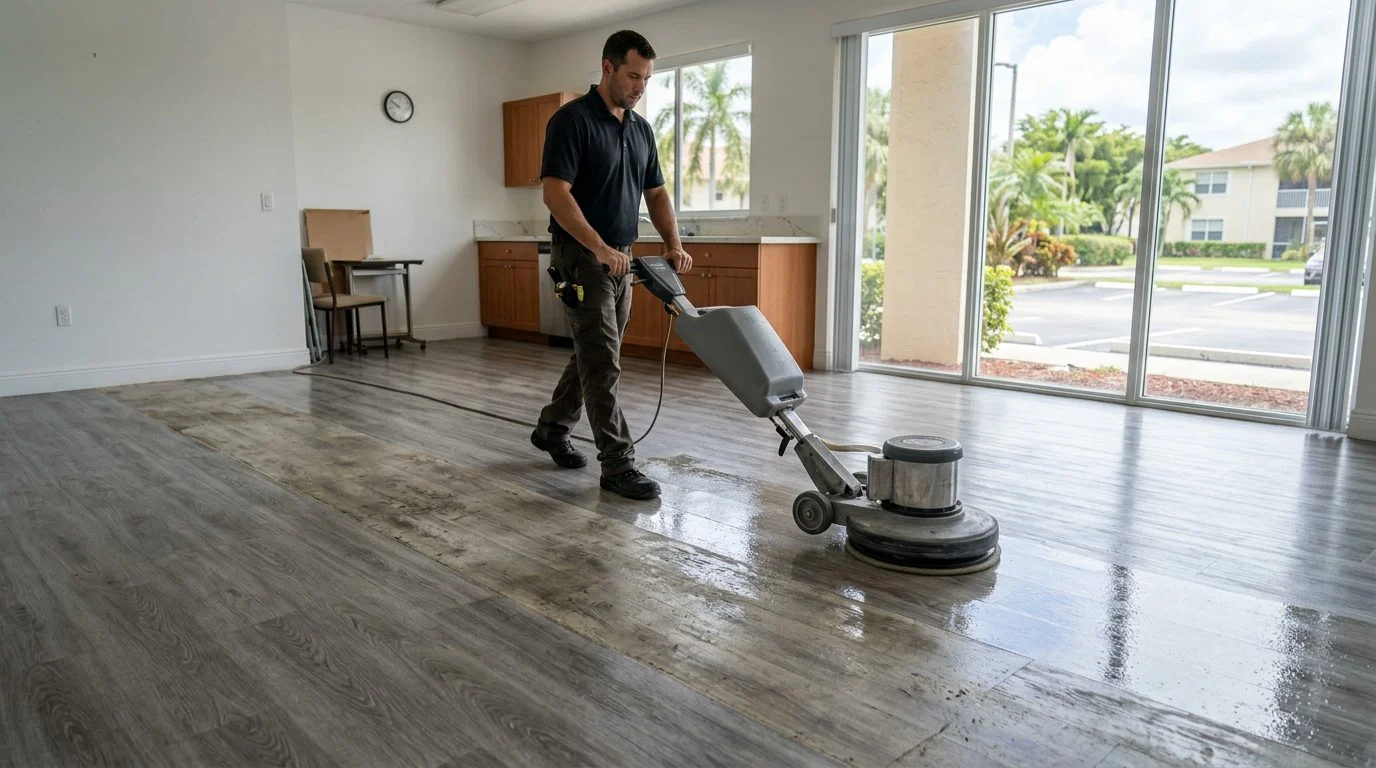
Dull VCT after cleaning often traces to old finish buildup or the wrong cleaning method, not the tile itself. Stripping removes old finish, so it belongs on a schedule. A busy corridor in a Coral Gables mid-rise may need stripping more often than a quiet hallway. The scope should say so.
Wood floors need moisture control. The Florida Department of Health publishes general information about mold.
Slip hazards matter too. Clean, well-maintained floors are an important part of any commercial property, and our team can discuss floor care maintenance options during a free first consultation.
Next Steps for Boards and Managers
Start by pulling the declaration, confirming which floors are common elements, and writing the vendor scope down. That order keeps the budget, the contract, and the floor plans in step.
- Pull the declaration, bylaws, and any floor-related rules.
- Mark each floor area as common, limited common, or part of a unit.
- Check the current budget line and the reserve balance.
- Put the vendor scope, schedule, and Safety Data Sheet requirement in writing.
Common Questions
Who pays for corridor floor care in a Florida condo?
The association generally pays for it from the operating budget. Owners share the cost through their assessments.
Who handles the floor inside my unit?
Usually the owner does, unless the declaration assigns that work to the association.
Should a board skip written terms with a vendor?
No. Written terms protect the association and make the work easier to check.
If your board is dealing with a dull lobby floor or an unclear split between the association and an owner, Gator Protection can review the floors with you. Gator Protection provides floor care maintenance in South Florida. La consulta inicial es gratuita, confidencial y sin compromiso de continuar. Reach out through our contact page.
How Gator Protection supports your building
Day porter service
On-site daytime attention keeps common areas clean, orderly, and ready for residents and visitors.
Floor care maintenance
Scheduled cleaning and upkeep help protect floor surfaces across shared spaces.
Coordination with boards and owners
Our team works with association leaders and property managers to define the work and keep it on track.
Consistent scheduling
Regular service calendars help buildings avoid surprises and maintain a steady standard.
Put floor care scope in writing
Clear, written terms describing which floors are covered, who handles them, and how often service occurs help prevent confusion between owners, boards, and service providers.
Services for South Florida condominiums
Corridor and lobby floors
Routine care for high-traffic common areas in buildings across Miami-Dade, Broward, and Palm Beach counties.
Floor care maintenance plans
Recurring service programs tailored to the size and needs of your property.
Day porter support
Daytime staff to address spills, debris, and everyday floor cleanliness as they happen.
Pressure washing and landscape services
Exterior hardscape and grounds care that complement your interior floor program.