
Landscape Services | Broward County
What Should a Landscape Crew Cover at Your Broward Office Park?
A well-defined grounds plan keeps every entrance, planting bed, and parking edge looking cared for, year after year.
By Ryan Jurney · Published November 22, 2026
Planning landscape maintenance for an office park? Our team can review your site’s landscape maintenance with you. Each named area of an office park needs its tasks, frequency, and checks written out, and it needs them on every visit.
It also gives you a standard to check the work against after the crew arrives. Below, you’ll find each area, what belongs in it, and what to ask for in writing.
Why a Visit-by-Visit Scope Matters at an Office Park
A visit-by-visit scope names each area of the park and the work that belongs there. Office parks share entries, parking edges, and planting beds that several tenants depend on. A line that says “landscape maintenance” can describe very different work from one bidder to the next. One bid may include edging and blowing, while another leaves them out. Naming each area closes that gap.
Treat the scope as a working checklist, not a sales sheet. Split each visit into four parts. The arrival check confirms the crew has reached the site and walked the entries and parking edges. The task blocks run area by area, in the same order each time. The walk-through lets the property contact review the grounds with the crew lead. The departure record lists what was done and what was flagged for follow-up. A tenant who sees a missed bed at the front entry will call the property manager, not the vendor, so that record matters.
If you're about to request quotes for an office park and aren't sure what each visit should include, our team can help you put that scope in writing. Talk it through with our team — the first consultation is free, confidential, and carries no obligation.

Lawn and Turf Areas: Mowing, Edging, and Cleanup
Lawn work should name how often each turf zone is mowed, how it is edged, and what happens to the clippings afterward.
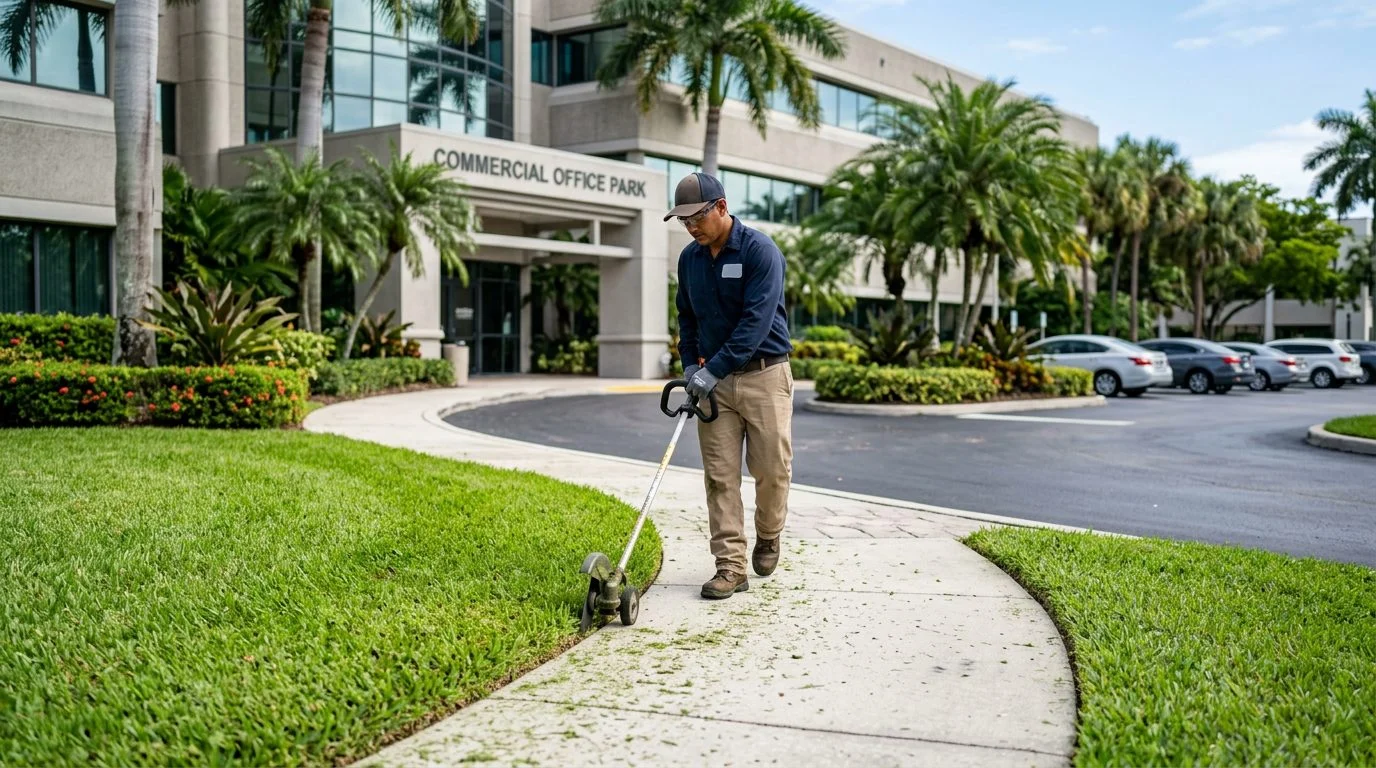
Write mowing frequency for each turf zone, not one number for the whole park. Edging belongs along walks, curbs, and bed lines. String trimming belongs around light poles, fixtures, and signs, where a mower can’t reach. Require blowing clippings off walks, parking surfaces, and entry drives after every mow. Don’t leave that to the crew’s judgment.
Some zones need different heights. Turf near main signage or along a busy road frontage often needs a tidier cut. Name those zones in the scope, so the crew knows where the standard is higher. Ask for the mowing height by zone, written into the scope, so turf is cut to the same standard on every visit.
Commercial fertilizer work on turf has its own certification rules. Fertilizer programs for commercial landscapes are planned around each property, and our team can review your site’s needs with you. Ask who on the crew holds that certification, and whether the scope includes fertilizer at all. See Florida licensing and certification for the requirements.
Planting Beds, Weeding, and Mulch
Planting beds need a recurring weeding task, a full sweep of every bed, and a mulch check on each visit.
Write weeding as its own recurring task. Describe it as a sweep of every bed and tree ring on each visit. That way no bed gets skipped because it looked fine from the walkway. Count the beds on the site plan, so the sweep covers the same beds every time. Bed edges should also be cut back to the line on each mow.
Check the mulch on every visit for three things. Look for thin spots, for mulch that has washed or blown onto walks, and for mulch piled against tree trunks. Mulch piled against a trunk should be pulled back from the bark, and the scope should say so.
How often mulch is replaced depends on bed type and sun exposure. Put the interval in the scope rather than guessing. For South Florida timing, see mulch timing in South Florida.
Shrubs, Trees, and Palms Along Sightlines
Pruning belongs in the scope for every plant that frames an entry, a sign, or a parking sightline, with a stated cut-back limit.
Name each plant group and how far its growth is cut back. For example, keep shrubs below a sign’s base or clear of a light fixture. Without a stated limit, one crew cuts hard and another barely trims, and both can say they did the job.
Keep pruning separate from shaping. Shaping changes a plant’s form. Clearing a sightline removes growth that blocks a view or a path. The scope should say which one is included on each visit.
Pruning debris should leave the property on the same visit. Debris left in beds or on pavement becomes a trip hazard and an eyesore for the next tenant who walks past.
Flag dead limbs, damaged palm fronds, and branches touching roofs, lights, or vehicles. Write each flag into the visit record. The property manager can then decide on follow-up work, rather than the crew deciding on the spot.
Entries, Walkways, and Parking Perimeters
Litter pickup and a clear, dry walkway should be required on every visit, because both affect appearance and safety.
Litter pickup should cover walks, curb lines, and planting edges. Those spots collect blown trash and leaf debris fastest. Put the pickup in every visit’s scope, not as an extra request.
Pressure washing is a separate line item. Walkways, entry pavers, and dumpster pads each need their own entry. Decide whether that work runs on a fixed schedule or as needed. Our team offers pressure washing services for these surfaces.
Hard surfaces also need to be clear before the crew leaves. Keeping floors clean and dry is a practical part of any commercial floor care routine, and our team can build one around your facility. Blowing matters here too. Clippings and mulch left on a walk are easy to slip on and easy to track into lobby entries. Check that edging and blowing leave walks and drives clear before the crew drives away.
Crew Supervision, Qualifications, and Site Conduct
The scope should name who supervises the crew, how its members are trained, and which site rules they must follow.
Ask how the crew is trained on its equipment. Then ask how it is trained on site rules, such as tenant hours, gate access, and parking restrictions. These rules matter most in a shared park, where one truck blocking an entry affects every tenant. A written list of the crew’s training is simple to request and easy to check later.
Name the person on the vendor side who is responsible for the site. Write down how that person is reached when a visit is missed or a problem comes up.
Ask for proof of workers’ compensation coverage. Florida’s insurance regulator says employers generally must carry workers’ compensation insurance, and that coverage pays benefits for job-related injuries. Under Fla. Stat. § 440.10, a contractor that sublets part of its work is liable for securing compensation for those employees, except where the subcontractor has already secured it. For a closer look, see the Florida workers’ comp checklist.
Ask whether new crew members are verified for work authorization. Under Fla. Stat. § 448.095, an employer must verify each new employee’s employment eligibility within 3 business days after the first day of pay. Ask too whether the company uses E-Verify. See E-Verify and landscape companies for how that applies.
Not sure what your next step is?
Talk it through with our team — the first consultation is free, confidential, and carries no obligation.
Visit Logs, Walk-Throughs, and Seasonal Changes
A visit log is the written record that shows each visit’s work was done, so it belongs in the scope.
Each log entry should list the date, the time, the tasks completed, and any items flagged. Both sides can review the same record. Without one, a missed bed becomes a disagreement with no evidence on either side. Keep the log simple. A short entry for each task block is enough, as long as the same format is used on every visit.
Schedule a periodic walk-through with the crew lead. Compare the log against the scope, note any gaps, and agree on changes in writing.
Seasonal changes need planning too. Florida’s summer rainy season adds mowing, weeding, and debris to the job. Rather than relying on ad hoc requests, build a seasonal adjustment clause into the scope. It should say what changes, and who approves it.
Frequently Asked Questions About Office Park Landscape Scope
The short answers below cover the core questions about this scope.
What are some landscaping duties at an office park?
Typical duties include mowing and edging, bed weeding and mulching, pruning along sightlines, debris removal, and pressure washing of hard surfaces. Each one should carry a frequency and a location.
What qualifications should a landscape crew have?
Ask our team about training on equipment and site rules, supervision, and workers’ compensation coverage. Write each item into the scope so it can be checked on a visit.
Should the scope change between seasons?
Yes, when the workload changes. Write the adjustment rule into the scope so changes are planned, not negotiated in the middle of a busy season.

Next Step: Defining Your Park’s Scope With Our Team
If you’re about to request quotes for an office park in Broward County, define the visit-by-visit scope first. That step helps you plan your service.
Our team provides commercial landscape maintenance across South Florida, including Broward County. Bring your current site plan, any existing scope or contract, and a list of tenant concerns about entries, parking, and planting beds. Bring the two or three areas you’re most concerned about, so the first consultation starts with them. Contact our team and we can walk through each area of your property with you.
La consulta inicial es gratuita, confidencial y sin compromiso de continuar.
Use the contact form or call the office to request a quote and set up your first consultation.
Core Duties to Define in Your Scope
Mowing and Edging
Name the turf areas, the mowing schedule, and the edging lines along walks, curbs, and building foundations.
Bed Weeding and Mulching
List each planting bed, how often it is weeded, and when fresh mulch is applied.
Pruning Along Sightlines
Identify shrubs and trees near entrances, driveways, and signs that need regular pruning for visibility and safety.
Debris Removal and Pressure Washing
Specify which hard surfaces are pressure washed, how often, and how clippings and debris are cleared.
Avoid Vague Scopes
A scope that says only "maintain the landscaping" leaves room for confusion. Spell out each task, its frequency, and its location before work begins.
Why Plan the Scope Up Front
Clear Boundaries
Defining which areas the crew maintains helps prevent gaps between lawn, beds, and hardscape edges.
Predictable Schedules
When each task has a set frequency, both the property and the crew know what to expect.
Mapped Zones
Noting where each duty applies, from main entrances to parking islands, keeps work organized across the site.
Coordinated Access
Aligning service hours with office traffic and tenant needs keeps the grounds tidy without disruption.