
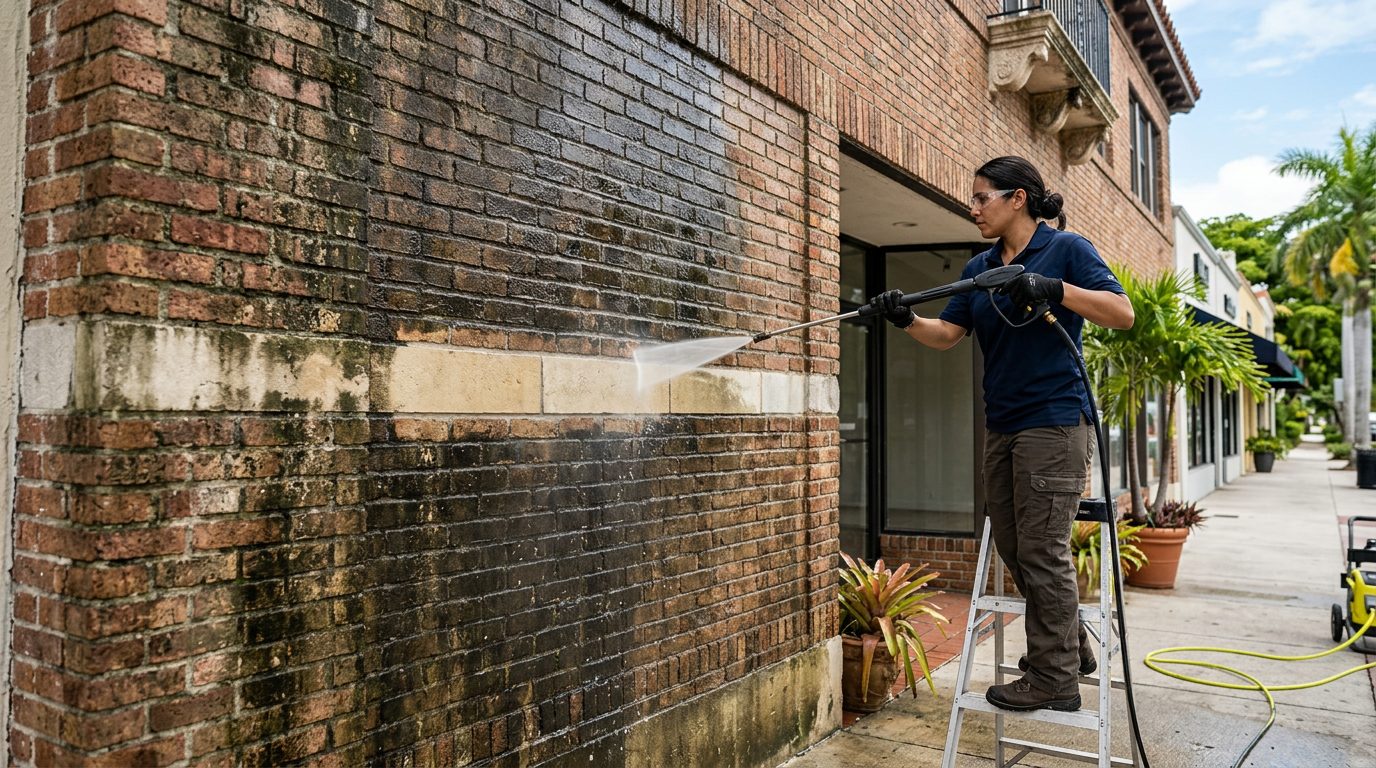
Pressure Washing | South Florida
Planning a Pressure Washing Job in Florida? Start With the Licensing Questions
Local receipts, state trade rules, and job-site paperwork each play a different role, so it helps to sort them out before any equipment goes on the property.
By Ryan Jurney · Published November 24, 2026
If you’re reading this, you may be deciding who should pressure wash a condo or commercial property, or you may be planning a cleaning business of your own. Florida answers the question in two layers: state trade licensing and local business tax receipts.
The Short Answer: Licensing for Pressure Washing in Florida
The first layer asks whether the work falls under a licensed trade at the state level. The second asks whether the business needs a local business tax receipt where it works. These are separate questions, so a yes on one does not settle the other.
Florida defines a local business tax as the fees and method a local governing authority uses to grant the privilege of doing business there. It does not mean any fees or licenses paid to any board, commission, or officer for permits, registration, examination, or inspection. Fla. Stat. § 205.022 Counties and incorporated cities both count as local governing authorities.
Whether a particular job needs a state trade license depends on the facts of that job. This page gives general information, not legal advice for a specific project.
If you're weighing who should pressure wash your condo or commercial property, our team is glad to talk through your situation with you. Talk it through with our team — the first consultation is free, confidential, and carries no obligation.

How Florida Contractor Licensing Is Organized
Pressure washing may or may not touch a licensed trade. The work itself decides that, not the equipment in the truck.
Knowing which side a job falls on is the first step.
Ask what the job actually changes. Cleaning a surface is a different task than repairing or rebuilding part of a building. The two can get bundled into one contract, which makes the line easy to miss.
Who signs the contract matters too. A property owner, board, or manager should know which party performs each part of the work.
When Pressure Washing May Fall Under a Licensed Trade
Pressure washing that is part of a larger construction, repair, or alteration project may be treated differently than routine exterior cleaning. That is the main situation where the state question changes.
Picture a condo association that hires one company to wash balconies and also patch cracked concrete in the same package. The washing is cleaning, but the patching may bring construction rules into play.
Work involving sealing, coatings, or structural repair can raise the same kind of question. The product and the surface both matter, so ask what is being applied and why.
Scope decides how the rules apply, not only the equipment. A pressure washer used on the same driveway can do routine cleaning one day and part of a repair project the next, because the work itself changed.
The practical step is simple. Ask the provider to split the scope into parts and name who performs each one.
Local Business Tax Receipts and County or City Rules
A local business tax receipt is the local layer, and it applies within the boundaries of the county or city that issues it.
Miami-Dade, Broward, and Palm Beach counties are separate jurisdictions.
Coral Gables and Miami Beach are incorporated cities, and each can be a local governing authority within its county. Brickell sits within the City of Miami, and South Beach sits within Miami Beach, so city rules can matter on those jobs.
Here is a detail that catches people. Where a county has levied the tax, the county tax collector may issue a municipal receipt and collect the tax. Fla. Stat. § 205.043
Timing matters too. A receipt is not valid for more than one year, and all receipts expire on September 30 each year, except as otherwise provided by law.
Chemicals, Insurance, and Other Requirements to Ask About
The cleaning products a crew uses are part of the conversation too. OSHA Hazard Communication Standard
Runoff is the second concern. The South Florida Water Management District says polluted runoff entering storm drains is discharged untreated into connected water bodies. That runoff can carry pollutants from paved surfaces and properties, so wash water management matters on every site.
Insurance and paperwork come next. Boards and property managers can ask for proof of insurance and licensing documents before work begins, and a provider should expect that request.
Can You Start a Pressure Washing Business Without a License?
Whether you need a state trade license depends on the work you plan to perform. The local receipt question stays the same either way.
Florida also declares unfair or deceptive acts in trade or commerce unlawful. Describe your licenses and insurance accurately in your marketing. Fla. Stat. § 501.204
Commercial clients such as condo associations often want documents in hand before they award work. Plan for that request early.
Is a local receipt the same as a state license?
No. A local receipt comes from the county or city where you work, while a state trade license is a separate question.
Can a county receipt cover work in a city?
Not automatically. Counties and incorporated cities are separate local governing authorities, so each may have its own rules.
Not sure what your next step is?
Talk it through with our team — the first consultation is free, confidential, and carries no obligation.
Talk With Gator Protection About Your Property
If you’re handling this for a condo board, a building you manage, or a business you’re about to launch, the timeline may already feel tight.
Gator Protection, Inc. offers day porter service, floor care maintenance, landscape services, and pressure washing. We serve South Florida, including Miami-Dade, Broward, and Palm Beach counties.
Our pressure washing service page describes the commercial exterior work we handle for South Florida properties.
La consulta inicial es gratuita, confidencial y sin compromiso de continuar.
Reach out through our contact form and tell us about your property and your questions.
How Gator Protection Supports Your Project
Focused South Florida Coverage
We serve Miami-Dade, Broward, and Palm Beach Counties, along with South Beach, Coral Gables, and Brickell.
A Supported Team
Our team includes assistants and office staff who help keep scheduling, communication, and follow-up organized.
Pressure Washing Within a Wider Service Mix
Pressure washing can be scheduled alongside our day porter, floor care, and landscape services for the same property.
Clear Answers Before Work Begins
We talk through the scope, timing, and questions that matter for your property before anything is scheduled.
Don't Assume One Document Covers Everything
A local receipt and a state trade license answer different questions. Confirm what applies to your specific location and job before you hire anyone or start work.
Questions to Settle Before Pressure Washing Begins
Confirm the Local Jurisdiction
Identify which one governs the property where the work will happen.
Ask About Required Paperwork
Find out what receipts, registrations, or permits the local office expects for exterior cleaning work.
Review the Property and Surfaces
Different surfaces and building types can raise different planning questions, so describe the site in detail.
Keep Records Organized
Keep copies of documents and scheduling details together so they are easy to share with property managers.