
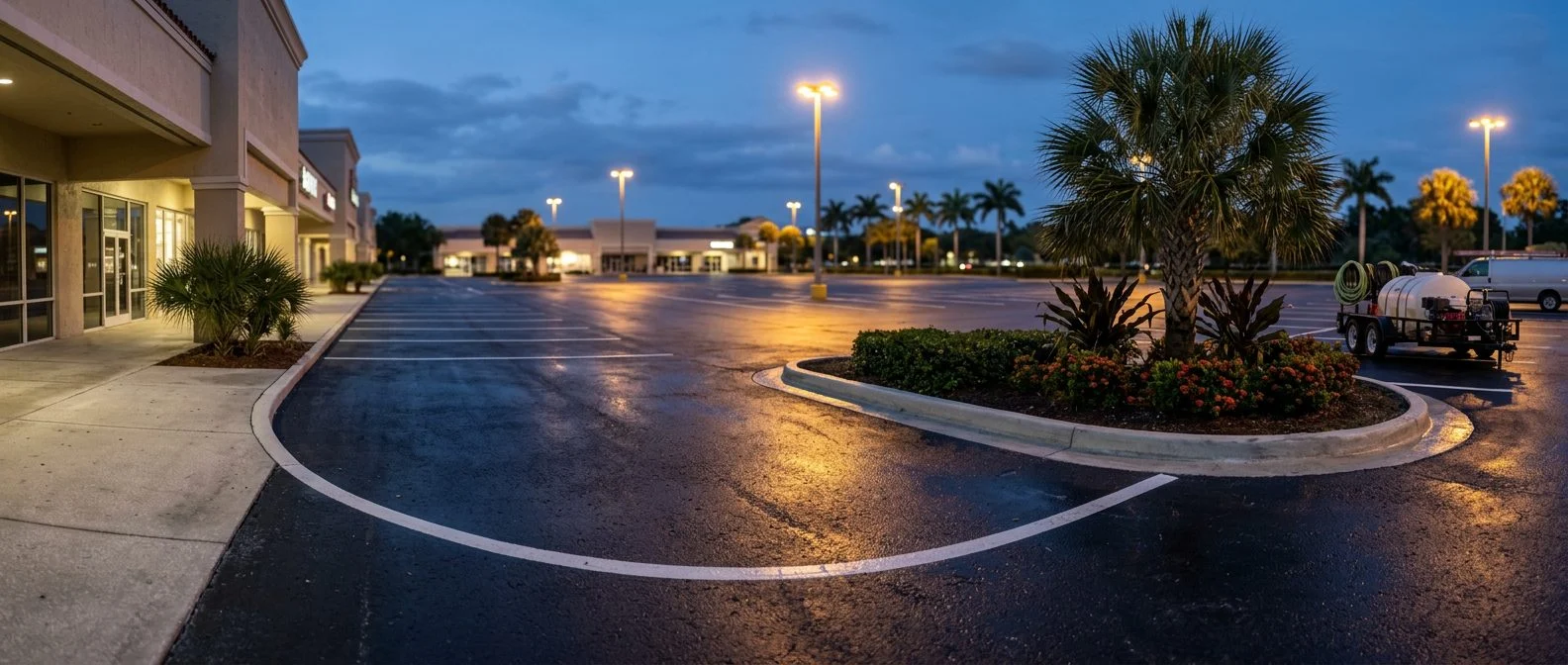
Pressure Washing | South Florida
Planning a Retail Lot Wash? Start with a Site Review
Talk with our team about the scope, timing, and access for your property, and get a plan built around your store hours.
By Ryan Jurney · Published November 24, 2026
Planning a wash starts with one question: how long will it take to pressure wash a retail parking lot this size? The short answer is that total square footage is only a starting point. Crew time follows the wash area, the soil, the surface, and the access limits on your property.
Below, each factor is explained, along with what to gather before you ask for a quote.
What Sets the Hours on a 40,000 Square Foot Retail Lot
Hours are set by the parts of the lot that get washed and how hard each part is to clean, not by the total footprint alone.
A 40,000 square foot figure includes buildings, landscape beds, and areas a crew never touches. Think of it as the size of the box. The crew’s work lives inside it, in the areas that need cleaning.
Two lots of the same size can take very different amounts of time. One may be a simple open asphalt field. Another may have many islands, a long drive-thru lane, and heavy oil in the stalls.
No single hour count fits every lot of this size. Layout, condition, and access differ from site to site, so the schedule has to be built from the site itself. Pressure washing involves several stages, and each stage changes with the property.
If oil-stained stalls, a busy drive-thru, and tight tenant hours are shaping your next wash, our team can review your lot and talk through a quote with you. Talk it through with our team — the first consultation is free, confidential, and carries no obligation.
Measure the Wash Area, Not Just the Footprint
The wash area is the paved surface a crew will actually clean, and it is usually smaller than the full property.
Start by separating the areas that need cleaning. Drive aisles, parking stalls, sidewalks, curb lines, dumpster pads, and loading zones each get different treatment. A dumpster pad with grease can take longer than a stall with light dust.
Landscaped islands, walls, and fencing add edge work. Crews must work around them, and each edge slows the pass. A lot with many islands often takes more time than a plain lot of the same size.
Before you ask for a quote, sketch a simple lot map. Mark the drive aisles, stalls, sidewalks, dumpster pads, loading zones, and islands. Add rough dimensions where you know them, such as the length of a curb run or the width of a drive aisle. Note where the buildings and entrances sit. A rough sketch gives the crew a clear starting point, even without a survey.
How Surface Type and Soiling Change the Pace
Surface type and soil decide how many passes and steps each section needs, so two areas of the same size can need very different time.
Asphalt and concrete respond differently. Asphalt is softer and can show marks from aggressive passes, so crews adjust pressure and nozzle choice. Concrete tolerates more pressure, but oil can sink deeper into its pores.
Retail lots carry familiar soils. Oil spots near parking stalls, tire marks, grease from drive-thru lanes, gum, and algae or mildew in shaded areas each need a different approach. Gum usually has to be scraped before washing. Mildew in shade often needs a cleaning solution left on the surface before rinsing.
Heavy staining adds steps. A degreaser or pre-treatment has to sit on the stain for a while before the crew rinses. Rinsing too early can spread the oil instead of lifting it. Crews often treat the worst stains first, then wash the rest of the section, so the treatment has time to work.
Traffic, Tenant Hours, and Access Limits
An open lot with steady customer traffic can only be washed in sections, so access limits often add as much time as the wash itself.
Customer cars stay in the way. A crew can only clean the part of the lot that is clear at the time. In an occupied lot, the work moves in stages and waits as vehicles come and go.
Phasing the lot keeps the site usable. Crews usually divide the property into zones so that walkways, store entrances, and some parking stay open. Each zone is washed, rinsed, and allowed to dry before the next one starts. The order of zones affects the total time.
Tenant hours and delivery schedules shape the plan too. A store that receives trucks at a fixed time may need its loading zone clear before then. Other tenants may want the front lot open all day. Those rules decide which sections can be washed and when.
Drive-thru lanes and fire lanes need careful sequencing. A busy drive-thru must stay usable during service hours. Fire lanes need to stay clear, so the crew plans that work in advance. These areas are often scheduled in short windows.
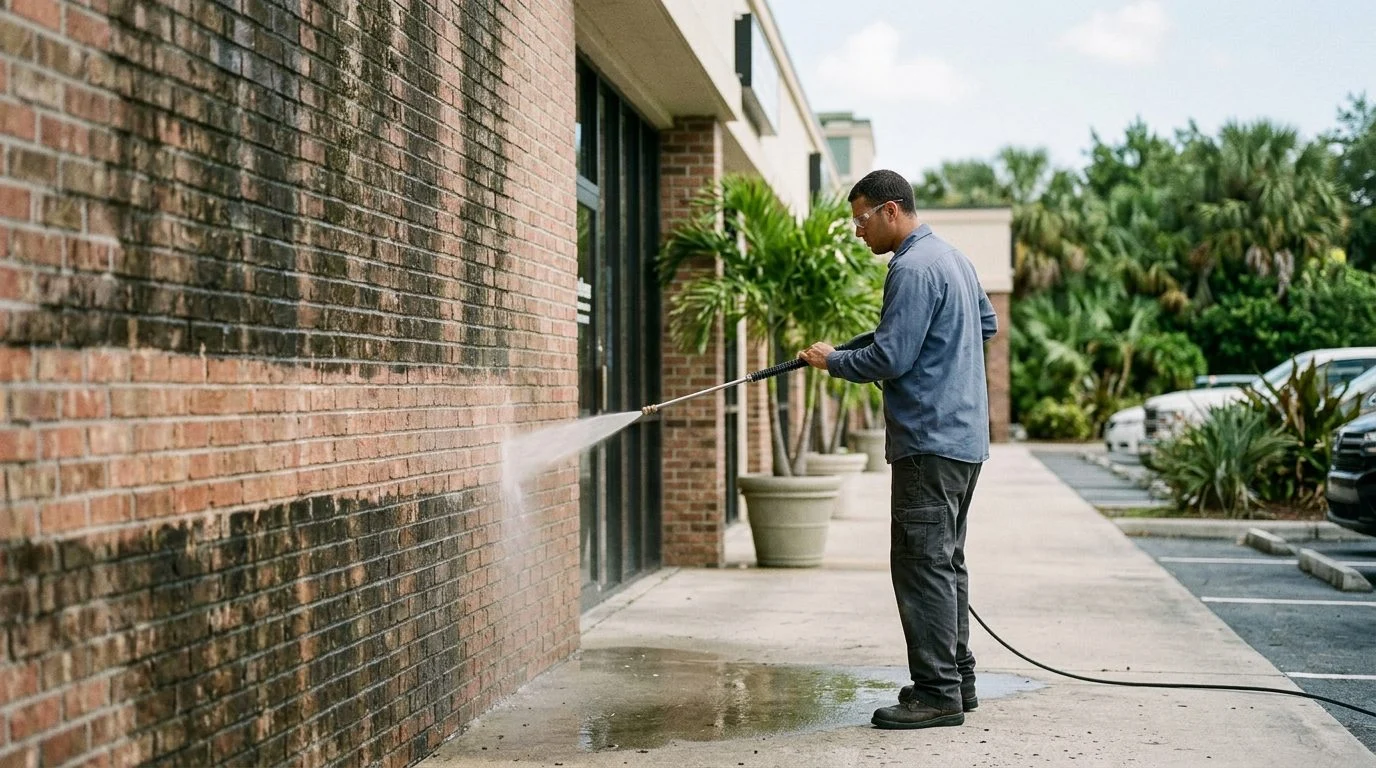
Choosing a Wash Window: Daytime or Overnight
Overnight washing usually means fewer vehicles and easier access, while daytime work follows the stores’ open hours and needs more sectioning.
Daytime work lines up with store hours. Customer traffic is heaviest then, so the crew works in smaller sections and moves around vehicles. The advantage is simpler coordination with staff, who can flag problems as they happen.
Overnight washing usually means fewer cars and freer access. The lot is quieter, and the crew can cover more ground in one stretch. Overnight work brings its own needs. Lighting must be good enough for safe work, and noise near homes or other tenants should be considered in advance.
Store opening times set the finish line. A lot should be dry and safe before the first customers arrive. Drying time depends on weather, so cool, wet, or humid conditions can extend the window. Rain can also interrupt a wash in progress, so the schedule needs some room to absorb a delay.
How Crew Size and Equipment Shape Elapsed Time
Crew size shortens calendar time on site, but it does not shorten the pre-treatment, rinsing, and cleanup each section needs.
Two terms help here. Labor-hours are the total person-hours across the crew. Elapsed time is the calendar time the crew spends on site. A larger crew can shorten elapsed time, but it cannot shorten the time a stain needs to sit under treatment.
Equipment and setup add time at both ends. Crews need water supply, hoses, and machines in place before work starts, then breakdown and cleanup afterward. A water source close to the work area saves time. A long hose run slows every pass.
Wash water is part of the plan.
This planning adds steps before the first pass. Wash speed on any section depends on its surface and soil, so the finished schedule is set after a site review.
Not sure what your next step is?
Talk it through with our team — the first consultation is free, confidential, and carries no obligation.
Why a Driveway Timing Estimate Does Not Transfer Directly
A driveway estimate does not carry over to a retail lot, because a driveway is usually one small, continuous surface.
Many people ask how long a driveway takes. A driveway is typically one continuous surface with one approach and few obstacles. Its hours come from its size, its stains, and its surface.
A retail lot is different in scale. It has many separate zones, traffic to manage, and far more edge work around islands and curbs. It may also have drive-thru lanes, fire lanes, and tenant deliveries. Each adds a step or a constraint that a driveway usually does not have.
So a driveway timing figure is not a reliable basis for a 40,000 square foot lot. Using one can miss the sectioning, traffic management, and wash-water control a lot needs. The comparison shows why the two projects are planned differently, even though both use similar equipment.
What to Gather Before You Request a Quote
Gather a lot sketch, photos of problem areas, surface type, stain locations, store hours, and water access before you ask for a quote.
- A lot sketch with rough dimensions and labeled zones
- Photos of the worst oil, gum, and grease areas
- The surface type for each section, asphalt or concrete
- Known stain and mildew locations, including drive-thru lanes
- Tenant and store hours, plus delivery and loading times
- Your preferred wash window, daytime or overnight
- Water access points and storm drains near the work area
The more specific the information, the closer the crew plan can match your lot. Specific details let the crew plan sectioning, pre-treatment, and wash-water control before arriving on site.
Frequently asked questions
How long does it take to pressure wash a 40,000 square foot retail lot?
Hours depend on the wash area, soil, surface, and access. The estimate is set after a site review.
Can a retail parking lot be pressure washed overnight?
Overnight washing is one option. It is planned around lighting, noise, and tenant needs.
What should property managers discuss with our team before a parking lot is cleaned?
If oil-stained stalls, a busy drive-thru, and tight tenant hours are shaping your next wash, contact our team with your lot sketch and photos. We can talk through the wash plan with you. La consulta inicial es gratuita, confidencial y sin compromiso de continuar.
How We Plan Your Lot Wash
On-Site Review
We walk the lot to measure the wash area and note surface type, traffic patterns, and areas that need extra attention.
Scheduling Around Your Business
We discuss daytime, early morning, and overnight options so customers and tenants are disrupted as little as possible.
Surface-Aware Methods
We adjust pressure and technique to the pavement and nearby landscaping, helping protect the property during the wash.
A Clear, Written Estimate
After the site review, you receive an estimate that explains the work included and the planned timeline.
Don't Estimate from Square Footage Alone
Two retail lots of the same size can need very different amounts of time. Soil levels, access points, and surface condition all change the schedule, so ask for a site review before you commit to a date.
What Changes the Schedule
Wash Area
Parking stalls, drive aisles, sidewalks, and loading zones each add to the total work.
Soil and Staining
Oil spots, grime, and algae take longer to treat than general dust and road film.
Surface Type
Asphalt, concrete, and pavers each need a different approach to avoid damage.
Site Access
Tight entrances, active tenants, and limited water or power access affect crew setup and workflow.
Ready to Plan Your Retail Lot Wash?
The First Consultation Is Free, Confidential, and Carries No Obligation to Continue.