
Day Porter Service | South Florida
Day Porter Service That Keeps Your Commercial Building Ready All Day
Steady, on-site attention for lobbies, restrooms, and common areas, from Miami-Dade and Broward to Palm Beach County.
By Ryan Jurney · Published November 8, 2026
Day Porter Workers’ Compensation in Florida
If you manage a condo or office building, you may be asking whether your day porter must be covered by workers’ compensation. Florida law puts that duty on the employer: a covered employer must secure compensation for its employees under Fla. Stat. § 440.10.
This guide explains how that duty applies to day porter work, who should carry the policy, and what to do after a first-day injury. It is written for condo boards, property managers, and small janitorial or grounds businesses in South Florida.
An injury on the job can leave a board or manager rethinking how day porter work is staffed, and we'd be glad to talk that through with you. Talk it through with our team — the first consultation is free, confidential, and carries no obligation.
The short answer for most day porter employers in Florida
For most day porter jobs, the employer that hires and pays the porter carries the duty to secure workers’ compensation. Florida law makes compensation payable whether or not anyone was at fault for the injury, except as provided in s. 440.09(3), as Fla. Stat. § 440.10 states. So the real question is who the employer is.
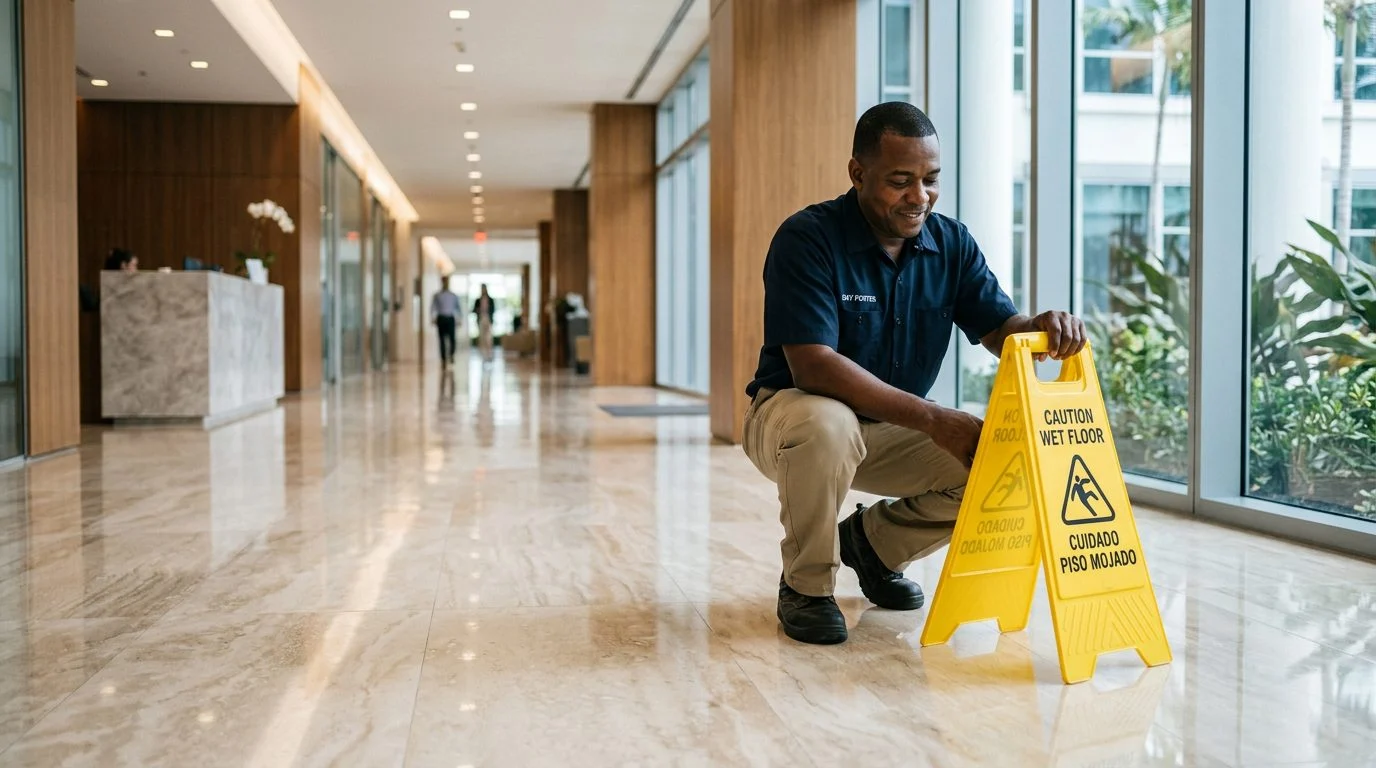
Day porter work is building upkeep, such as trash removal, restrooms, lobbies, and spill cleanup. It is not construction. It still involves wet floors and cleaning chemicals, so safety habits matter from the first shift. Start by confirming in writing who appears as the employer on payroll.
How employee status changes the answer
Whether a porter is an employee or an independent contractor turns on the working relationship and the statutory criteria. Federal rules state that calling workers “independent contractors” does not make employee protections go away, as 29 C.F.R. § 795.105 explains.
The test looks at the whole arrangement. 29 C.F.R. § 795.110 sets out the economic reality test under the Fair Labor Standards Act, which asks whether the worker is economically dependent on the employer or is in business for themself. Key facts include who sets the schedule, who supervises the work, who controls pay rates, and who supplies equipment.
Florida also penalizes misclassification. If an employer fails to secure compensation as required by this chapter, and classifies a worker as an independent contractor who does not meet the independent-contractor criteria, the department shall assess a penalty not to exceed $5,000 for each such employee, under Fla. Stat. § 440.10. Each arrangement turns on its own facts, so review how your porter’s work is actually run.
Who carries the policy: association, management company, or contractor
The business that pays the porter and directs the daily work is the one to check first.
A building that uses a management company may have the management company as the payroll employer. If a janitorial contractor supplies the porter, the contract and certificate of insurance show who carries the policy. Florida law says a contractor must require its subcontractors to provide evidence of workers’ compensation insurance, per Fla. Stat. § 440.10.
Ask for the certificate, check the policy dates and the named insured, and keep a copy in the building file. Mistakes often happen when no one checks these details until a claim is filed.

First-day injuries can still qualify for Florida workers’ comp
A first-day injury should be handled the same way as any other workplace injury, starting with a written report made that same day. Florida law defines time of injury as the time the accident that caused the injury occurred, per Fla. Stat. § 440.02. That makes the exact time a key detail to record.
Write down the time, the location, what the porter was doing, what caused the fall or cut, and who saw it. A common mistake is waiting to see whether the injury gets worse before reporting. That delay leaves gaps in the record. Whether a particular injury is covered depends on the facts of the incident.
What benefits a brand-new worker may receive
No amount or outcome can be promised in advance.
Not sure what your next step is?
Talk it through with our team — the first consultation is free, confidential, and carries no obligation.
The first 24 hours after a porter is hurt
In the first day, get the worker medical attention, record the scene, and report the injury in writing. Take photos of the spot, note the names of any witnesses, and record the cause, such as a wet floor or a spilled cleaner.
Florida’s Department of Financial Services publishes injured worker FAQs that cover reporting an injury. Prompt notice keeps the timeline clear for everyone involved.
Prevention matters too.
When a porter’s injury claim is disputed
Each dispute depends on its own record, so written documentation from the start is essential.
Florida law also shows why coverage matters. If an employer fails to secure compensation as Chapter 440 requires, the injured employee may choose to claim compensation under the chapter or to sue for damages, per Fla. Stat. § 440.11. Securing coverage before an injury happens is the step within your control.
If you’re planning or reviewing your building’s day porter staffing, we’d be glad to talk through the scope with you. Our initial consultation is free, confidential, and comes with no obligation to continue. You can reach out through our contact page.
Frequently asked questions
Does a day porter need workers’ compensation in Florida?
Florida law requires a covered employer to secure compensation for its employees. The duty sits with the employer that employs the porter.
Is a day porter an employee or a contractor?
A contract label does not decide it. The working relationship, including schedule, supervision, and pay control, decides it.
What should I ask my janitorial vendor about insurance?
Ask for a certificate of insurance that shows workers’ compensation coverage and its policy dates.
Why Building Managers Choose Our Day Porter Service
On-Site During Business Hours
Our porters work while your tenants and visitors are in the building, so spills, litter, and restroom needs are handled as they come up.
Consistent Standards
Each shift follows a clear checklist, so the building looks the same on Monday morning and Friday afternoon.
Supervised Staff
Our team oversees porter scheduling and quality checks, so you have one point of contact for questions and changes.
Across South Florida
We serve commercial properties in Miami-Dade, Broward, and Palm Beach Counties, including South Beach, Brickell, and Coral Gables.
Plan Coverage Before Your Building Needs It
Gaps in day porter coverage often show up at peak hours. Tell us your building's traffic pattern and we will recommend a staffing plan that fits it.
What a Day Porter Handles
Restroom Upkeep
Regular restocking, cleaning, and checks throughout the day, so restrooms stay usable and presentable.
Lobby and Common Areas
Glass, entry mats, elevators, and seating kept clean for tenants and visitors.
Spill and Trash Response
Prompt cleanup of spills and waste in hallways, break rooms, and shared spaces.
Shift Reporting
Clear notes on what was done and what needs attention, so building management stays informed.
Ready for a Cleaner, Better-Managed Building? Start with a Free, Confidential Consultation.
More of our services
- Day Porter Service in Miami-Dade
- How to Set Up a Day Porter Shift for Resident Requests After Hours