
Floor Care Maintenance | South Florida
Peeling Commercial Floors? Find Out What Humidity Is Doing Underneath
Lifting finish in a busy lobby or hallway is rarely random. Here is how Florida's climate, cleaning habits, and building conditions can work together to loosen a floor's protective coat.
By Ryan Jurney · Published November 27, 2026
Your entrance floor looked fine last season, and now the finish is lifting at the doors. You want to know why it happened and whether the floor can be saved.
In humid Florida buildings, floor finish peels mainly because moisture gets trapped between the film and the floor. Thick coats and recoats applied before the finish has cured can trap moisture and solvents the same way. Heavy foot traffic and wet entrances then wear the weak spots until the film lifts.
What Peeling Finish at Entrances Usually Looks Like
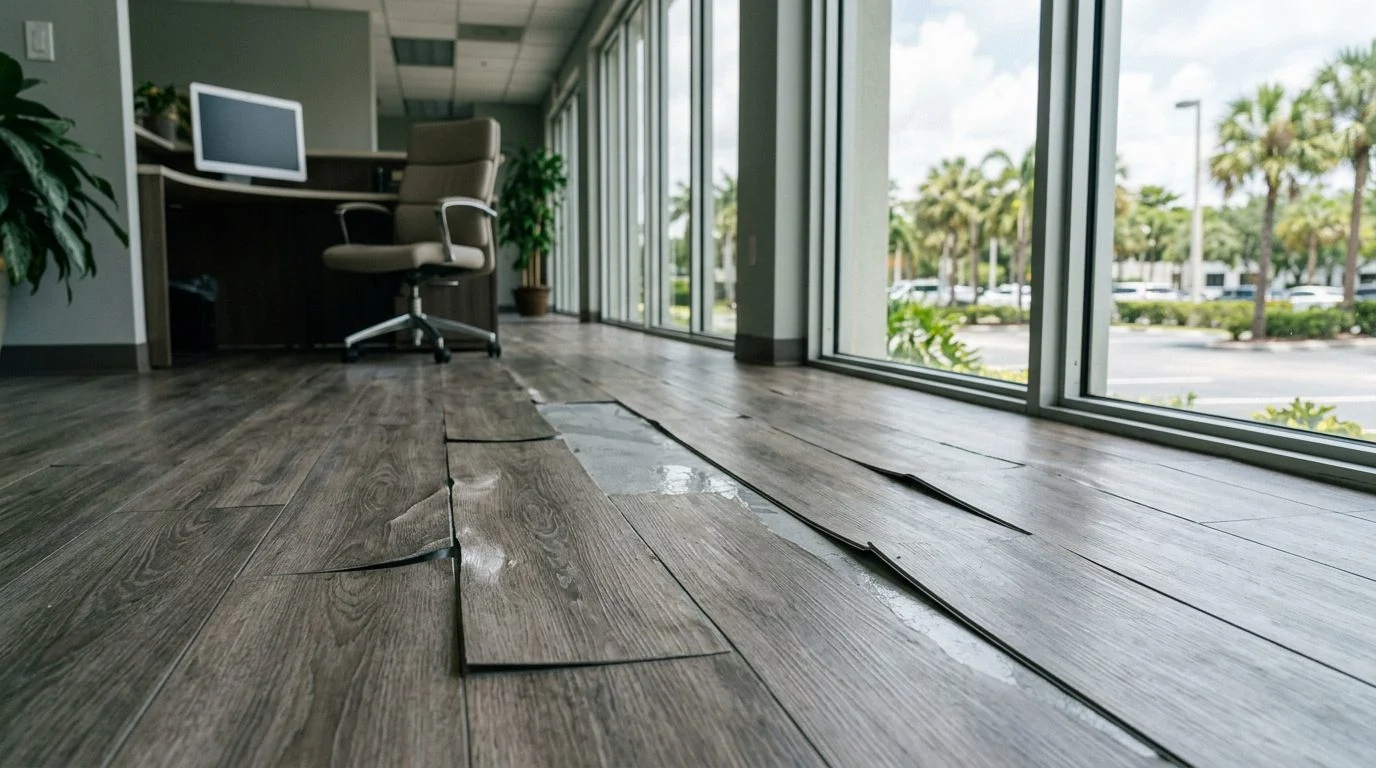
Peeling finish usually starts at the entrance, where edges curl and flakes collect near the doors.
Look for a few common signs. Edges curl or lift away from the floor. Hazy or white patches appear. Small flakes show up along the threshold. In worse cases, the finish separates from the surface in sheets instead of thinning out.
Entrances fail first for a simple reason. Most traffic passes through them, and that traffic tracks in water and grit. These floors also get frequent wet cleaning, which pushes water toward the edges and seams.
Whether a floor can be saved depends on the cause and the extent of the damage. A small lifted patch and a finish peeling across a whole lobby call for different responses.
Many people try to fix the surface first by adding another coat. That can add to the problem if the old film is still holding moisture or is already failing.
If finish is lifting at your entrances, you don't have to decide on a recoat alone. Contact our team to set up a walk-through of the affected doorways. Talk it through with our team — the first consultation is free, confidential, and carries no obligation.
How Humidity Gets Under the Finish
Humidity gets under the finish when moisture moves into the space between the film and the floor and weakens the bond.
Floor finish is a thin film that bonds to the floor surface, called the substrate. The bond holds only while the film sticks to that surface. When water vapor sits underneath, the film can lose its grip.
South Florida buildings give moisture plenty of chances to move. Warm, humid outdoor air meets cool, air-conditioned interiors, and the difference can leave dampness at the floor. Doorways are where outside air keeps coming in.
Doorways also bring moisture in directly. Rain and standing water ride in on shoes and cart wheels. Cleaning water that isn’t fully dried can soak into seams and edges.
Here’s the tricky part. A floor can look dry while moisture remains under the finish. The film may hold for a while, then lift later. That delay is why the failure often seems to come out of nowhere.
Over-Application and Thin Build-Up Problems
Too many coats, or coats applied too heavily, can trap solvents and water that the film has no way to release.
Each coat needs room to dry and cure. A heavy layer can skin over on top while the solvents and water underneath stay put. Those trapped materials weaken the film from the inside.
An over-built finish also turns brittle. Brittle film doesn’t wear down gradually. It cracks and separates in sheets, often at the edges where traffic is heaviest.
A coat applied over film that’s still curing causes another problem. The layers can pull apart before either one has set. The result looks like peeling, even though the cause is in the layers themselves.
Crews often add coats to hide dullness. That habit builds the film up over time. Before adding another layer, the existing build-up should be checked. Keeping a simple log of when each coat went down helps with that check.
Recoat Timing and Cure Windows
Recoat a finish only after it has fully cured, not just when it feels dry to the touch.
Dry-to-touch and fully cured are different points. A finish can feel dry on the surface while the film underneath still releases water and solvents. Recoating at that stage traps what’s still inside. The new coat can’t bond well to the layer below.
Humidity and temperature change how long cure takes. Damp, humid weather can slow curing, so a schedule that worked in a dry month may be too short in a wet one. Cool conditions slow it too.
Walking on a finish too early has a similar effect. Foot traffic and rolling carts load the film before it’s ready to take that weight.
Recoat intervals should follow the product’s written directions and the condition of the existing finish. A fixed calendar date ignores both. A floor that’s peeling at the doors may not be ready for a recoat at all.
Other Factors That Speed Up Peeling at Doorways
Grit, cleaning residue, and heavy wet mopping can each speed up peeling at doorways.
Sand and grit carried in from outside act like sandpaper on the finish. They scratch the film and create weak points where lifting starts. Worn or missing entry matting lets more grit cross the threshold. That puts more load on the finish right at the door.
Cleaning products matter too. A product that leaves residue can dull the finish and make later coats harder to bond. Products that aren’t compatible with the finish can cause the same trouble. When choosing a cleaner, the EPA Safer Choice program lists floor-cleaning and floor-finish products that are Safer Choice-certified.
Frequent wet mopping is the last factor. Too much water pushes into seams, edges, and under lifted film. Wring the mop well and dry the edges after cleaning.
Can the Floor Be Saved? Why a Damage Check Comes First
A damage check should come before any new finish goes down, and no outcome can be promised before it’s done.
The check starts with a walk-through. The inspector maps which areas are lifting, how far the failure reaches, and whether the damage stays at the entrance or spreads across the floor.
Several things get checked during the walk. Adhesion at the lifted edges shows whether the film still grips. Signs of moisture under the finish point to the cause. The number of existing coats shows how much build-up is there. The condition of the substrate shows what the floor can take.
The findings point to a decision. A spot repair may fit a small, contained patch. Stripping and recoating may be needed for widespread failure. A different finish may suit a high-moisture entrance. The right choice follows from what the check finds.
Stripping adds its own safety step.
Common Questions
Can peeling floor finish be repaired without stripping the whole floor?
A small, contained area may be repaired on its own. The check shows whether the damage is limited to that area.
How long should you wait before recoating a floor finish?
Wait until the finish is fully cured, not just dry to the touch. Follow the product’s written directions and the condition of the existing finish.
What causes floor finish to lift at doorways?
Trapped moisture, grit, thick build-up, and wet mopping are common causes. They often work together, which is why a walk-through matters.
Not sure what your next step is?
Talk it through with our team — the first consultation is free, confidential, and carries no obligation.
Talk Through Your Floor With Our Team
To talk through lifting finish at your entrances, contact Gator Protection, Inc.
Picture a facility manager who sees finish lifting at the lobby doors. The real question is whether to recoat now or check the floor first. Recoating too soon can lock moisture under a new layer, so the walk-through comes first.
Gator Protection, Inc. offers floor care maintenance, day porter service, and pressure washing across South Florida, including Miami-Dade, Broward, and Palm Beach counties.
La consulta inicial es gratuita, confidencial y sin compromiso de continuar.
Use the contact form to ask our team for a walk-through of the affected doorways.
How We Approach Floor Care in South Florida Buildings
Start with the cause
We look at the floor, the finish, and the conditions in the building before recommending any repair or recoating.
Protect the surface
Our floor care maintenance is designed to keep finishes intact and extend the life of the floors your tenants, staff, and visitors walk on every day.
Coordinated with your operations
Our team works alongside your day porter and janitorial services so floor work fits the way your building is actually used.
Clear communication
We explain what we found and what we recommend in plain language, so you can make informed decisions for your property.
Before You Recoat
Recoating over a lifting or damp area can trap moisture and cause the new finish to fail as well. Have the affected area checked first so the repair addresses the source, not just the surface.
Common Reasons Floors Peel in Humid Buildings
Moisture moving up from below
Humid air and slab moisture can work against a floor finish, especially in ground-level spaces and areas with limited ventilation.
Finish applied in too-thick layers
Heavy coats can trap solvents and moisture beneath the surface, weakening the bond with the floor and with the coats below.
Buildup from cleaning products
Residue from detergents and some cleaning routines can prevent new coats from bonding properly, leading to lifting over time.
Recoating before the finish has cured
Adding a new layer before the previous one has fully set can cause adhesion problems that appear weeks or months later.