
Pressure Washing | Miami Condos
A Clear Scope Turns Condo Pressure Washing Into a Plan Everyone Can Check
Here is how to set surfaces, methods, timing, and sign-off so the board and the crew work from the same page.
Start With a Free Consultation
Free
First consultation, confidential, with no obligation to continue
3
Services we can scope together: pressure washing, floor care, and day porter service
By Ryan Jurney · Published November 18, 2026
If your condo board has been asked to get the exterior pressure washed, you’re probably still gathering facts before anyone signs. A pressure washing scope of work is the written description of what gets cleaned, how, where, when, and to what extent.
Write it in a set order: surfaces first, then the method for each, then preparation, schedule, quote, and review. The sections below follow that order and end with a checklist you can use before a board vote.
Why a Condo’s Pressure Washing Scope Needs to Be in Writing
A written scope matters because a vague request invites disputes over coverage, timing, and cost. “Pressure wash the building” can mean the street-facing walls only, or the walls, walkways, pool deck, and parking area too. Two contractors who hear that phrase can price two different jobs.
A written scope also gives a board a clear standard for the work it is buying. A price alone does not show whether the entrances that started the complaint are included.
Many readers are not the people who will run the job. You may be a unit owner, a board member, or a manager gathering facts for a vote. If the cost may be billed to owners, the process matters too. Under Fla. Stat. § 718.103, a special assessment is any assessment levied against a unit owner other than the assessment required by a budget adopted annually.
If your board is weighing this decision now, you don't have to write the scope alone. Our team can walk through your building and a draft scope with you. Talk it through with our team — the first consultation is free, confidential, and carries no obligation.
Define the Exterior Walls, Roof and Gutters, and Sidewalks and Parking Areas
List every exterior surface by name and location, and attach a site map or rough measurements. Name street-facing walls, balconies, stairwells, and rear elevations as separate items. Vague labels like “building exterior” hide what’s included.
Roof and gutters belong on their own line. State whether gutters are included and whether debris removal is part of the job. Roof work and wall work often use different methods and carry different risks, so mixing them makes the price hard to check.
Sidewalks, entrances, pool decks, and parking areas need approximate square footage or a map. Staining at entrances and walkways often starts the request, so name those spots by door number or address. Call out high-traffic zones too, because they tend to stain fastest.
Miami buildings often have tile, stucco, and painted masonry. Note which surface is which. The material changes the method, as the next sections explain.
Windows, Glass Panels, and Other Surfaces to Handle Separately
Windows and glass panels should have their own lines because they need their own method and care. Don’t fold them into a general item called “exterior cleaning.” Specify whether window cleaning covers the inside, the outside, or both.
State whether screens and frames are included. A crew that skips them can still say the job is done, so the scope should say what done means for windows.
Other surfaces need a stated approach too. Painted trim, stone or stucco, and metal railings can react differently to water pressure and cleaning solution. Write each one as its own item, with the method the contractor will use.
That way the board can see which parts of the building get gentle handling and which do not. A surface the scope never names is the one most likely to become a dispute after the work.
Choose the Cleaning Method for Each Surface, and What the 2000 PSI Question Really Asks
A psi number alone doesn’t describe the work, so the scope should name the method for each surface. The surface, its material, and the type of dirt all shape what is appropriate. Strong spray can strip a painted finish, while gentle wash may not lift heavy mildew from concrete.
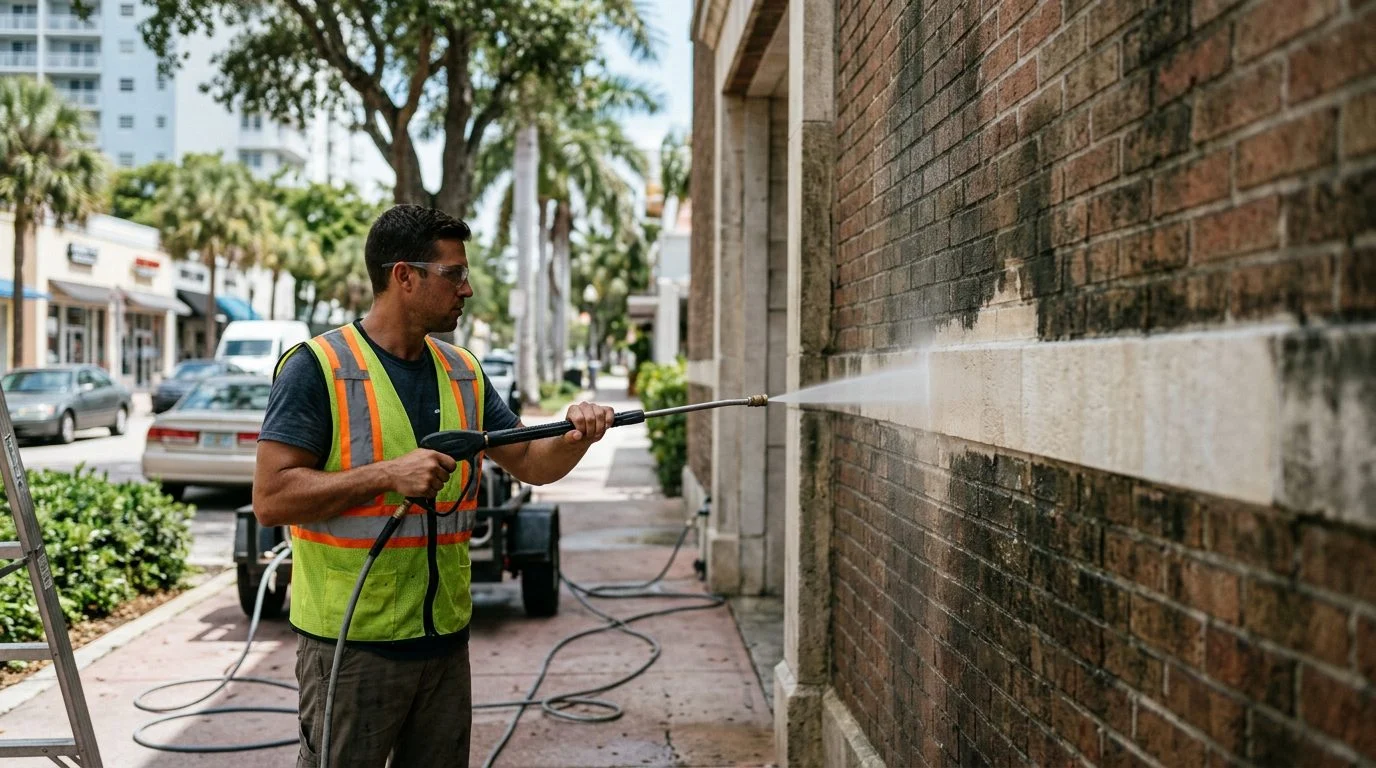
Pressure washing uses high-pressure water on hard, durable surfaces such as concrete walkways. Soft washing uses lower pressure with cleaning solution on delicate or painted surfaces. A good scope can name each method for the areas it fits.
Require the contractor to state the method and equipment it plans to use for each area in its proposal. That turns a general sales phrase into a written commitment the board can review with our team.
Soft washing involves cleaning chemicals, so the scope should cover safety. Proper handling of cleaning products is an important part of keeping a commercial space safe for the people who use it. Ask for the safety data sheets for every product the contractor plans to use.
The right setting depends on the facts of your building, which is why the scope should call for a site assessment before work starts.
Pre-Cleaning Preparation: Protecting Landscaping, Vehicles, and Building Openings
Each preparation task should be assigned to a named party, so the building and the contractor both know their part. Tasks left unassigned tend to fall through the cracks on the day of the work.
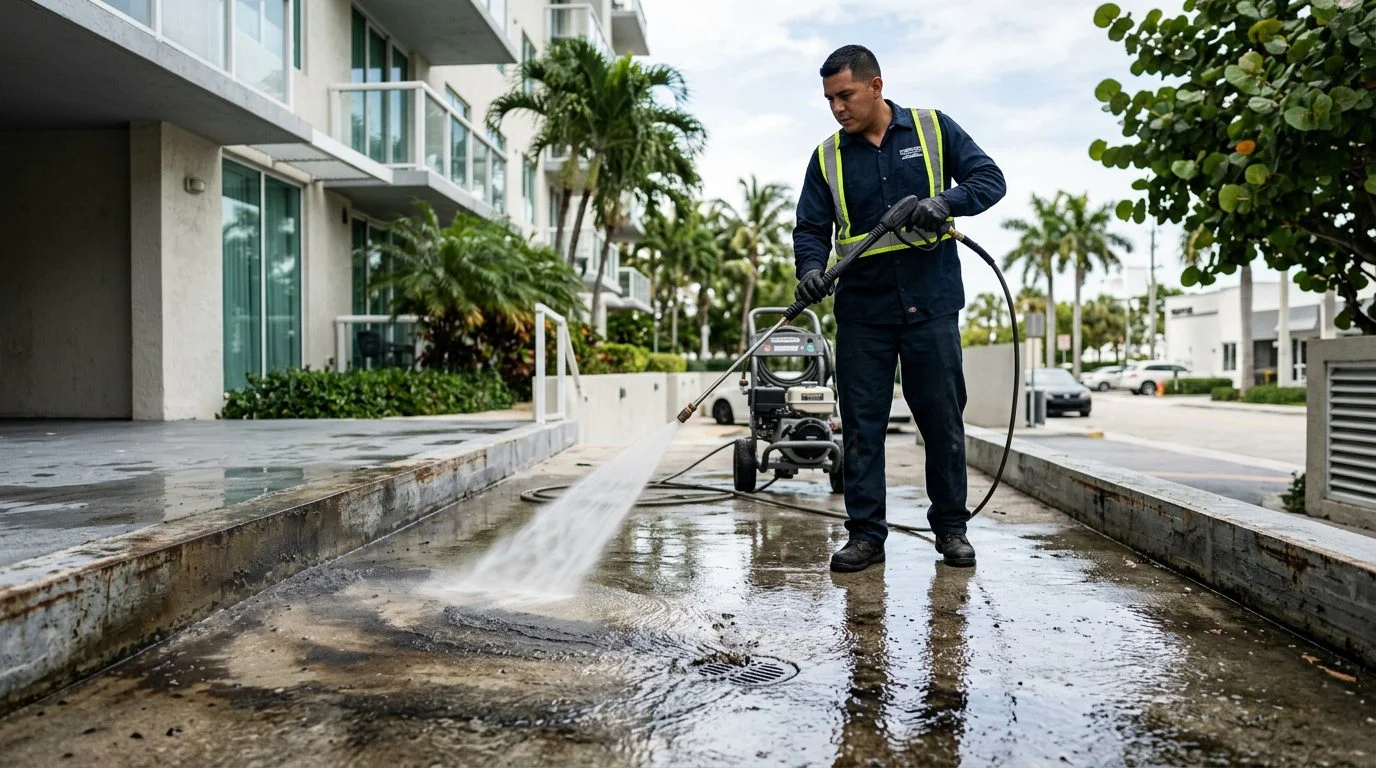
Vehicles need to be moved out of the wash area. Plants and landscaping need covering or protection from runoff and chemicals. Name who handles each item. Sprinkler timing can be affected by local water-use guidance, so we will talk through how that is handled during your free consultation.
Electrical fixtures, light covers, and signage can take on water. Window seals, door seals, and vents need a check before and after the work. List who checks them and what they look for.
Residents should receive notice. The scope should say who writes and delivers pre-cleaning notices, and when. Keep preparation as its own section, so the board can see what the building must do, not only what the contractor must do.
Schedule, Access, and Coordinating Work Around Residents
The scope should set the work window, access rules, and a process for delays before work begins. Name the days and hours the crew may work, and any noise or hour limits that apply to your building. Check your building’s own rules and write them in.
Access is a common source of friction. Include gate codes, key handling, and where equipment will be staged. A crew that can’t reach the service entrance or garage loses time, and lost time usually becomes added cost.
Day porter service can help here. A porter who handles daily building needs can share a plan with the pressure washing crew, so cleaning and daily operations don’t work against each other. Gator Protection offers day porter service and can coordinate both on one plan.
Weather or building conditions can delay the job. Write down who decides to reschedule, how notice goes out, and how the new date gets recorded. A delay recorded in writing is easier to resolve than one each side remembers differently.
Not sure what your next step is?
Talk it through with our team — the first consultation is free, confidential, and carries no obligation.
How to Read a Pressure Washing Quote Against Your Scope
A quote should match the scope line by line, so each surface, method, and task has a price you can check. If the quote groups everything into one number, the board can’t see what it’s paying for.
The quote should state the scope it covers, what is included, what is excluded, and how change orders are handled. A change order is a written change to the scope and its price. Ask for unit or area pricing, so adding or removing a section can be calculated without a new negotiation.
The scope should also ask for proof of the contractor’s insurance and the terms for any damage claims. Ask what happens if a surface is damaged, who reports it, and how it’s resolved. Write those answers into the scope, not into a side conversation.
Make sure any quote you receive from us spells out the exact scope of work. Reviewing how the scope and Gator Protection’s quote line up on surfaces and methods helps the board confirm what is included.
Review Checklist Before the Board Approves, and Next Steps
Before the board votes, confirm that every surface, method, preparation task, schedule item, and quote line appears in the scope. Also confirm that acceptance steps are written down.
- Every surface named by location
- Each method stated, with equipment and chemicals
- Preparation tasks assigned to a named party
- Work window, access rules, and delay process defined
- Quote lines matching scope lines
- Acceptance criteria written, including a walk-through after completion
A walk-through lets the board confirm the work matches the scope before final payment. Record the findings in writing.
Board process matters too. Under Fla. Stat. § 718.112, any meeting at which a proposed annual budget will be considered by the board or unit owners must be open to all unit owners. For a budget meeting at which the board will propose a substitute budget, written notice must go out at least 14 days before the meeting, by hand delivery or mail to each unit owner.
Frequently asked questions
Is 2000 psi enough to pressure wash a condominium or commercial building?
A psi number alone doesn’t settle it. The surface, material, and dirt decide the method, so the scope should name a method for each area.
Do I need a written scope for a condo pressure washing job?
Yes, a written scope gives a board a clear standard to hold the contractor to the agreed work.
What is the difference between pressure washing and soft washing?
Pressure washing uses high-pressure water on hard, durable surfaces. Soft washing uses lower pressure and cleaning solution on delicate or painted surfaces.
If your board is weighing this decision now, you don’t have to draft the scope alone. Our team can walk through your building and a draft scope with you. La consulta inicial es gratuita, confidencial y sin compromiso de continuar. You can contact our team to start.
What a Strong Condo Scope Includes
Named surfaces
List each area by location, such as lobby walkways, garage entries, pool decks, balconies, and building faces.
A method for every surface
Specify the approach for each material so delicate finishes are treated differently from concrete and masonry.
Timing and access
Set the work window, resident notice, and parking or water access needs before the crew arrives.
Runoff and protection
Describe how plants, fixtures, and nearby surfaces will be covered and how rinse water will be managed.
Watch Out for a Single Number
A psi figure on its own does not describe the job.
Questions to Settle Before You Sign
Which areas are in and out?
Name every zone covered and note any exclusions, so nothing is assumed to be included.
How will the work be checked?
Agree on a walkthrough, a photo record, and a simple sign-off step for each area.
How often will it repeat?
Set a maintenance interval for each surface so the building keeps a consistent appearance.
Who handles the site day to day?
Confirm the contact person, the on-site schedule, and how changes will be communicated.